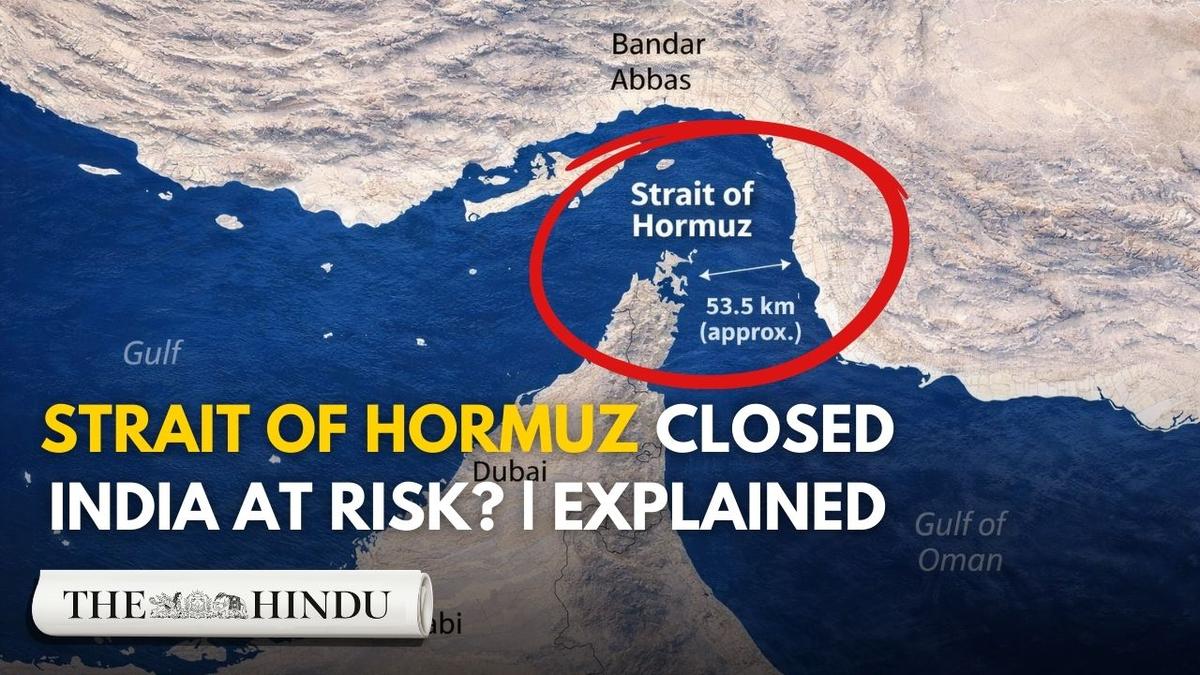
The world treats every Middle East flare-up like it’s the end of the global economy, but usually, it's just noise. This time feels different. When Iran and Israel move from shadow boxing to direct missile exchanges, the conversation shifts instantly to a tiny, hook-shaped strip of water called the Strait of Hormuz. If you’ve looked at a map lately, you’ll see it’s the only way out for tankers leaving the Persian Gulf. It’s the world's most important oil transit point. Period.
Forget the Red Sea or the Suez Canal for a second. Those are important, sure. But the Strait of Hormuz is in a league of its own. We’re talking about a waterway so narrow—only 21 miles wide at its tightest point—that it carries roughly 20% of the world’s daily oil consumption. That’s about 20 or 21 million barrels of oil every single day. If that door slams shut because of the Iran-Israel conflict, the global economy doesn't just slow down. It hits a wall. You might also find this connected article useful: Strategic Asymmetry and the Kinetic Deconstruction of Iranian Integrated Air Defense.
The Geography of a Global Chokepoint
You can't understand the leverage Iran holds without looking at the physical constraints of the Strait. While the total width is 21 miles, the actual shipping lanes are much tighter. Large tankers have to stay within two-mile-wide channels, separated by a two-mile buffer zone. These lanes sit almost entirely within Omani and Iranian territorial waters.
Iran knows this. They’ve spent decades turning the northern shore of the Strait into a fortress. It’s not just about their navy; it’s about "asymmetric" capabilities. We're talking about thousands of fast-attack boats, sea mines, and shore-based anti-ship missiles tucked into the jagged coastline. If Tehran decides to make the passage "unsafe" for commercial shipping, they don't need to sink every ship. They just need to sink one or two, or even just threaten to do it, to send insurance premiums into the stratosphere. As highlighted in latest reports by Reuters, the effects are worth noting.
Most people think a "closure" means a literal blockade with ships lined up across the water. It doesn't. It means making the risk so high that no captain or insurance underwriter will touch a voyage through the Gulf. When Lloyd's of London marks the area as a high-risk zone, the "closure" has effectively happened without a single shot being fired.
Why China is More Worried Than the US
There’s a common misconception that a Hormuz shutdown is an American nightmare. It’s not. The United States has spent the last decade becoming a net exporter of oil and gas. While a global price spike would hurt at the pump in Georgia or California, the US isn't physically reliant on those Gulf barrels anymore.
The real panic is in Beijing, Tokyo, and Seoul.
Asian markets are the primary destination for the oil moving through the Strait. China, specifically, is the world's largest importer of crude. They get a massive chunk of their energy from Saudi Arabia, Iraq, and Kuwait—all of which must pass through Hormuz. If Iran closes the tap, China’s industrial engine starts to stutter within weeks. This creates a weird geopolitical irony. The US wants to keep the Strait open for global price stability, but China needs it open for national survival.
The Illusion of Bypassing the Strait
You'll often hear "don't worry, there are pipelines." I've looked at the data, and honestly, the pipelines are a joke compared to the scale of the shipping lanes. Saudi Arabia has the East-West Pipeline, which can move about 5 million barrels a day to the Red Sea. The UAE has a line that skips the Strait to reach the Gulf of Oman.
Add them all up. Even in a best-case scenario where every pipeline is running at 100% capacity, you still have about 15 million barrels a day with nowhere to go. There is no "Plan B" for 75% of the oil that moves through Hormuz. If the Strait closes, that oil is trapped. It stays in the ground or sits in storage tanks until the conflict ends. You can't just truck 20 million barrels of oil across the desert.
The Liquefied Natural Gas Factor
Everyone focuses on the oil, but the secret weapon in this conflict is Liquefied Natural Gas (LNG). Qatar is one of the world's top LNG exporters, and every single one of their ships goes through the Strait of Hormuz.
Europe has spent the last few years trying to wean itself off Russian gas. They've replaced it largely with LNG from the US and Qatar. If the Iran-Israel conflict spills over and shuts down the Strait, Europe’s plan for energy security evaporates. You're not just looking at expensive gas for your car; you're looking at the inability to heat homes in Berlin or power factories in Milan. This gives Iran immense "soft" power over European diplomacy. They aren't just holding the oil market hostage; they're holding the European power grid hostage.
How Iran Uses the Strait as a Shield
Iran's leadership isn't suicidal. They know that a full-scale closure of the Strait would be an act of war that would likely bring a devastating response from the US and its allies. So, they play a different game. They use the threat of closure as a deterrent against Israeli or American strikes on their nuclear facilities or internal infrastructure.
It’s a "porcupine" strategy. Iran makes itself too painful to swallow. If Israel strikes Iranian soil, Iran can retaliate by seizing a tanker or "accidentally" letting a few mines drift into the shipping lanes. It’s a way to de-escalate by threatening global economic escalation. They’ve done this for years—the 1980s "Tanker War" during the Iran-Iraq conflict proved that even a low-level conflict in these waters can disrupt global trade for years.
The Role of the US Fifth Fleet
The only thing standing between the status quo and total chaos is the US Navy's Fifth Fleet, headquartered in Bahrain. They spend their days patrolling these waters specifically to keep the "Global Commons" open.
However, modern warfare has changed. In the past, a US carrier group was an untouchable symbol of power. Today, the proliferation of cheap drones and hypersonic missiles—many of which Iran has developed or acquired—makes protecting slow-moving oil tankers an absolute nightmare. The US can win a conventional war, but can it guarantee the safety of a 300,000-ton VLCC (Very Large Crude Carrier) against a swarm of 500-dollar suicide drones? That's the question keeping Pentagon planners up at night.
What Happens to Your Wallet
Let's get practical. If the Strait closes tomorrow, oil doesn't just go up by five or ten dollars. Analysts at Goldman Sachs and the IEA have modeled these scenarios for decades. We're talking about a jump to $150 or $200 a barrel almost instantly.
The ripple effect is what kills you. It’s not just the price of gas. It’s the price of the plastic in your phone, the fertilizer used for your food, and the shipping cost for every single thing you buy on Amazon. A Hormuz closure is a massive, global "inflation tax" that hits the poorest countries the hardest. While the US and Israel trade blows, a family in a developing nation might find they can no longer afford cooking oil or grain because transport costs doubled overnight.
How to Track the Real Risk
If you want to know if the situation is actually getting critical, don't watch the political speeches. Watch the "War Risk" insurance premiums. When the companies that insure these tankers start refusing coverage or 10x their rates, that's when you know the "closure" is real.
You should also keep an eye on the "dark fleet"—the tankers that move Iranian oil despite sanctions. If those ships stop moving, it's a signal that even Iran thinks the water is too hot. Usually, they want their own oil to flow, but if they're willing to sacrifice their own revenue to hurt their enemies, the situation has moved into a final, dangerous phase.
Monitor the daily reports from the Energy Information Administration (EIA) regarding global petroleum liquids consumption and the International Maritime Organization (IMO) alerts for the Persian Gulf region. These sources provide the raw data without the political spin. If the volume through the Strait drops by even 10% due to security incidents, expect the markets to react with extreme volatility.
Pay attention to the specific types of ships being targeted. If the aggression moves from Western-owned tankers to "neutral" vessels or those destined for Asian ports, it means the traditional rules of engagement have been tossed out. This is a clear indicator that the regional conflict has shifted from a targeted spat to a total economic blockade.

.png?format=1500w)