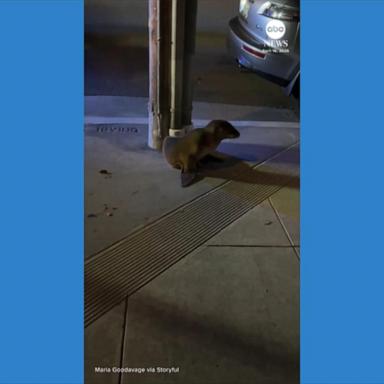
The camera zooms in on a set of big, watery eyes. A pup—let’s call him "Braveheart" because local news anchors love a cheap narrative—shuffles across a San Francisco sidewalk. The crowd gathers, keeping a "respectful" distance while clogging the air with the sound of shutter clicks. The rescue truck arrives. The pup is crated, driven away to a facility, and the internet celebrates another victory for humanity.
This isn’t a rescue. It’s a vanity project masquerading as conservation.
We have reached a point where our pathological need to "save" individual animals is actively blinding us to the ecological reality of the Pacific coast. When a sea lion pup wanders into a residential neighborhood, it isn’t a Disney plot point. It is a biological signal. By intervening, we aren’t fixing the problem; we are just silencing the alarm so we can go back to sleep.
The Sentimentality Trap
Mainstream media loves the "lost wanderer" trope. They frame these events as freak accidents—a confused pup took a wrong turn at the Pier 39 sign.
The reality is colder. These animals are often on land because they are starving. They are "foraging" in the only places left, or their internal navigation is haywire due to domoic acid poisoning—a neurotoxin produced by harmful algal blooms.
When you "rescue" a pup that is biologically destined to fail, you are interfering with a brutal but necessary feedback loop. Evolution doesn't care about your Instagram feed. It cares about fitness. In the wild, the weak die so the species survives. By artificially inflating the survival rate of the least fit individuals, we are tinkering with the genetic pool of the Zalophus californianus in ways we don't fully understand.
The Economics of Feel-Good Conservation
I have spent years watching non-profits burn through donor capital. If you want to see a Masterclass in inefficient resource allocation, look at the books of a typical marine mammal rescue center.
It costs thousands of dollars to rehabilitate a single sea lion pup. We’re talking specialized fish gruel, 24-hour veterinary monitoring, transport, and tagging. All for an animal that has a high probability of re-stranding or failing to compete once it’s dumped back into the same degraded environment it fled.
Imagine a scenario where those same hundreds of thousands of dollars were diverted from "individual rescue" to "habitat systemic recovery."
- Individual Rescue: Saves one pup. High PR value. Zero impact on ocean health.
- Systemic Recovery: Funds lobby efforts against industrial overfishing of forage fish (sardines and anchovies). Low PR value. High impact on the entire food web.
We choose the pup because it has a face. A sardine does not. But without the sardine, the pup is just a walking corpse we’ve temporarily reanimated.
The Domoic Acid Deception
Let’s talk about the "why" that the 6 o'clock news ignores. Many of these wandering pups are victims of toxic blooms. These blooms are fueled by nutrient runoff—nitrogen and phosphorus from our lawns and industrial farms.
When we rescue a "sick" sea lion, we treat the symptom. We flush the toxins, we feed them up, and we release them. But we haven't touched the water chemistry. We haven't addressed the agricultural policies that make the coast a toxic soup.
Rescuing the pup is a sedative for the public conscience. It allows the resident of a San Francisco high-rise to feel like "something is being done" without having to change their consumption habits or vote for aggressive environmental regulation. It’s the ecological equivalent of putting a Band-Aid on a sucking chest wound and calling it surgery.
Stop Humanizing the Wild
The "People Also Ask" sections of search engines are filled with queries like "Do sea lions feel gratitude?" or "How can I help a lost pup?"
The answer to the first is: No. They are apex predators with a complex social structure that does not include "thanking" a biped for a net full of thawed herring.
The answer to the second is: Leave it alone.
Biologically, a pup on a sidewalk is a data point. If it dies, its carcass provides nutrients to a host of other organisms. This sounds "cruel" only if you view nature through the lens of a suburban living room. Nature is a closed-loop system of energy transfer. Human intervention breaks the loop. We take the energy out of the system, process it through a medical facility, and then drop it back in where it doesn't belong.
The Displacement of Responsibility
Every time a crowd cheers for a sea lion rescue, a corporate polluter breathes a sigh of relief. Why? Because the public's emotional energy is being spent on a singular, manageable event.
We are obsessed with the "heroic save" because it has a clear beginning, middle, and end. You catch the animal, you fix the animal, you release the animal. It’s a tidy narrative.
Fixing the Pacific Decadal Oscillation or the collapse of the kelp forests? That’s hard. It’s messy. It doesn't have a cute protagonist.
By focusing on the "wandering pup," the media keeps the conversation centered on human kindness rather than human complicity. We aren't "saving" these animals from nature; we are saving them from the world we built, and we’re doing it in the most inefficient way possible.
The Moral Hazard of "Release"
There is a dark side to the rehabilitation industry that no one wants to admit: the "Failure to Thrive" rate.
A significant percentage of rescued marine mammals don't make it after release. They haven't learned the hunting skills required in a competitive environment. They've been habituated to humans. Some become "nuisance animals," hanging around docks and getting shot by frustrated fishermen or mangled by boat propellers.
Is it more "humane" to put an animal through the trauma of capture and confinement, only to release it into a depleted ocean where it will starve more slowly? Or is that just a way for us to shift the location of its death so we don't have to see it on our morning jog?
Rethinking the Rescue Culture
If we actually cared about sea lions, we would stop treating them like pets and start treating them like the bio-indicators they are.
A sea lion on a city street is a scream from the ocean. It’s a message that the offshore pantry is empty and the water is poisonous. Instead of sending a rescue team with a net, we should be sending scientists to map the bloom and lawyers to sue the polluters.
We need to trade our blankets and crates for policy and protection. We need to accept that death in the wild isn't a failure—it's a function.
Until we stop prioritizing the individual "cute" animal over the health of the entire biome, we are just hobbyists playing at conservation. The next time you see a pup in a neighborhood, don't cheer for the rescue. Demand to know why the ocean is so broken that the sidewalk looks like a better option.
Stop the rescues. Start the restoration.