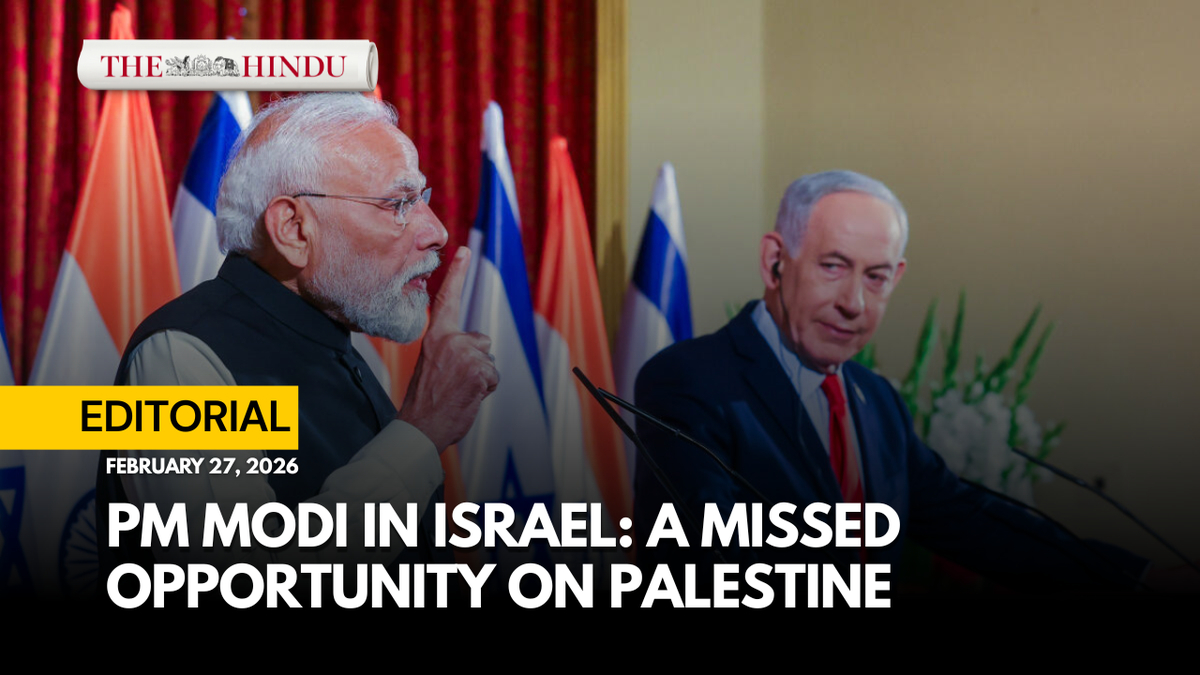
The chattering classes are mourning again. Following Prime Minister Modi’s recent 24-hour sprint through Jerusalem, the editorial board at The Hindu and the usual cocktail circuit of "neutral" observers have reached a grim consensus: India missed an opportunity to "balance" its stance on Palestine. They see a 72,000-person death toll in Gaza and a right-wing Israeli government facing domestic protests, and they conclude that New Delhi should have played the moral arbiter.
They are wrong. Dead wrong.
The idea that India "missed" an opportunity assumes that India wanted that opportunity in the first place. It assumes that foreign policy is a high school debate where points are awarded for fairness. In the real world—the one involving the IMEC (India-Middle East-Europe Economic Corridor) and the I2U2 grouping—India isn't "taking sides." It is finally behaving like a Great Power by refusing to let a 75-year-old regional deadlock dictate its 21st-century trajectory.
The Myth of the "Balanced" Stance
For decades, Indian diplomacy was paralyzed by an ideological ghost: the belief that any handshake in Tel Aviv required a ritualistic stop in Ramallah. This "hyphenation" wasn't strategic; it was a security blanket for a country that felt it needed permission from the Arab world to exist.
The "missed opportunity" crowd argues that by not mentioning Palestinian sovereignty more forcefully, India risks its ties with West Asian powers. This is a fundamental misunderstanding of the modern Middle East. I have seen diplomats sweat over the "Arab Street" for years, ignoring the fact that the "Arab Palace" has already moved on. Riyadh and Abu Dhabi aren't looking at India through a Palestinian lens anymore. They are looking at India as an anchor for the IMEC to bypass Russian and Chinese influence.
When the UAE and Saudi Arabia are quietly (and sometimes loudly) integrating with the Israeli economy, why should India be more Palestinian than the Arabs? The "balanced stance" is a relic of the Non-Aligned Movement—a period when India had a massive ego and a microscopic GDP. Today, the math has changed.
De-hyphenation is the Only Honest Policy
What the critics call a "tilt" is actually "de-hyphenation" in its purest form. It is the radical idea that India can have a $10 billion+ trade relationship with Israel based on water technology, semiconductors, and defense co-production, without needing to solve a land dispute in the Levant.
Why the "Moral" Argument Fails
- Sovereignty is not a Gift: Critics want Modi to demand a two-state solution during a state visit. But India’s recognition of a Palestinian state is already on the books. Repeating it for the thousandth time as a performative gesture doesn't save lives in Gaza; it only irritates a strategic partner that provides the Barak-8 missile systems protecting Indian skies.
- Labor as Diplomacy: During this visit, India agreed to send 50,000 workers to Israel. The "humanitarian" take is that these workers are replacing Palestinians. The "insider" take? India is securing high-paying overseas employment for its citizens while filling a critical structural gap in a partner's economy. That is cold, hard national interest.
- The Iran Paradox: The editorialists fear that "standing with Israel" ruins the Iran relationship. Imagine a scenario where India tries to please everyone. We end up with a stalled Chabahar Port and zero Israeli tech. By being clear about where we stand on "terrorism and its supporters," India actually gains more respect in Tehran and Riyadh because its red lines are visible, not blurry.
The Fetish of "Regional Balance"
The most exhausting critique is that India must maintain a "historically calibrated regional balance." This is code for "don't do anything that makes anyone mad."
If India had followed that advice, it would never have signed the Civil Nuclear Deal with the US or performed the 1998 nuclear tests. True strategic autonomy is not about staying in the middle; it’s about having the power to move the needle. Israel is a "Special Strategic Partner" because it offers what no one else in the region can: a laboratory for AI, Cybersecurity, and Arid-land Agriculture.
Palestine, unfortunately, has become a site of tragic internal disarray. Between Fatah and Hamas, there is no unified entity for India to "balance" with. Expecting an Indian Prime Minister to fix a rift that the Arab League couldn't solve in half a century is not just optimistic—it’s delusional.
Stop Asking the Wrong Question
The "People Also Ask" columns want to know: "Is India abandoning Palestine?"
The answer is: India is abandoning the hyphen.
We are moving toward a transactional, interest-based foreign policy. If Israel provides the Phalcon AWACS that keep our borders secure, we treat them as a defense pillar. If we need oil from the GCC, we treat them as an energy pillar. One does not cancel the other.
The "missed opportunity" was actually a avoided trap. By refusing to get bogged down in the moralizing theater of the Gaza conflict, India signaled that its time is too valuable to be spent on performative diplomacy. We are no longer a country that seeks "moral leadership" while our people remain in poverty. We are a country that seeks "technological leadership" to ensure they don't.
If that makes the editorial boards uncomfortable, good. It means the policy is working.
Would you like me to analyze how the IMEC's success specifically depends on this new India-Israel-UAE axis?