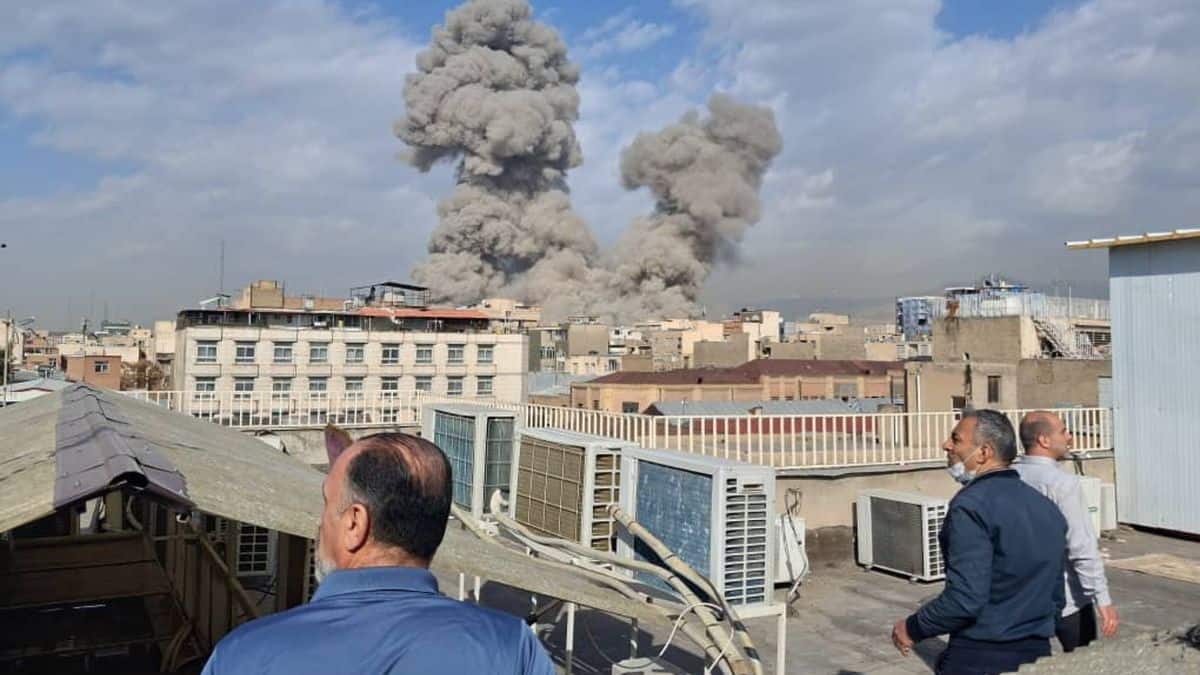
The closure of schools and the prohibition of public gatherings within a nation-state under aerial threat are not merely safety precautions; they are the activation of a Civilian Friction Reduction Protocol. When Iran initiated its retaliatory strike against Israel in April 2024, the Israeli Home Front Command’s decision to halt all educational and social activity served a dual purpose: the immediate preservation of human capital and the optimization of military logistics. By clearing the roads and confining the population to hardened structures, the state minimizes "noise" in its domestic systems, allowing air defense assets and emergency responders to operate with zero civilian interference. This event represents a critical case study in how modern states manage the transition from "business-as-usual" to "high-intensity kinetic defense" within a window of mere hours.
The Triple-Tiered Defensive Architecture
The effectiveness of Israel’s response rested on three distinct yet overlapping layers of national readiness. Understanding these layers explains why a massive drone and missile swarm resulted in negligible structural damage.
Kinetic Interception (The Hard Layer):
The physical neutralization of incoming threats occurs across a stratified vertical corridor. This includes the Arrow-3 system for exo-atmospheric intercepts, David’s Sling for medium-range ballistic and cruise missiles, and the Iron Dome for short-range threats. The technical challenge is not just the hit-to-kill accuracy but the Discrimination Logic—the software's ability to instantly calculate a projectile's trajectory and ignore those headed for unpopulated areas, thereby conserving limited interceptor inventory.Civilian Sequestration (The Soft Layer):
The directives issued to the public—shutting schools, canceling sporting events, and limiting gatherings to fewer than 1,000 people—function as a biological firewall. By removing the variable of a mobile, panicked population, the state reduces the potential for mass-casualty events that would force a disproportionate and perhaps premature strategic escalation.Electronic Warfare and Signal Dominance (The Invisible Layer):
Widespread GPS jamming (spoofing) across the region during the attack served to degrade the guidance systems of Iranian loitering munitions. This creates a "navigation vacuum," forcing missiles to rely on less accurate inertial navigation systems (INS), which significantly increases the "Circular Error Probable" (CEP), making it harder for the attacker to hit specific high-value military targets.
The Economic Cost Function of Defensive Persistence
A fundamental asymmetry exists in the economics of this engagement. The cost of an Iranian "Shahed" loitering munition is estimated between $20,000 and $50,000, whereas a single Tamir interceptor (Iron Dome) costs approximately $40,000 to $50,000, and an Arrow-3 interceptor can exceed $2 million.
When an adversary launches a saturation attack, they are attempting to induce Interception Bankruptcy. The goal is to force the defender to spend $1 billion in interceptors to defeat $50 million in incoming hardware. The structural bottleneck for the defender is not just the immediate financial cost, but the Re-arm Rate. If the attacker can launch waves faster than the defender can manufacture or procure replacement interceptors, the defensive shield eventually collapses through simple math.
Logic of the Proportional Response
The closure of schools is also a signal in the language of international diplomacy and deterrence. By taking extreme internal measures, a government communicates the gravity of the threat to its allies, specifically the United States and the UK, effectively "priming" the coalition for collective defense. The participation of the RAF and US Air Force in intercepting drones over Jordanian and Iraqi airspace was not a spontaneous act; it was the result of a pre-coordinated Integrated Air and Missile Defense (IAMD) framework.
This framework operates on the principle of Depth Defense. If a drone can be neutralized 500 miles from the border by a fighter jet using an air-to-air missile, the domestic high-altitude systems (Arrow) do not need to be engaged. This preserves the most expensive and capable assets for the final, most dangerous terminal phase of a ballistic missile's flight.
Mechanisms of Iranian Loitering Munitions
The threat profile of the April 2024 attack was defined by three distinct flight characteristics:
- Drones (Slow, Low, Voluminous): These function as "distraction assets." They occupy radar bandwidth and attempt to flush out the locations of hidden air defense batteries.
- Cruise Missiles (Medium-speed, Low-altitude): These utilize terrain masking to avoid detection. Their flight paths are non-ballistic, meaning they can change direction to strike a target from the rear.
- Ballistic Missiles (High-speed, Exo-atmospheric): These are the primary "kill" assets. They travel at hypersonic speeds during re-entry, leaving the defender with a reaction window measured in seconds.
The synchronized arrival of these three categories is intended to overwhelm the Engagement Management System. If the drones arrive 10 minutes before the ballistic missiles, the defender can process them sequentially. If they arrive simultaneously, the system faces a "target saturation" crisis.
The Psychological Component of Gathering Bans
The decision to ban gatherings is a counter-measure against Psychological Attrition. In a prolonged conflict, the goal of the attacker is often to disrupt the "Metabolic Rate" of the target nation—its ability to conduct commerce, educate its youth, and maintain social cohesion. By preemptively shutting down these systems, the Israeli government exercises a "controlled pause." This prevents the chaos that would occur if a strike happened while schools were in session, which would trigger a systemic shock that could paralyze national decision-making.
The "Red Alert" (Tzeva Adom) system remains the primary interface between the military and the civilian. The latency between detection and notification is now sub-three seconds. This level of integration is only possible in a society where the civilian infrastructure (telecoms, apps, radio) is secondary to the national defense requirement.
Regional Geopolitical Friction
The intercept of Iranian assets over neighboring sovereign airspace (Jordan) introduces a variable of Collaborative Sovereignty. It demonstrates that in the face of a shared ballistic threat, traditional geopolitical boundaries become porous. The tactical necessity of "intercepting early" outweighs the diplomatic friction of violating or utilizing another nation's airspace. This creates a temporary, kinetic-driven alliance that exists only as long as the projectiles are in the air.
The limitation of this strategy is its sustainability. A state cannot remain in a "Level 3 Mobilization" (schools closed, economy paused) indefinitely without incurring catastrophic GDP loss. Therefore, the closure of schools is a tactical move with a strict "expiry date." It is a tool used to survive the initial 24–48 hour shock, after which the state must either escalate to stop the threat at its source or de-escalate to resume economic function.
Strategic Play
The transition of a nation-state from a civilian to a mobilized posture in under six hours requires a Modular Crisis Protocol. For organizations or states looking to replicate this level of resilience, the focus must shift from "Point Defense" (stopping a single missile) to "Systemic Elasticity" (the ability of the entire society to bend and snap back).
The final strategic move in this scenario is the Offensive-Defensive Pivot. Once the "Hard Layer" has successfully neutralized the incoming threat with a high success rate (e.g., 99%), the defender gains "Diplomatic Capital." They can choose to refrain from an immediate kinetic counter-strike, using their successful defense as a position of moral and tactical strength to solidify international coalitions. The defense itself becomes a form of counter-attack, as it proves the adversary's primary weapon system is obsolete against current technology.
Future readiness depends on the shift toward Laser-Directed Energy Weapons (DEW). Replacing a $50,000 interceptor with a "shot" that costs $2 in electricity is the only way to permanently solve the Interception Bankruptcy problem and ensure that the closure of schools remains a rare, short-term necessity rather than a permanent state of existence.
Would you like me to analyze the specific technical specifications of the Arrow-3's exo-atmospheric kill vehicle compared to the Shahed-136's navigation suite?