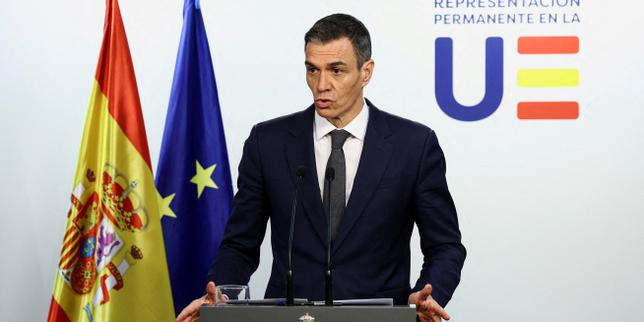
Pedro Sánchez is playing a high-stakes game of moral posturing with a deck of cards he doesn't actually own. The recent headlines painting the Spanish Prime Minister as the "brave" European holdout against the Trump administration’s geopolitical doctrine are missing the structural reality of the situation. It isn't bravery. It is a fundamental misunderstanding of how power functions in a deglobalizing world.
When Sánchez shouts « Non à la guerre » (No to war) from the safety of a Mediterranean podium, he isn’t just opposing a specific military policy. He is signaling to the world that Spain prefers the comfort of a bygone era—the 1990s "End of History" delusion—over the brutal, transactional reality of 2026. This isn't just a difference in political style. It is a strategic disaster that will cost Spanish citizens their economic security and their relevance on the global stage.
The Myth of Neutrality as a Power Move
The consensus in the European press is that Spain is acting as the "conscience of Europe." This is a comforting lie. In international relations, "conscience" without "capability" is just noise.
Spain currently spends roughly 1.3% of its GDP on defense. For years, the Spanish government has outsourced its security to the United States while simultaneously lecturing the U.S. on the immorality of its foreign policy. You cannot effectively oppose the "hegemon" when you are entirely dependent on that same hegemon’s nuclear umbrella and intelligence sharing to keep your borders secure.
This is the "Free Rider Paradox." By positioning himself as the anti-Trump, Sánchez is gambling that the U.S. will continue to provide security out of habit rather than interest. That is a failing bet. The new administration doesn't view alliances as sacred bonds; it views them as balance sheets. When Sánchez says "no" to the U.S. strategic vision, the response from Washington won't be a diplomatic debate. It will be a bill.
The Trade-Off Nobody Mentions: Tariffs and Energy
The "lazy consensus" suggests that standing up to Washington earns Spain "soft power" in the Global South or within the EU. Let’s look at the actual data. Spain’s largest export markets outside the EU are dominated by the United States.
If you want to understand the cost of Sánchez's rhetoric, look at the agricultural sector in Andalusia or the automotive plants in Valencia. Foreign policy is not a separate silo from the economy. When you pick a fight with a protectionist administration over abstract moral principles, you are inviting retaliatory tariffs on olive oil, wine, and car parts.
- The Energy Trap: Spain has tried to position itself as a green energy hub, but it still relies heavily on global LNG markets—markets where the U.S. is the dominant player.
- The Investment Flight: Capital is a coward. If Spain becomes the "problem child" of the Western alliance, American private equity and tech investment will simply pivot to more compliant partners like Poland or Greece.
I have watched dozens of governments mistake "Twitter applause" for "geopolitical leverage." They are not the same. Sánchez is winning the social media war and losing the trade war before it even begins.
The Morocco Factor: A Lesson in Realpolitik
While Sánchez is busy opposing Trump’s "belligerence," he is ignoring a much more immediate threat to Spanish sovereignty: the shifting sands of North Africa.
The previous Trump administration recognized Moroccan sovereignty over Western Sahara in exchange for the Abraham Accords. This fundamentally changed the power dynamic in the Maghreb. While Spain tries to play the role of the impartial mediator, Morocco is modernizing its military and strengthening its ties with the U.S.
By alienating Washington, Spain is effectively handing the keys of the Mediterranean to Rabat. If a conflict or a migration crisis erupts in the Strait of Gibraltar, who do you think the U.S. will support? The "moral" leader who tweets opposition to their policies, or the "strategic" partner who hosts their bases and buys their F-35s?
Imagine a scenario where the U.S. decides to relocate its naval presence from Rota to a new facility in Morocco. The economic impact on southern Spain would be catastrophic. The loss of strategic relevance would be permanent. This is the price of "saying no" without having a backup plan.
The Fallacy of the European Front
The competitor article suggests that Sánchez is leading a European resistance. This is a fantasy. Europe is not a monolith.
- Germany is terrified of losing its export market and is already signaling a willingness to negotiate on defense spending.
- Italy under Meloni has found a way to bridge the gap between European identity and "America First" realism.
- Poland and the Baltics view the U.S. security guarantee as existential and will not follow Spain into a diplomatic wilderness.
Sánchez isn't leading a movement; he is standing on an island. As the rest of Europe pivots toward a pragmatic, transactional relationship with the U.S., Spain’s "No to War" stance looks less like leadership and more like an inability to adapt.
The 2% Reality Check
For a country to have an independent foreign policy, it must have the means to enforce it.
$$Security = (Military Capability \times Economic Leverage) + Strategic Alliances$$
If any of those variables are near zero, your "Security" is a gift from someone else. Spain’s military capability is neglected. Its economic leverage is tied to the very markets it is antagonizing. Its strategic alliances are being strained by a refusal to meet basic NATO commitments.
People often ask: "Isn't it better to stand for peace than to follow a bully?"
This is the wrong question. The right question is: "Can you afford the consequences of your protest?" Peace is not a default state of the world; it is an expensive commodity maintained by those with the strength to deter conflict. When Spain opposes the U.S. strategic posture without building its own deterrent, it isn't promoting peace—it is promoting its own vulnerability.
Stop Prioritizing Optics Over Outcomes
The obsession with "being on the right side of history" is a luxury for countries that don't live in the real world. In the boardroom and the situation room, outcomes are the only metric that matters.
Sánchez’s rhetoric may secure him a legacy as a progressive icon in the short term. But the long-term cost will be a Spain that is poorer, less secure, and increasingly isolated from the centers of global power. If you want to protect Spanish interests, you don't do it by shouting at a superpower from across the Atlantic. You do it by making yourself indispensable to that superpower's goals.
The current strategy is a masterclass in how to lose friends and fail to influence people. It is time to stop the grandstanding and start practicing the cold, hard art of the deal.
The world isn't listening to Spain's moral objections. It is watching Spain's decline into strategic irrelevance.
Fix the defense budget. Secure the trade routes. Stop pretending that a "No to War" slogan is a substitute for a national security strategy.