A single shipping container, salt-crusted and dented from its journey across the Pacific, swings over the Port of Long Beach. It is one of thousands. Inside are lithium-ion batteries, or perhaps silk-blend fast-fashion, or the semiconductors that will soon live inside your microwave. For decades, the transaction that brought this box here followed a predictable, silent ritual. The Chinese factory owner and the American retailer agreed on a price. That price was written in U.S. dollars. The money moved through a clearinghouse in Manhattan. The world turned on a green axis.
But lately, the ritual is stuttering.
In a small office in Shenzhen, a CFO named Zhang sits behind a desk cluttered with three different monitors. He isn't looking at the Dow Jones. He is looking at a contract with a Brazilian mining firm. For the first time in his thirty-year career, the numbers on the screen aren't preceded by the "$" symbol. They are denominated in yuan.
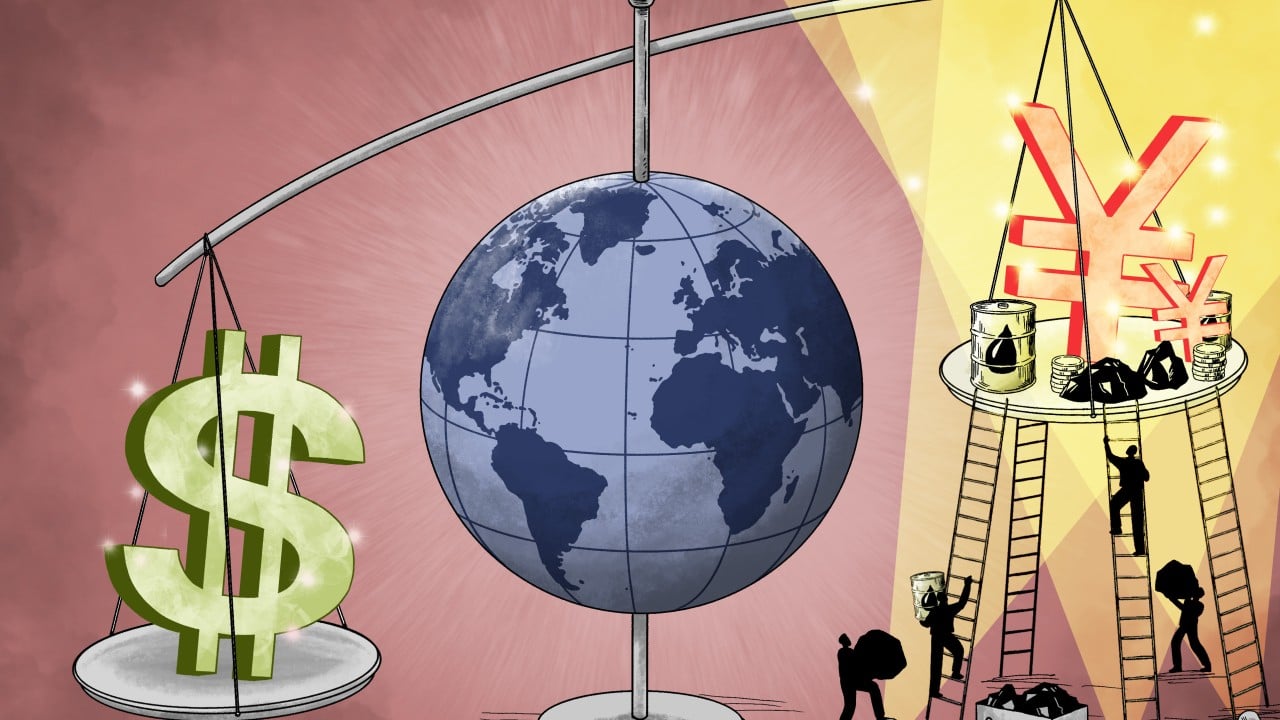
This is not a sudden revolution. It is a slow, methodical thawing of a frozen financial order. For the better part of a century, the U.S. dollar has been the world’s "exorbitant privilege," a term coined by the French to describe how America can run massive deficits because everyone else needs its currency to trade. If you want oil, you need dollars. If you want copper, you need dollars. If you want to save for a rainy day, you buy U.S. Treasuries.
China’s trade engine, a roaring furnace of manufacturing that now accounts for nearly 15% of global exports, is finally trying to break that monopoly. They are no longer content to build the world’s goods only to let a foreign currency capture the value of the exchange.
The Gravity of the Factory Floor
To understand why this matters to you—to your gas prices, your savings account, and the stability of your porch deliveries—you have to look at the sheer physics of trade. Money follows goods. For years, China was the "world’s factory," but it functioned like a subcontractor. It took orders in dollars, paid its workers in yuan, and recycled its profits back into U.S. debt.
This created a bizarre tether. Even as China grew into a superpower, it remained financially shackled to the Federal Reserve’s interest rate decisions. When the Fed hiked rates in Washington to fight American inflation, Zhang’s business in Shenzhen felt the squeeze. His costs went up. His debt became harder to manage.
The strategy has shifted. China is now leveraging its position as the largest trading partner to over 120 countries. They are telling their partners: "We buy your oil, your soy, and your iron. Why are we involving a third party’s currency? Let’s settle this in yuan."
It sounds like a dry accounting change. It is actually a geopolitical earthquake. When Russia was cut off from the dollar-based SWIFT system, the world watched a live-fire demonstration of the dollar’s power as a weapon. For Beijing, that was the final signal. Dependence on the dollar is no longer just an economic inconvenience; it is a national security vulnerability.
The Friction of Control
If the yuan is so backed by a massive trade engine, why hasn't it already toppled the dollar? The answer lies in a fundamental tension that the Chinese government has yet to resolve: the desire for power versus the fear of chaos.
To be a true global reserve currency, a currency must be "free." It must be able to move across borders at the click of a button. It must be subject to the whims of the market. The U.S. dollar is messy, volatile, and often frustrating, but it is liquid. You can always get your money out.
The yuan is different. It is a controlled substance.
The Chinese Communist Party views the total liberalization of the yuan with the same suspicion a captain views a leak in a hull. If they let the currency float freely, wealthy Chinese citizens might move their capital out of the country to escape a cooling property market or a regulatory crackdown. This "capital flight" could destabilize the entire domestic economy.
So, China is attempting a delicate, perhaps impossible, middle path. They are creating "offshore" yuan markets and digital currency bridges that allow for trade settlement without giving up total control over their internal financial system. They want the yuan to be a global leader while remaining a domestic servant.
Think of it like a high-speed train. China has built the most impressive tracks in the world (their trade networks). But the train (the yuan) is still tethered to a station master who won't let go of the manual override.
The Ghost in the Machine
Consider the "Petroyuan." For decades, the "Petrodollar" was the bedrock of American influence. Saudi Arabia sold oil exclusively in dollars, ensuring that every nation on earth had to hold greenbacks to keep their lights on.
Now, look at the headlines coming out of Riyadh and Abu Dhabi. They are talking to Beijing about yuan-denominated oil contracts. This isn't just about trade; it's about the emotional and psychological shift of global trust. When a country chooses a currency, they aren't just choosing a medium of exchange. They are placing a bet on a system of laws, a military's reach, and a nation's future.
But there is a ghost in this machine: the "Triffin Dilemma." This is an old economic paradox which suggests that the country whose currency is the world’s reserve must be willing to run massive trade deficits to supply the rest of the world with its money.
China’s entire economic identity is built on trade surpluses. They sell more than they buy. If they want the yuan to be the king of the mountain, they might have to flip their entire economy upside down—buying more from the world than they sell to it. Are they ready to stop being the world’s factory and start being the world’s consumer of last resort?
The Weight of the Greenback
The U.S. dollar remains a formidable fortress, not because it is perfect, but because the alternatives are currently unfinished. When the world gets scared—when a pandemic hits or a war breaks out—investors don't run to the yuan. They run to the dollar. They run to the perceived safety of U.S. law and the depth of the American bond market.
The dollar is the "least ugly" house on a block undergoing a massive, painful renovation.
However, arrogance is a dangerous financial strategy. The U.S. debt is climbing past $34 trillion. The political system is increasingly fractured. If the world perceives that the "manager" of the dollar is no longer responsible, the "moat" protecting the currency begins to dry up.
China’s roaring trade engine isn't going to replace the dollar tomorrow morning. There will be no cinematic "fall of the empire" moment where everyone throws their greenbacks into the street. Instead, the world is becoming "multipolar." We are moving toward a fractured landscape where some regions trade in dollars, some in yuan, and some in a digital basket of assets we haven't even fully realized yet.
The Silent Shift in the Grocery Aisle
What does this mean for the person standing in the grocery aisle in Ohio or the shopkeeper in Manila?
It means the "peace dividend" of the last thirty years is expiring. When the dollar is the only game in town, Americans benefit from lower import costs and cheaper debt. As the yuan carves out its own sphere of influence, that privilege erodes. Competition for resources becomes more expensive. The "silent tax" of a weakening currency hegemony starts to show up in the price of those lithium batteries and silk-blend shirts.
The dents on that shipping container in Long Beach aren't just from the sea. They are the marks of a world where the rules of the game are being rewritten in real-time.
In Shenzhen, Zhang finishes his contract. He clicks "send." The yuan moves. A few miles away, a massive ship loaded with electric vehicles pulls away from the pier, heading for Europe. It doesn't need a single U.S. dollar to complete its journey. The engine is roaring, the tracks are laid, and the station master is watching the clock.
The sound you hear isn't a crash. It's the sound of the ice breaking, one contract at a time.
Would you like me to look into the specific regional trade blocs, like the BRICS nations, that are currently leading the move toward yuan-denominated settlements?