Holi serves as the primary atmospheric and social vent for the Indian subcontinent, a ritualized suspension of the caste, class, and gender hierarchies that define the remaining 364 days of the calendar year. While casual observers perceive the event as a chaotic celebration of color, a structural analysis reveals a sophisticated mechanism for social recalibration. The festival functions through the deliberate application of "liminality"—a state of being between two worlds—where established norms are inverted to prevent systemic social fatigue.
The Lunar Trigger and Agricultural Baseline
The timing of Holi is not arbitrary; it is governed by the Purnima (full moon) of the Hindu month of Phalguna. This positioning serves a specific economic function at the intersection of the Rabi harvest and the onset of the tropical summer.
The agricultural cycle creates a period of high liquidity and temporary labor surplus. As the winter crops are reaped, the agrarian economy experiences a peak in disposable income and a localized dip in labor demand before the grueling heat of the pre-monsoon season sets in. Holi acts as the distributor for this surplus, fueling a massive internal consumption spike in textiles, pigments, and food commodities.
The Physics of Pigment and Social Erasure
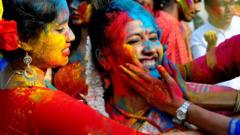
The core technology of Holi is the application of gulal (colored powder) and abeer. This serves a dual purpose: sensory stimulation and visual democratization.
- Identity Masking: By coating the body in dense, opaque pigments, the visual markers of caste and economic status—such as skin tone, clothing quality, and jewelry—are effectively neutralized. This creates a "blank slate" state where the billionaire and the day laborer are visually indistinguishable.
- Psychological Disinhibition: The physical act of smearing color onto another person’s face breaks the "untouchability" barriers inherent in traditional South Asian social structures. It mandates physical contact across demographic lines that are otherwise strictly segregated.
The Holi Dahan and the Thermochemistry of Purification
The festival begins with Holika Dahan, the ritual burning of a pyre. Beyond the mythological narrative of Prahlad and Holika, this act functions as a public health and sanitation utility.
- Waste Management: Historically, the pyre served as a communal disposal point for organic waste and dried underbrush accumulated during the winter.
- Pathogen Reduction: The high-intensity heat generated by communal pyres in dense urban and rural settlements provides a localized "cauterization" of the environment. As the season transitions from the cool dry winter to the humid heat of spring, the rise in ambient temperature encourages bacterial growth. The massive, synchronized fires of Holika Dahan act as a crude but effective method of environmental sterilization.
- Thermal Shock: The temperature of these pyres typically exceeds 600°C, creating convection currents that assist in the dispersal of stagnant winter air.
The Chemistry of Intoxication: The Bhang Variable
The integration of Bhang (cannabis derivatives) into the Holi framework is a calculated social bypass. In a society that traditionally prizes restraint and Vedic sobriety, the sanctioned use of Bhang during Holi provides a "safety valve" for suppressed anxieties.
Unlike alcohol, which often triggers aggressive volatility, the psychotropic effects of Bhang in a communal setting tend toward a flattening of the ego. This facilitates the "Basant" spirit—a state of high-arousal joy that allows for the temporary dissolution of the rigid social ego. The economic impact of this sanctioned consumption is significant, supporting a regulated shadow economy of state-licensed Bhang shops that see 400-600% increases in volume during the 48-hour festival window.
Regional Variations as Economic Indicators
The manifestation of Holi varies according to local resource availability and historical power dynamics.
The Braj Circuit (Mathura and Vrindavan)
In the heartland of the festival, the Lathmar Holi of Barsana and Nandgaon involves a ritualized reversal of gender power dynamics. Women strike men with wooden staves (lathis), while men defend themselves with shields. This is a controlled expression of gender-based friction, allowing for the venting of systemic grievances within a safe, ritualized boundary.
The Urban Commercial Model
In Tier-1 cities like Mumbai and Delhi, Holi has shifted from a neighborhood-based ritual to a ticketed event. This commodification introduces a "pay-to-play" exclusivity that contradicts the festival’s original leveling intent. These events utilize high-pressure water cannons and synthetic dyes, creating a different set of environmental externalities, specifically regarding water table depletion.
Environmental and Public Health Externalities
The transition from natural, plant-based dyes to synthetic pigments represents a significant failure in the festival's modern iteration.
- Natural Baseline: Traditionally, colors were derived from Tesu (Palash) flowers, turmeric, and beetroot. These substances have documented antifungal and antibacterial properties, serving a dermatological purpose during the season change.
- Synthetic Shift: Modern dyes often contain lead oxide, mercury sulfite, and aluminum bromide. The metabolic cost of processing these toxins via skin absorption creates a post-festival spike in dermatological and respiratory clinical visits.
- Hydrological Stress: In regions facing water scarcity, the use of water-tankers for "rain dances" represents a misallocation of critical resources. A single mid-sized Holi event can consume upwards of 50,000 liters of treated water, often in areas where groundwater levels are receding at a rate of 0.5 meters per year.
The Global Export of the Holi Aesthetic
The "Color Run" and "Holi One" festivals in Western markets represent a decapitated version of the ritual. By stripping the festival of its lunar timing, its agricultural significance, and its social inversion mechanics, the West has exported only the aesthetic of the powder. This is "Festival-as-a-Service" (FaaS), where the visual output is optimized for social media saturation rather than social cohesion.
In the domestic Indian market, this globalized version is flowing back in, leading to the "Instagrammification" of the ritual. This creates a feedback loop where the authenticity of the experience is sacrificed for the saturation of the digital image, leading to a decline in the traditional communal participation in favor of curated, private celebrations.
The Lathmar Strategy for Social Cohesion
To maintain the functional utility of Holi as a social stabilizer, the focus must shift from pure celebration to the preservation of its leveling mechanics. Organizations and local municipalities should prioritize the return to standardized, non-toxic pigment production as a matter of public health policy.
The strategic play for the next decade involves decoupling the festival from high-water-use activities and re-anchoring it in its dry-powder roots. This preserves the "identity masking" utility while mitigating the hydrological impact. Stakeholders must recognize that the value of Holi lies not in the color itself, but in the temporary erasure of the barriers that prevent a highly stratified society from functioning as a cohesive unit. Any evolution of the festival that reinstates those barriers—via VIP zones or high-cost barriers to entry—destroys the very mechanism that makes the festival a vital component of the Indian social contract.

.png?format=1500w)