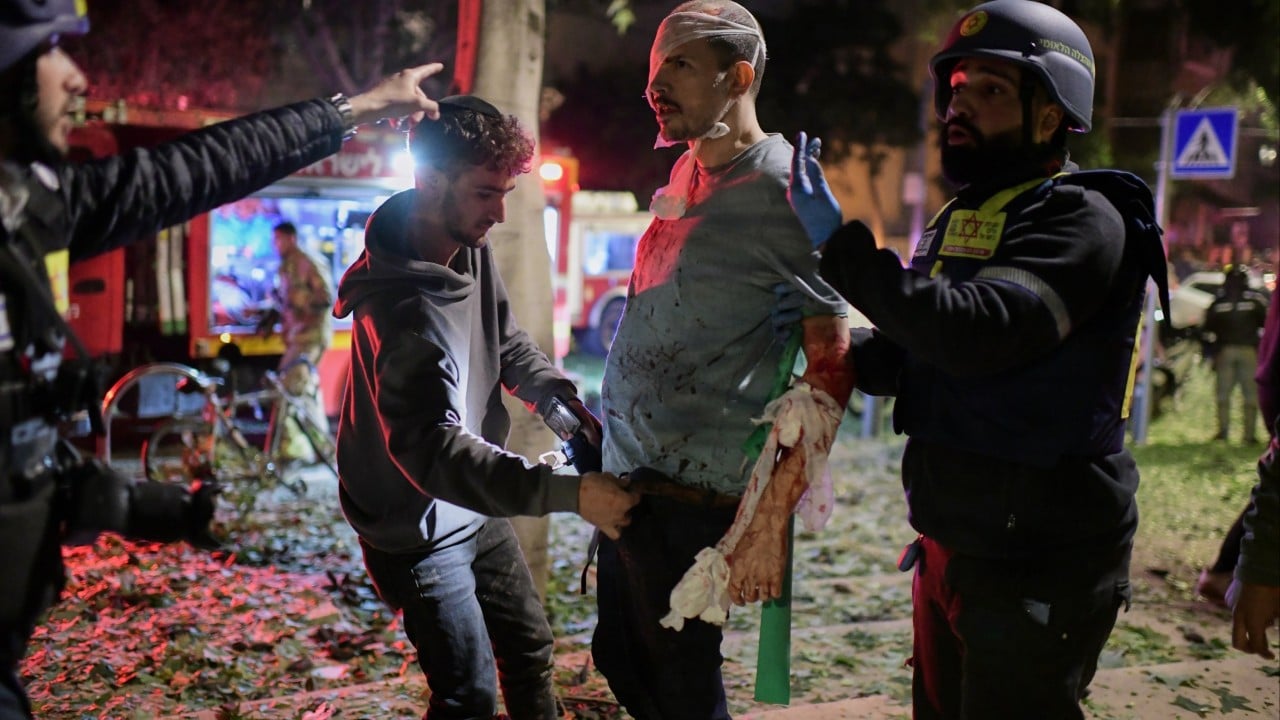
The sound starts as a low-frequency vibration in the marrow of your teeth. It is not the cinematic whistle of a falling object, but a tectonic groan that signals the atmosphere itself is being displaced. In the split second before the shockwave shatters the glass of the neighboring cafe, there is a vacuum—a sharp, sudden intake of breath where the city holds its collective lungs.
Then comes the roar.
Beirut is a city built on layers of history, most of it scarred. But the recent escalation between Israel, Hezbollah, and the shadow-hand of Iran has added a new, terrifying stratum to the rubble. This is not the contained, surgical skirmishing of the last decade. The rules of the "tit-for-tat" engagement have been shredded. We are witnessing the expansion of a local grudge into a regional conflagration, and the cost is being paid in the currency of human nerves and concrete dust.
The Geography of Fear
To understand the strikes on Lebanon, you have to look past the maps with their red-shaded zones of influence. Instead, look at a kitchen in Dahieh. Imagine a mother, Layla—a hypothetical but statistically certain representation of thousands—who is currently deciding whether to pack a suitcase or buy another gallon of drinking water. She knows the geopolitics better than most PhDs. She knows that when Hezbollah launched rockets in "solidarity" with Gaza, it was an invitation for the storm.
The strikes are no longer confined to the southern border. They are reaching into the heart of the capital and stretching north toward the Bekaa Valley. This is a deliberate widening of the aperture. Israel's military objective is the dismantling of Hezbollah’s infrastructure—the hidden launchpads, the reinforced bunkers, and the supply lines that hum with Iranian support. But infrastructure is rarely found in a vacuum. It is threaded through apartment blocks and tucked behind bakeries.
When a missile hits a target in a dense urban environment, the "collateral" is not just a statistic. It is the loss of a generation’s sense of safety. The "Iron Shield" of Hezbollah, once touted as a deterrent, has become a lightning rod.
The Invisible Strings of Tehran
There is a persistent myth that this is a two-sided war. It isn't. To view Lebanon as a standalone actor is to ignore the invisible umbilical cord connecting the Lebanese hills to the halls of power in Tehran.
Iran’s strategy has always been one of "forward defense." By backing Hezbollah, they created a powerful proxy capable of pinning down the Israeli military without a single Iranian soldier crossing a border. It was a masterpiece of asymmetric warfare until it wasn't. Now, as the conflict intensifies, Lebanon finds itself as the chessboard for a game being played by grandmasters who don't live on the board.
Consider the logistics. Hezbollah is not just a militia; it is a state within a state. It has its own schools, its own social services, and its own multi-billion dollar arsenal. This arsenal, largely provided by Iran, is the reason the current strikes are so ferocious. Israel is not fighting a band of insurgents; they are fighting a modern, well-equipped army that has spent twenty years digging into the limestone of the Levant.
The stakes for Iran are existential. If Hezbollah is crippled, Tehran loses its most effective "insurance policy" against a direct strike on its nuclear facilities. Because of this, the pressure to escalate is immense. Every time a Hezbollah commander is neutralized in a targeted strike in Beirut, the pressure cooker of regional war hisses louder.
The Calculus of the Rubble
War is often described through the lens of strategy, but on the ground, it is an exercise in brutal arithmetic.
Israel’s air campaign is designed to create a "buffer zone" of sorts—not necessarily through physical occupation, but through the systematic destruction of anything that can launch a projectile. They are operating under the doctrine that the only way to stop the rockets falling on Northern Israel is to make the cost of firing them unbearable for Lebanon.
But there is a flaw in this logic that history keeps repeating.
Destruction rarely breeds a desire for peace; it breeds a more resilient form of resentment. When a young man watches his family's livelihood vanish in a cloud of grey dust, he doesn't usually blame the logistics of the militia hiding in his basement. He blames the hand that pulled the trigger. This is the cycle that keeps the Levant in a state of perpetual mourning.
The statistics tell one story: hundreds of strikes, thousands of displaced families, megawatts of power lost. But the narrative is different. It is the story of a country that was already on its knees due to economic collapse, now being kicked in the ribs. The Lebanese Lira was already worthless. The port was already a ruin from the 2020 explosion. The people were already tired.
The Sound of One Door Closing
In the diplomatic hallways of Washington and Paris, there is a frantic effort to find an "off-ramp." They talk about UN Resolution 1701 and the withdrawal of forces to the Litani River. They speak in the sterile language of de-escalation.
But go back to the street level.
The "off-ramp" feels like a fantasy when the sky is filled with the drone of UAVs. These drones are a constant, buzzing reminder of the new age of warfare. They are the "mosquitoes of the apocalypse," hovering for hours, watching, waiting for a heat signature or a cell phone signal. They have turned the act of living into an act of exposure.
The human element of this war is a profound, soul-crushing fatigue. It is the fatigue of the father who has to explain to his five-year-old why they are sleeping in a car tonight. It is the fatigue of the doctor in a Beirut hospital who is running out of surgical gauze because the supply chains are choked.
The Ghost of 2006
Everyone in Lebanon is haunted by the ghost of the 2006 war. They remember the thirty-four days that felt like thirty-four years. But this time, the weaponry is more precise and far more lethal. The "smart bombs" can take out a single floor of an apartment building, but they cannot contain the fires that follow.
The shift in the last few days has been the move from border skirmishes to deep-state strikes. When Israel struck the heart of the southern suburbs, they weren't just hitting a building; they were sending a message to Tehran: Your shield is no longer impenetrable. Hezbollah’s response—deeper rocket fire into the Israeli Galilee and toward Haifa—is the echo of that message: If we burn, you will feel the heat.
This is no longer a localized conflict over a few miles of disputed farmland. It is a regional reset. The "Axis of Resistance," led by Iran and executed by Hezbollah, is being tested in a way it hasn't been since its inception. And as the two sides clash, the sovereign state of Lebanon—a nation of artists, chefs, and entrepreneurs—is being treated as little more than a backdrop.
The Weight of the Silence
After the strikes, there is a specific kind of silence. It is heavy. It smells of pulverized stone and old insulation.
In this silence, the geopolitical "experts" will tell you about the strategic necessity of the strikes. They will talk about "degrading capabilities" and "re-establishing deterrence." They will use words that sound clean and clinical.
But look at the hands of the people digging through the debris. Their fingernails are broken, and their skin is coated in the fine, white dust that has become the signature of modern conflict. They are not thinking about Iran’s regional hegemony or Israel’s security concerns. They are looking for a photo album. They are looking for a cat. They are looking for a sign that the world they woke up in still exists.
The tragedy of the current strikes is not just the loss of life, though that is the ultimate ledger. The tragedy is the theft of the future. Every missile that lands in Lebanon is a blow to the idea that the country can ever truly recover from its long, agonizing decade of misfortune.
The sky over Beirut used to be a brilliant, Mediterranean blue. Now, it is often a hazy, bruised purple, stained by smoke and the persistent, invisible trails of jets. The people below do not look up anymore. They look at the ground, waiting for the next vibration, wondering if the next groan of the earth will be the one that finally swallows the last of their hope.
The war has moved past the border. It has moved into the bedrooms, the schools, and the very air of the Levant. And as the global powers calculate their next move, the people of Lebanon are left with a single, devastating realization: in the game of giants, it is always the earth that suffers.