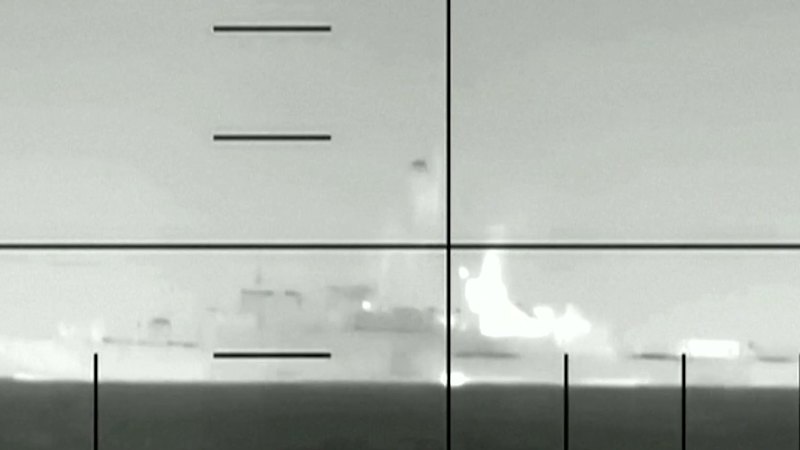
The recent sinking of an Iranian frigate by a United States Navy attack submarine marks more than a local skirmish. It represents a definitive shift in the physics of maritime power. While headlines focus on the diplomatic fallout, the technical reality is far more sobering. A single Virginia-class submarine effectively dismantled a symbol of regional naval ambition without ever breaking the surface. This engagement provides a cold look at the widening gap between traditional surface fleets and the invisible reach of modern undersea warfare.
The encounter took place in the narrow corridors of the Strait of Hormuz. For years, these waters have seen a tense dance of "gray zone" tactics—speedboats buzzing destroyers, drones shadowing tankers, and mines threatening the global oil supply. But the introduction of a heavy-weight torpedo into this equation changes the math. Surface ships, no matter how heavily armed, are increasingly becoming high-value targets with limited means of defense against an adversary they cannot see.
The Mechanical Brutality of the Mk 48 ADCAP
To understand why the Iranian vessel stood no chance, one must look at the weapon used. It was likely a Mk 48 Advanced Capability (ADCAP) torpedo. Unlike the Hollywood depiction of a torpedo hitting the side of a ship and exploding, the ADCAP is designed for a much more violent purpose.
It uses a proximity fuse to detonate directly beneath the ship’s keel.
The resulting explosion creates a massive gas bubble that lifts the entire ship out of the water. As the bubble collapses, the ship drops into a void, and the weight of the bow and stern causes the "back" of the vessel to snap. No amount of damage control or hull thickness can save a ship once its structural spine is broken. This is not a tactical hit; it is a total physical deletion of the target's ability to float.
The Iranian frigate, a vessel designed for surface-to-surface engagements and coastal patrol, lacked the sophisticated sonar arrays and anti-submarine warfare (ASW) suites necessary to even detect the launch. By the time the acoustic signature of the torpedo’s propeller was picked up by the ship's passive sensors, the weapon was already in its terminal homing phase.
Why the Persian Gulf is a Submariner's Nightmare
Geography dictates the terms of engagement in the Gulf. The average depth is only about 50 meters. For a massive nuclear submarine, this is like trying to hide in a bathtub. This is why many analysts previously doubted the efficacy of large US submarines in these waters. They argued that thermal layers, high salinity, and the constant noise of commercial shipping would make a submarine easy to track.
They were wrong.
The US Navy has spent decades perfecting shallow-water acoustics. Modern Virginia-class submarines utilize pump-jet propulsion rather than traditional propellers, which significantly reduces the cavitation noise that usually gives a submarine away. Furthermore, the "noise" of the Gulf—the clatter of thousands of civilian vessels—actually acts as a cloak. An expert sonar operator can hide a submarine’s signature within the ambient roar of the global supply chain.
On the other side, the Iranian Navy has invested heavily in "asymmetric" assets. Their strategy relies on swarms of fast attack craft and land-based cruise missiles. These are effective tools for harassing merchant ships or delaying a surface strike group. However, they are utterly useless against an underwater threat. You cannot swarm a submarine with speedboats. You cannot hit it with a truck-mounted Silkworm missile.
The Intelligence Failure Behind the Deployment
The fact that the Iranian warship was in a position to be targeted suggests a catastrophic breakdown in their maritime domain awareness. Iran has spent years bragging about its domestic sonar capabilities and its "Fateh" class coastal submarines. Yet, in the moments leading up to the strike, the frigate was operating as if it were in safe waters.
There is a psychological component to this failure. Surface commanders often fall victim to the "horizon trap." If they cannot see a threat on radar or via a drone feed, they tend to operate with a false sense of security. The US submarine, likely operating under orders to enforce "freedom of navigation" or responding to a specific provocation, exploited this blind spot.
This event also highlights the limitations of Russian and Chinese technology exports to the region. Many of the sensors and electronic warfare suites on Iranian vessels are derivatives of older Soviet designs or modern Chinese commercial hardware. While these look impressive in a military parade, they struggle to filter out the complex interference of a shallow-water environment to find a target as quiet as a US nuclear-powered attack sub.
The Cost of the Invisible War
Warships are expensive. The loss of a single frigate represents hundreds of millions of dollars and years of training for a specialized crew. More importantly, it represents a loss of face. For a regional power that projects its image through naval strength, having a ship vanish from the surface in seconds is a devastating blow to morale.
The US, meanwhile, is proving that its most potent deterrent is the one it rarely shows. The "Silent Service" operates without the fanfare of a carrier strike group. There are no photo-ops of a submarine transit. There is only the sudden, violent evidence of their presence.
This creates a new reality for every captain in the Iranian Navy. Every time they leave port, they must now reckon with the possibility that an invisible predator is already sitting beneath their hull. This psychological pressure is often more effective than any diplomatic sanction. It forces the adversary to spend ruinously on defensive technologies that may not even work, diverting funds from other offensive programs.
Beyond the Immediate Conflict
This sinking is a case study in why the US is shifting its focus away from large, vulnerable surface platforms toward undersea and unmanned systems. The vulnerability of the Iranian frigate is a mirror. It shows what could happen to any navy—including the US Navy—if it fails to master the undersea domain.
China is watching this engagement closely. They are currently building the world’s largest network of undersea sensors, often called the "Great Underwater Wall," specifically to counter the advantage the US currently holds. They know that in a conflict over the Taiwan Strait or the South China Sea, the first and last shots will likely be fired from beneath the waves.
The Iranian Navy now faces a choice. They can continue to build surface ships that serve as little more than targets, or they can attempt to move their own operations underwater. But building a quiet submarine is significantly harder than building a fast boat. It requires precision engineering and acoustic modeling that Iran has not yet demonstrated.
Concrete Risks of Escalation
The danger now lies in how Iran chooses to respond. Since they cannot effectively hunt US submarines, they may turn back to the tools they know.
- Increased Mine Seeding: Shallow waters make it easy to drop bottom-dwelling mines that are difficult to sweep.
- Targeting Commercial Shipping: If a navy cannot hit the enemy’s warships, it often goes after the enemy’s economic interests.
- Cyber Attacks on Port Infrastructure: Moving the conflict from the water to the digital grid.
None of these options, however, solve the fundamental problem. The US has demonstrated that it can reach out and touch any vessel in the Gulf with total impunity.
The era of surface ships being the primary arbiter of maritime power is closing. In the confined, cluttered waters of the modern world, the advantage goes to the entity that can operate in the dark. The sinking of the frigate was not a fluke; it was a demonstration of a new standard in naval warfare where visibility is synonymous with death.
Armies and navies must now adapt to a battlefield where the most dangerous threat is the one that never shows up on a radar screen.