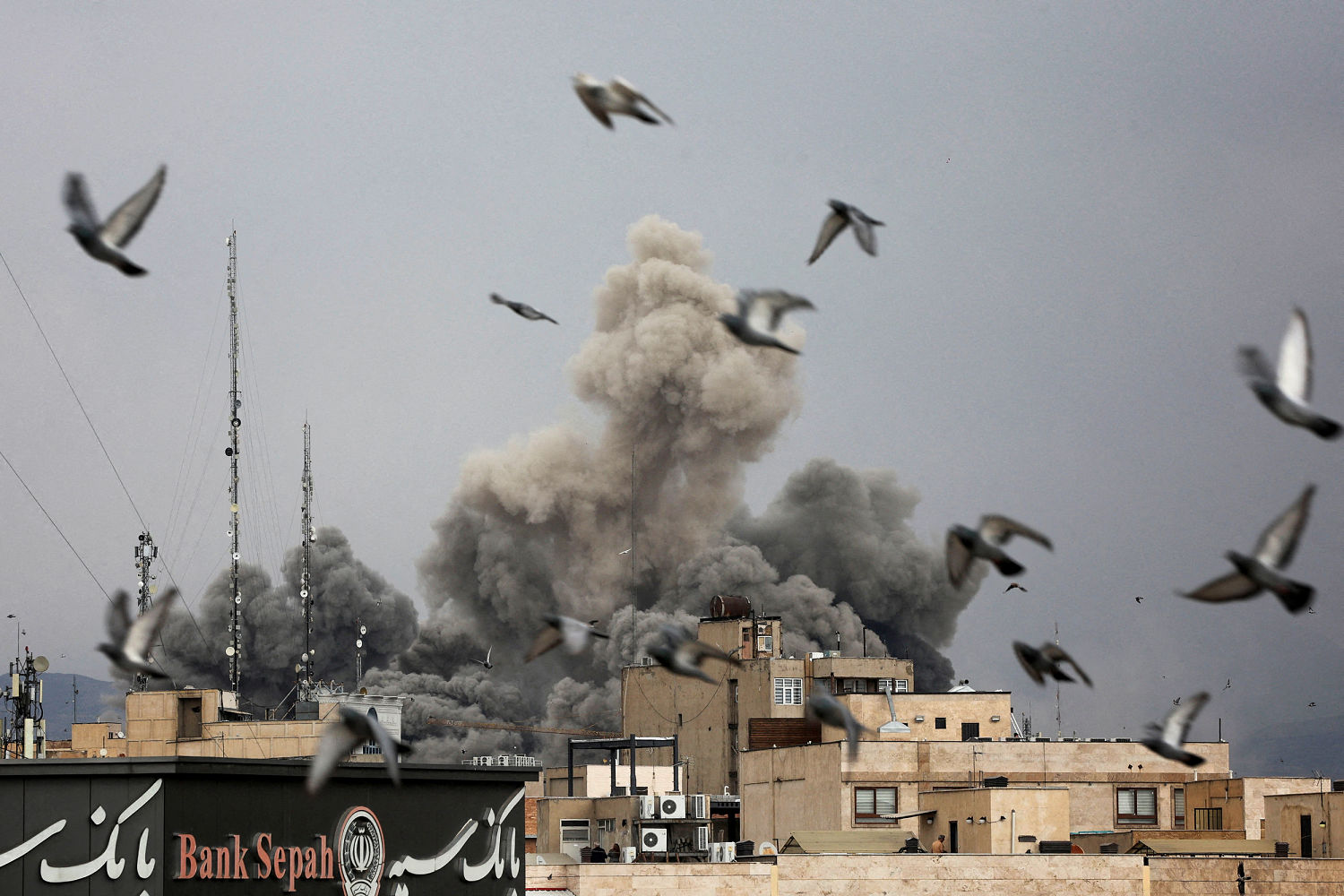
The psychological insulation that once protected the Iranian capital has evaporated. For decades, the residents of Tehran lived under the assumption that while the borders might be porous and the periphery volatile, the heart of the Islamic Republic was an untouchable fortress. That illusion died with the precision strikes that have systematically dismantled the regime’s sense of domestic control. Today, the city is defined by a heavy, vibrating anxiety. It is not just the fear of external ordnance, but the realization that the state’s security apparatus—the very thing that justifies its iron-fisted rule—is failing its most basic mandate.
When you walk through the Grand Bazaar or wait for a train at Sadeghiyeh, the conversation isn’t about if another strike occurs, but how deeply the infiltration goes. The "ghost" in the machine is no longer a metaphor. It is a documented reality of intelligence breaches that have turned high-security compounds into glass houses. This isn’t just a military crisis. It is a foundational collapse of the social contract between a surveillance state and a population that has traded liberty for the promise of a shield that is now riddled with holes.
The Architecture of Vulnerability
Tehran was never built to be a modern battlefield. Its sprawling, chaotic urbanization and its reliance on centralized power structures make it a nightmare for civil defense. As regional tensions escalate into direct kinetic exchanges, the structural weaknesses of the city are laid bare.
The primary issue is the concentration of high-value targets within dense civilian corridors. Unlike many global capitals that move their sensitive administrative and military hubs to the outskirts, the IRGC and various ministries are woven into the residential fabric of Tehran. When a "surgical" strike is planned, the margin for error is non-existent. For the person living in an apartment block in northern Tehran, the proximity to a drone research facility or a safe house isn't a point of pride—it's a death sentence.
The Intelligence Vacuum
The recent series of assassinations and explosions within the city limits points to a systemic failure of counter-intelligence. It suggests that the threat is not just coming from the sky via long-range missiles, but from the ground. Local recruitment and the compromise of mid-level officials have created a environment where no location is truly "blacked out."
If an adversary can track a target to a specific room in a heavily guarded compound, the physical walls of that compound become irrelevant. The regime has responded with a frantic internal purge, but these "loyalty audits" often do more harm than good. They breed a culture of paranoia among the rank and file, leading to a paralysis in decision-making. When everyone is a suspect, no one is actually watching the gates.
The Economic Toll of a Permanent Alert
The instability has sent the rial into another tailspin, but the deeper economic damage is seen in the flight of human capital and the freezing of domestic trade. Business in Tehran operates on the rhythm of the news cycle.
Investors are not looking at quarterly returns; they are looking at the flight paths of unidentified aircraft. This state of permanent alert has decimated the middle class's ability to plan for a future. When the sky could fall at any moment, people stop buying property, they stop starting businesses, and they start looking for ways to move their remaining wealth into hard currency or digital assets.
- Retail stagnation: Foot traffic in major commercial hubs has dropped as people avoid large gatherings.
- Real estate volatility: Prices in "target-adjacent" neighborhoods are fluctuating wildly as residents seek safer zones.
- Logistical friction: Increased checkpoints and security protocols have slowed the movement of goods into the city, driving up the cost of basic necessities.
The Myth of the Iron Dome of Diplomacy
For years, the Iranian leadership relied on a strategy of strategic ambiguity and the belief that the international community would prevent a full-scale escalation to protect global energy markets. That gamble has failed. The current reality is that the deterrence once provided by proxies is being bypassed. The war has come home, and the diplomatic channels that used to offer a "cool-down" period are currently clogged with mutual distrust and a shift in regional power dynamics.
The city’s air defense systems, while formidable on paper, face a saturation problem. Modern warfare utilizes "swarm" tactics and electronic warfare that can confuse even the most sophisticated radar arrays. In Tehran, the sound of anti-aircraft fire has become a grim lullaby. It is a sound that serves as a reminder of the state’s presence, but also its desperation. Every missile intercepted is a temporary reprieve, not a victory.
Social Fragmentation and the Security State
The internal pressure is reaching a boiling point. There is a visible rift between those who believe the state must double down on its defensive posture and a younger generation that views the current insecurity as the direct result of decades of confrontational foreign policy.
In the tea houses and private Telegram channels, the narrative is shifting. The state-run media continues to project an image of defiance and readiness, but the reality on the street is one of exhaustion. People are tired of being the collateral in a "shadow war" that is no longer in the shadows. This disconnect creates a dangerous vacuum. When a population loses faith in its government's ability to provide physical safety, the legitimacy of that government begins to erode from the inside out.
The Technical Reality of Modern Urban Warfare
To understand why Tehran feels so exposed, one must look at the evolution of precision-guided munitions (PGMs). We are no longer in an era of carpet bombing. We are in an era of "kinetic impact" where the goal is to neutralize a single individual or a specific piece of hardware with minimal surrounding damage.
However, "minimal" is a relative term. In a city as packed as Tehran, the shockwave of a strike, the disruption of the power grid, and the inevitable secondary fires create a cascade of chaos. The city’s infrastructure—much of it aging and poorly maintained—is not equipped to handle these shocks. A single strike on a power substation doesn't just darken a neighborhood; it kills the water pumps, it shuts down the hospitals, and it severs the communication lines that the city relies on to manage the crisis.
The Role of Cyber Warfare
Beyond the physical strikes, Tehran is a primary target for sophisticated cyber-attacks. These are often the precursors to kinetic action. By disabling traffic management systems or interfering with the city's internal communication networks, an adversary can create a state of artificial panic before a single shot is fired.
The integration of digital and physical threats means that "safety" is no longer a geographical concept. You can be in the most reinforced bunker in the city, but if your communication system is compromised, you are isolated and vulnerable. The regime’s attempt to create a "National Internet" is an admission of this vulnerability, but it also isolates the population even further, cutting them off from the information they need to navigate the crisis.
The Psychological Siege
The most potent weapon being used against Tehran right now is not a missile. It is the psychological weight of the unknown. Living in a city where the rules of engagement are being rewritten in real-time creates a unique form of trauma. It is a slow-motion catastrophe.
You see it in the way people drive, the way they scan the horizon, and the way they hoard supplies. The city is holding its breath. The Iranian leadership is faced with a choice that has no good outcome: escalate and risk a total war that the city cannot survive, or hold back and watch as their internal security is picked apart piece by piece.
The "Deep State" in Iran is currently focused on survival, but that survival is being bought at the cost of the city's soul. The vibrancy that once defined Tehran—its art, its intellectual defiance, its relentless energy—is being replaced by a cold, functional survivalism.
The streets are still busy, but the movement is different. It is hurried. It is purposeful. It is the movement of a people who know that the sky above them is no longer theirs. The city of mountains and history has been reduced to a map of targets, and every citizen is now a reluctant cartographer, marking the places they can no longer afford to go.
Check your emergency supplies today. Not because a strike is guaranteed tomorrow, but because the infrastructure of certainty has already been destroyed. Modern urban survival starts with acknowledging that the "safe zones" on the map are an outdated concept. Focus on decentralized communication and localized resources. When the grid fails or the sirens start, the only thing that matters is the immediate 50-meter radius around you.