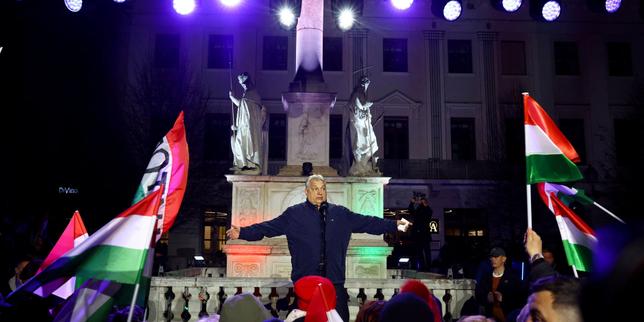
The iron grip Viktor Orban has held over Hungary for sixteen years is finally slipping. As polls open across the country this Sunday, April 12, 2026, the political machine that once seemed invincible is sputtering under the weight of a stagnant economy and a defector who knows exactly where the bodies are buried. For the first time since his return to power in 2010, Orban is not the hunter; he is the prey.
Péter Magyar, a former Fidesz insider and the ex-husband of Orban’s former Justice Minister, has done what the fragmented "liberal" opposition failed to do for a decade. He has built a movement, the Tisza party, that speaks the language of the Hungarian heartland while promising to dismantle the very "mafia state" he once helped serve. This is no longer a battle of ideologies between a cosmopolitan Budapest and a conservative countryside. It is a civil war within the Hungarian right, and Orban is losing.
The Architect of His Own Isolation
Orban’s strategy has always relied on a simple trade-off: domestic prosperity funded by European Union transfers in exchange for a slow dismantling of democratic checks. That deal is dead. With nearly €20 billion in EU funds still frozen due to rule-of-law violations, the patronage network that keeps Fidesz loyalists fed is starving.
The economic reality for the average Hungarian is grim. Inflation peaked at a staggering 26% in 2023, and the recovery promised for 2025 never arrived. GDP growth has flatlined, and the budget deficit remains stuck at 5%, well above the EU’s limit. When the money ran out, the cracks in the facade became canyons. Public services, particularly healthcare and education, are in a state of visible decay. Teachers have spent years on strike, and hospitals are struggling with chronic shortages of staff and supplies. Orban’s narrative of a "sovereign" Hungary standing tall against Brussels rings hollow when the citizens cannot afford basic groceries.
The Magyar Factor
The rise of Péter Magyar was not a slow burn; it was an explosion. After breaking with the party in early 2024 following a scandalous presidential pardon in a child abuse case, Magyar took to social media to expose the inner workings of the Fidesz propaganda wing. He didn't come from the left. He came from the core of the establishment, and that makes him dangerous.
Magyar’s Tisza party has consistently led Fidesz in the polls by as much as 10 points in the final weeks of the campaign. His platform is surgically precise:
- Anti-Corruption: Joining the European Public Prosecutor’s Office to unfreeze EU funds.
- Economic Realignment: Moving away from the failed "Eastern Opening" that tethered Hungary to Russian energy and Chinese debt.
- Restoration of Meritocracy: Ending the practice of awarding major state contracts to a handful of Orban-linked oligarchs.
The Geopolitical Dead End
Orban’s "peacemaker" routine regarding the war in Ukraine has finally hit its limit. By positioning Hungary as the Kremlin’s primary advocate within the EU, he has isolated himself from his traditional allies in the Visegrád Group. Poland, once Hungary’s staunchest defender in Brussels, has moved on. Even the election of Donald Trump, whom Orban has courted relentlessly, has not provided the immediate economic windfall the Prime Minister promised.
The voters are beginning to see the "peace" Orban offers as a form of vassalage. While he claims that supporting Ukraine would bankrupt the nation, the reality is that his refusal to align with the West has already done the job. The arrival of U.S. Vice President JD Vance in Budapest this week to "help" Orban win only served to highlight how desperate the incumbent has become for external validation.
The Mechanics of a Power Shift
If Magyar wins a simple majority, the transition will be chaotic. Fidesz has spent sixteen years gerrymandering districts and packing every independent institution—from the judiciary to the media authority—with loyalists. A Tisza government would face a "deep state" designed to block its every move.
However, the momentum is currently with the opposition. Turnout in the first hours of voting has already broken post-Socialist records. In Budapest and major provincial cities, the mood is not one of anxiety, but of an ending.
Orban’s campaign has resorted to the only tool it has left: fear. The state-controlled media is saturated with claims that a Magyar victory would mean immediate conscription into the Ukrainian war effort. It is a tired script. After a decade and a half of hearing that the "Brussels elites" and "George Soros" are responsible for every domestic failure, the Hungarian public appears to have found a new culprit.
The Prime Minister’s path to a fifth term requires more than just his usual base; it requires the silence of the disillusioned. But the streets are no longer silent. Whether Orban can survive this siege depends on whether his machine can still grind out a victory when the fuel—money and belief—has finally run dry.