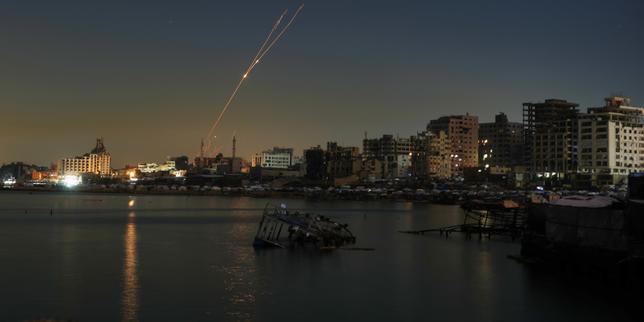
The light from the smartphone is the only thing illuminating Amira’s face in the pitch-black basement of a crumbling apartment block in Deir al-Balah. Outside, the world is a symphony of drones and distant thuds. But on her screen, the world has moved on. She scrolls through a feed that, just weeks ago, was a frantic ledger of her neighbor’s names, of blood types needed, of bread lines and white phosphorus. Now, the algorithm has shifted. The pixels are filled with a different fire. Long-range missiles over Isfahan. Ballistic trajectories mapped over the Red Sea. Strategic analysts in crisp suits sitting in London studios debating the "regional escalation" between Iran and Israel.
Amira feels a cold, hollow sensation that has nothing to do with the lack of flour. It is the realization that she has become a footnote in someone else’s war.
The Gravity of a New Ghost
War is often a competition for the eyes of the world. For months, the narrow strip of land known as Gaza was the center of the human moral compass. Every headline, every protest, every diplomatic cable revolved around the humanitarian catastrophe unfolding in the rubble. Then, the horizon widened. When Tehran and Tel Aviv began their direct exchange of fire, the spotlight didn't just move; it expanded until the original subject was washed out by the glare.
The fear in the camps isn't just about the next strike. It is about the "total oblivion" of their cause. When two regional titans clash, the world holds its breath for a global conflagration. In that panicked gasp, the slow, agonizing starvation of a child in northern Gaza becomes "background noise." It is a brutal law of media physics: a larger explosion will always drown out a smaller scream, even if that smaller scream has been echoing for half a year.
Consider the shift in the diplomatic halls of Brussels and Washington. Before the Iranian escalation, the rhetoric was sharpening. There were talks of "red lines" regarding Rafah. There was a growing, palpable pressure for a permanent ceasefire. But the moment the first Iranian drone took flight, the narrative shifted back to "unwavering defense." The leverage that humanitarians had spent months building evaporated overnight. The focus moved from protecting a displaced population to preventing a third world war.
The Logistics of Being Ignored
This isn't just a matter of hurt feelings or media cycles. It is a matter of cold, hard logistics. When the world’s attention pivots to a potential state-on-state war between Iran and Israel, the "bureaucracy of empathy" slows down.
Imagine a hypothetical aid coordinator named Elias. For weeks, he has been fighting for every truckload of canned goods and medicine. He relies on the constant, nagging pressure from international governments to force open the gates at Kerem Shalom. But now, his contacts in the State Department aren't picking up. They are in "situation rooms" discussing the Strait of Hormuz. The maritime corridor that was supposed to bring life-saving supplies? It is now a secondary concern compared to the safety of naval destroyers facing anti-ship missiles.
The Iranian shadow provides a convenient fog. Under its cover, actions that would have sparked a week of international outrage now barely make the ticker at the bottom of the screen. The "total oblivion" isn't an accident; it is a byproduct of how we process crisis. We are biologically wired to fear the predator in front of us more than the one already biting our leg. Iran is the new, larger predator. Gaza is the wound we’ve grown used to seeing.
The Architecture of the Pivot
To understand why this happens, we have to look at the history of regional distractions. In 1982, as the world watched the escalating tensions of the Cold War and the Falklands, the invasion of Lebanon took place under a fractured global gaze. The pattern is consistent: when a "systemic threat"—something that could change the map of the world—appears, the "humanitarian threat" is demoted.
The Iranian escalation changed the math for every player on the board. For the Israeli government, it provided a moment of strategic relief. The intense, agonizing scrutiny on their operations in Gaza was diluted. For the United States, it was a return to a familiar, comfortable script: protecting an ally against a regional rival, rather than the messy, politically divisive task of policing a humanitarian disaster.
But for the 2.3 million people trapped between the sea and the fence, this shift is a death sentence written in ink so faint nobody bothers to read it.
A Hunger That Doesn’t Watch the News
In the north of the strip, the grass is being pulled from the earth to make a bitter soup. The people there do not care about the "geopolitical ramifications" of a drone strike on an airbase in the desert. They do not care about the enrichment levels of uranium or the tactical capabilities of the Iron Dome. They care about the fact that the "food drops" have become less frequent because the airspace is now a highway for missiles.
The cruelty of the "Gaza oblivion" is that the suffering does not pause just because the cameras have moved. The famine doesn't take a break while the UN Security Council debates the sovereignty of Persian soil. If anything, the isolation makes the suffering more acute. When you believe the world is watching, there is a shred of hope that the madness must have a limit. When you realize the world is looking over your shoulder at something bigger, that limit disappears.
The Shadow of the Greater War
The rhetoric of "regional stability" is a high-level game played with human lives as the currency. We talk about Iran's "proxies" and Israel's "deterrence" as if we are moving pieces on a mahogany board. We forget that the pieces bleed.
The real danger of this new conflict is not just the bombs that might fall on Tehran or Tel Aviv. It is the silence that will fall on the tents in Rafah. It is the permission given by distraction. If the international community is preoccupied with preventing a nuclear-capable Iran from entering a direct war, who is left to count the calories entering Gaza? Who is left to document the demolition of the last standing bakeries?
We are witnessing a disappearing act. A whole people, their history, their agony, and their future, are being folded into the creases of a much larger map. The "total oblivion" isn't a future possibility; it is a process that has already begun. Every time a news anchor pivots from the casualty counts in a Gaza hospital to the "strategic depth" of the Iranian Revolutionary Guard, the disappearance accelerates.
Amira turns off her phone. The battery is at three percent. She needs to save it to use as a flashlight later, to find her way through the dark to the water tank that might be empty. She lies back on the cold concrete. The drones are still there, humming like a swarm of angry wasps. She realizes that for the people in the shiny studios, the hum has become a lullaby—a constant, drone-like background noise that they have finally learned to sleep through.
The world is no longer looking at her. And in the dark, without the light of the screen, she wonders if she still exists at all.