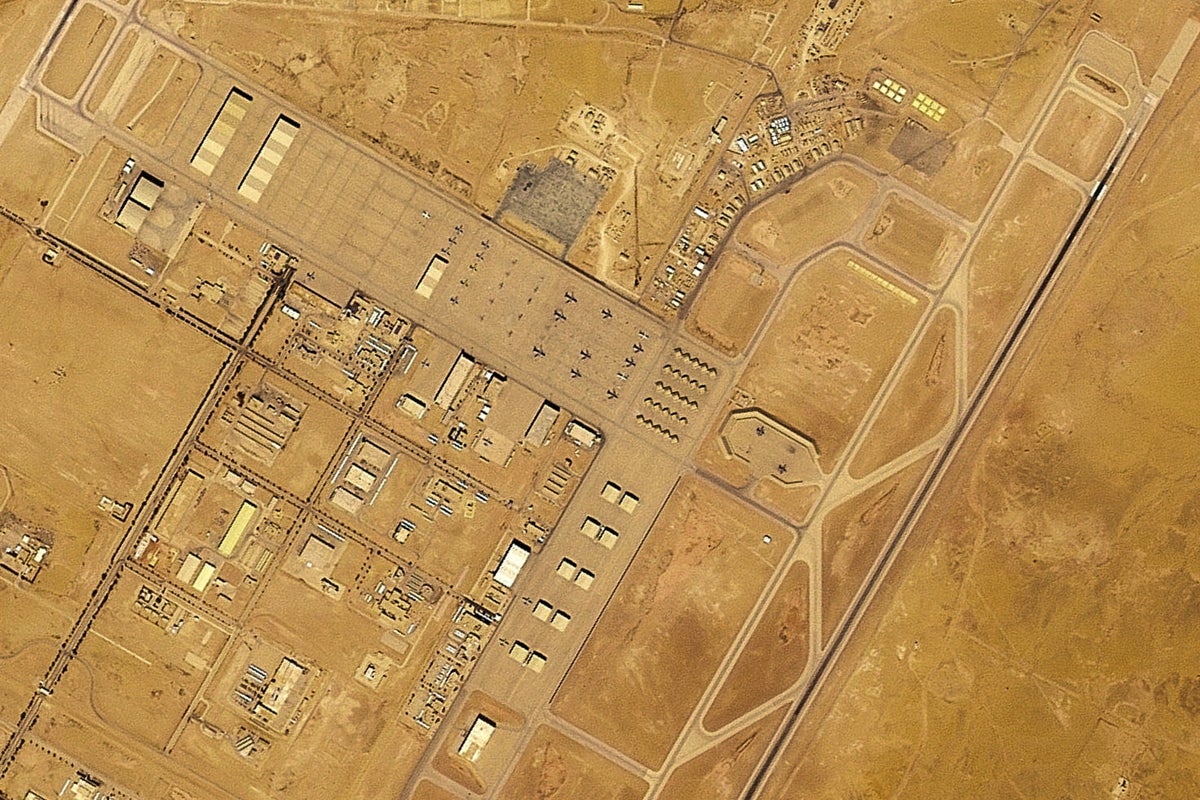
The media loves a blurry satellite photo of a runway. It’s easy. It’s visual. It suggests a looming conflict that keeps clicks high and blood pressure higher. When images surfaced showing U.S. military aircraft parked at Prince Sultan Air Base in Saudi Arabia, the narrative was instant: Washington is bracing for an immediate, kinetic showdown with Tehran.
They’re reading the map upside down.
If you think a few dozen F-15s and a Patriot battery on a tarmac represent a secret buildup for a regional war, you’ve never spent a day in a windowless room at the Pentagon. Those planes aren't a hidden dagger; they are a neon sign. In the world of high-stakes signaling, if a satellite can see it, it’s because the military wants it seen.
The "rising tension" trope is a lazy shortcut used by analysts who can’t distinguish between theater and strategy. We aren't watching the prelude to World War III. We are watching a masterclass in bureaucratic posturing and legacy logistics.
The Transparency Trap
Modern commercial satellite imagery from firms like Maxar or Planet Labs has created a "transparency trap." Because anyone with a credit card can now see a flight line in the desert, we assume we have total situational awareness.
We don’t.
True military intent is buried in what the satellites don't see. It’s in the subterranean hardened facilities, the encrypted burst transmissions, and the sub-surface naval movements in the Strait of Hormuz. Parking a fleet of multi-role fighters out in the open, where a $500 drone or a commercial satellite can count the rivets, is the military equivalent of puffing out your chest in a bar. It’s designed to prevent a fight, not start one.
I have watched billions of dollars in "strategic deployments" vanish into the ether because the public mistook a temporary rotation for a permanent escalation. The U.S. Air Force doesn't telegraph a real strike by letting its assets bake in the sun for weeks while the world's media discusses their arrival. When the U.S. wants to hit something, the first sign isn't a satellite photo; it's a sudden lack of targets.
Logistical Inertia is Not a Strategy
The competitor's narrative suggests these movements are a nimble response to Iranian "provocations." That is a fundamental misunderstanding of how the U.S. military moves. Moving a squadron is like turning a supertanker. It involves months of planning, contractor agreements, fuel pre-positioning, and diplomatic haggling.
What we are seeing is likely Logistical Inertia.
The U.S. has been trying to "pivot to Asia" for a decade, yet it remains tethered to the Middle East by sheer administrative weight. These aircraft aren't there because there is a new, urgent threat. They are there because the infrastructure exists to hold them, and the bureaucratic machinery of the Department of Defense finds it easier to maintain a presence than to dismantle it.
Consider the $E=mc^2$ of military presence: Mass equals energy times the speed of the bureaucracy. If you see a sudden "buildup," look at the budget cycle. Look at the expiration of basing agreements. More often than not, these "tensions" are the justification for the spending, rather than the cause of the deployment.
The Reality of Modern Deterrence
| Feature | Media Interpretation | Insider Reality |
|---|---|---|
| Visible Aircraft | Imminent Strike | Signaling and Deterrence |
| Patriot Batteries | Defensive Shield | Reassuring Nervous Allies |
| New Tarmac Construction | Preparing for War | Using Up Remaining Annual Budget |
| Increased Sorties | Combat Drills | Maintaining Pilot Hours |
The Saudi-American Marriage of Convenience
Let’s address the elephant in the hangar: Saudi Arabia.
The presence of U.S. hardware on Saudi soil isn't just about Iran. It’s about the "Petrodollar Security Blanket." Riyadh doesn't want U.S. planes there to bomb Tehran; they want them there so the U.S. is physically invested in Saudi stability. If Iran kicks the hornet's nest, the U.S. has to respond because its own people and "expensive toys" are in the line of fire.
It is a hostage strategy.
The U.S. knows this. Every time a satellite photo "reveals" a new deployment, the State Department gets a win in Riyadh, and the Pentagon gets a win on Capitol Hill. It’s a symbiotic relationship built on the perception of threat, even when the actual risk of a full-scale Iranian invasion is at its lowest point in years.
Iran isn't a conventional military power. They don't win with tanks and planes. They win with proxies, cyberwarfare, and asymmetric disruption. You don't counter a Houthi drone with an F-15 parked at Prince Sultan Air Base. You counter it with intelligence and localized defense. The planes on the runway are for the cameras; the real war is happening in the code and the shadows where satellites can't reach.
Deconstructing the "People Also Ask" Nonsense
If you search for these deployments, you’ll find questions like, "Is the U.S. going to war with Iran?" The answer is a resounding "No," and the satellite photos are the proof. In a real escalation, you prioritize Operational Security (OPSEC). You don't leave your most valuable assets sitting in a neat row like a used car lot.
Another common query: "Can Iran reach U.S. bases in Saudi Arabia?" Of course they can. Iran has the largest missile arsenal in the region. This is exactly why the U.S. wouldn't concentrate its forces in a predictable, highly visible location if it actually expected a missile barrage. The fact that the planes are there, visible and stationary, suggests that the U.S. intelligence community assesses the risk of a direct strike as near zero.
The Cost of the Wrong Perspective
When we obsess over these images, we ignore the true shifts in the region. While we argue over how many F-15s are in the desert, we ignore:
- The Shift to Autonomy: The real threat in the Middle East is the democratization of precision-guided munitions. A $2,000 drone can do more damage to an oil refinery than a billion-dollar fighter jet can prevent.
- The Energy Pivot: As the world shifts away from a total reliance on Middle Eastern crude, the strategic value of these bases plummets. We are watching the sunset of an era, not the dawn of a new war.
- The Chinese Incursion: While the U.S. parks planes, China is building ports and 5G networks. We are playing Risk; they are playing Go.
I have seen generals beg for more "visible presence" just to satisfy a congressman who wants to look "tough on Iran." It's a waste of flight hours and taxpayer money. It’s a performance for an audience of one: the media cycle.
Stop Reading the Runway
The next time you see a "breaking" report featuring a grainy satellite shot of a Saudi airbase, ignore the planes. Look at the shadows. Look at the lack of movement.
If the U.S. were actually going to war, you wouldn't see a single plane on that tarmac. You’d see empty hangars, darkened runways, and a deafening silence from the Pentagon.
The presence of the aircraft is the ultimate proof of peace—or at least, the ultimate proof that both sides are still willing to play the game of theatrical deterrence. We are stuck in a loop of 20th-century optics while 21st-century warfare evolves in the background.
The media is busy counting wings. The real players are counting the seconds until those planes become obsolete.
Stop looking at what they want you to see. The planes are the distraction. The status quo is the story.
Move your eyes elsewhere.