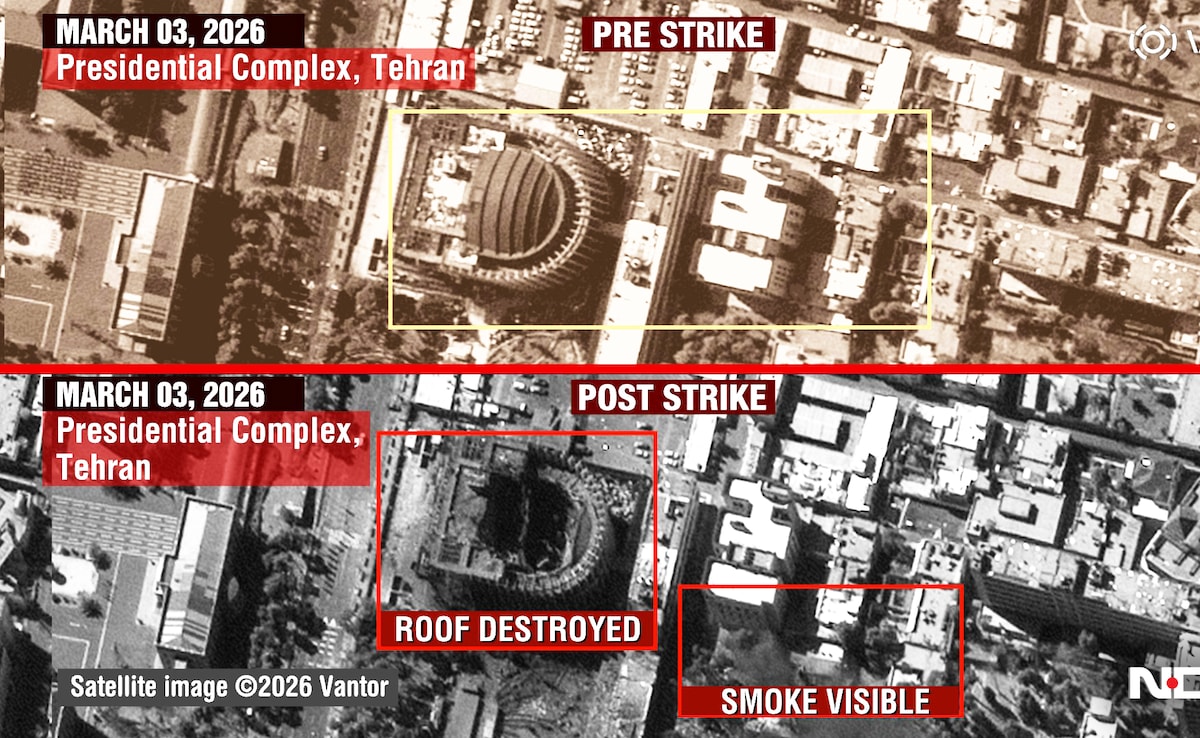
The era of plausible deniability in Middle Eastern shadow wars just hit a concrete wall. New high-resolution satellite imagery has surfaced, and the pictures don't lie. We aren't looking at "accidental fires" or "technical malfunctions" anymore. The latest overhead shots from Tehran show clear, precision damage to some of the most sensitive locations in the Islamic Republic. Specifically, the footprints of strikes are visible at the Islamic Revolutionary Guard Corps (IRGC) headquarters and within the perimeter of the Presidential Palace complex.
It's a massive security breach. If you're an official in Tehran right now, you aren't just worried about the missiles; you're worried about the fact that someone has the coordinates to your front door and the capability to hit it without breaking a sweat. This isn't just about broken glass and charred concrete. It's a psychological blow that says "we can see you, and we can touch you."
The IRGC Headquarters Architecture of Failure
The IRGC isn't just a military branch. It's the backbone of the entire Iranian state. When their main nerve center takes a hit, the ripple effects go through the entire command structure. Satellite analysts have identified specific scars on the rooftops of buildings within the headquarters' footprint.
The precision is what stands out. We aren't seeing massive, indiscriminate craters that leveled entire city blocks. Instead, we see surgical punctures. This suggests the use of high-precision munitions designed to penetrate hardened structures before detonating. It's the kind of work that requires real-time intelligence and incredibly sophisticated guidance systems.
You have to wonder how the air defense systems missed this. Tehran is supposed to be one of the most defended cities in the region, bristling with S-300 batteries and domestic variants like the Bavar-373. Yet, the imagery shows the strikes landed exactly where they were intended. It’s an embarrassing look for a regime that constantly touts its "impenetrable" shield.
Presidential Palace Perimeter Breached
The most jarring part of the new data involves the Presidential Palace. While the main residence remains standing, the surrounding support structures and security checkpoints show unmistakable signs of kinetic impact.
Think about the message that sends. The President is the face of the nation. Hitting the grounds of his office—even if the man himself isn't the target—is a classic "shot across the bow." It tells the leadership that nowhere is off-limits. Most analysts agree that these weren't attempts to "decapitate" the leadership, which would likely trigger a total regional war. Instead, these are calibrated warnings.
The damage at the palace grounds appears focused on administrative and security infrastructure. It disrupts the daily flow of the executive branch. It forces the leadership to scurry into bunkers, proving they can't even guarantee their own safety in the heart of the capital.
What the Rubble Tells Us About the Weapons Used
By looking at the "splash" patterns and the depth of the holes in the roofs, weapons experts can start to piece together what actually happened. Large ballistic missiles usually leave wide debris fields. What we see in these satellite photos is tighter.
- Punctured Roofs: Indicates "bunker-buster" style kinetic energy penetrators.
- Minimal Collateral: Nearby civilian housing appears untouched, which is a hallmark of Western or Israeli precision tech.
- Multiple Impact Points: Suggests a coordinated swarm or a multi-missile flight path designed to overwhelm local sensors.
It’s highly likely these were either long-range drones or low-flying cruise missiles. Cruise missiles are notoriously hard to track because they hug the terrain, staying under the radar "horizon" until it's too late for the defenders to react.
The Intelligence Gap and the Human Element
How do you get the exact coordinates for a specific wing of an IRGC office? You don't just guess by looking at Google Maps. This kind of targeting requires "human intelligence" (HUMINT). Someone on the ground likely verified these spots.
The satellite photos prove that Iran’s internal security has massive holes. It’s one thing to have a missile that can fly 1,000 miles. It’s another thing to know exactly which window to fly it through. The psychological impact on the IRGC rank-and-file is probably worse than the physical damage. They’re looking at these same photos and realizing that their secrets aren't secret.
Analyzing the Geopolitical Fallout
Tehran’s official state media has been remarkably quiet about the specifics. They usually claim they intercepted everything or that the damage was "minor." But when private satellite companies like Maxar or Planet Labs release these images to the public, the regime's narrative falls apart.
The international community sees this as a shift in the "rules of engagement." For years, the fight was in Syria, Lebanon, or at sea. Now, the fight is in downtown Tehran. This escalation changes the math for every other player in the region, from Riyadh to Tel Aviv to Washington.
If you're tracking this, keep your eyes on the "repaired" sections in future satellite passes. How fast they fix these buildings tells you a lot about their current resources and how much they want to hide the evidence. Don't expect a formal admission of the scale of the damage from the Iranian side. They’ll keep painting over the scars, but the overhead view doesn't blink.
The next logical step for anyone following this is to monitor the movement of mobile air defense units around Tehran. If they start shifting their S-300s from the borders to the city center, you know they're spooked. Watch the flight tracking data for government-linked aircraft too; if the leadership starts moving to secondary cities like Isfahan or Mashhad, the satellite photos did their job of intimidation.