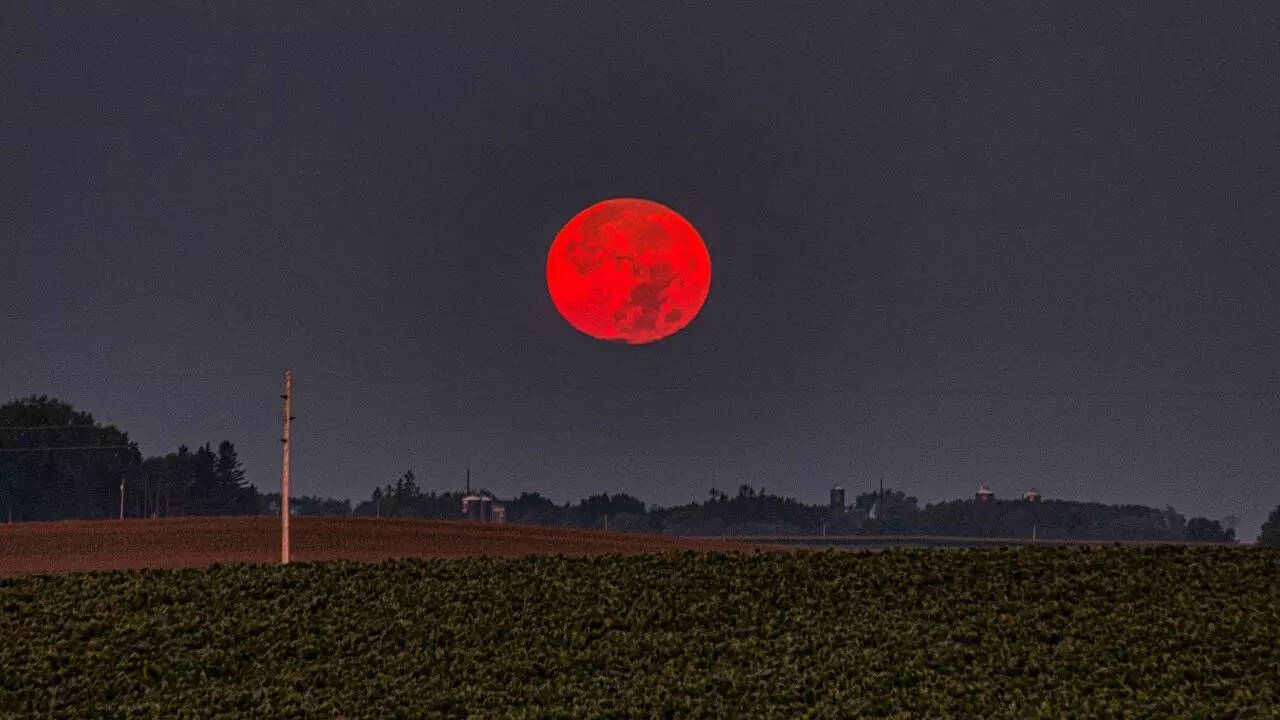
A total lunar eclipse does not hide the moon in darkness. Instead, it paints the lunar surface in a deep, often unsettling crimson. This phenomenon, colloquially dubbed the Blood Moon, is frequently dismissed by surface-level reporting as a simple trick of the light or a harmless celestial quirk. While it poses no physical threat to Earth, the mechanics behind this transformation reveal a complex interaction between planetary physics, atmospheric pollution, and the evolution of human vision. To understand why the moon turns red, you have to look not at the moon itself, but at the thin, fragile ring of air surrounding our own planet.
The Physics of the Global Sunset
The moon has no light of its own. It serves as a celestial mirror, reflecting the sun. During a total lunar eclipse, the Earth moves directly between the sun and the moon, casting a shadow known as the umbra. Logically, the moon should disappear. It should be a black void against the stars. It doesn't vanish because the Earth's atmosphere acts as a massive, spherical lens.
As sunlight hits the edge of the Earth, it enters the dense gases of our atmosphere. This transition causes the light to bend, a process called refraction. Think of it as a global prism. While the Earth’s bulk blocks the direct path of the sun’s rays, the atmosphere catches the light at the edges and redirects it into the shadow.
But not all light makes it through.
The atmosphere is a filter. It is composed of nitrogen, oxygen, water vapor, and various particulates. Sunlight contains every color of the visible spectrum. Short-wavelength light—the blues and violets—scatters easily when it hits gas molecules. This is Rayleigh scattering, the same reason the sky looks blue during the day. By the time sunlight has traveled through the long, horizontal stretch of atmosphere required to reach the moon during an eclipse, the blues and greens have been stripped away. Only the long-wavelength reds and oranges survive the journey.
In essence, a Blood Moon is the projection of every sunrise and sunset on Earth occurring at that exact moment, cast onto the lunar surface.
Volcanic Interference and the Aerosol Factor
Not every Blood Moon looks the same. Some appear as a bright, copper orange, while others are so dark they are nearly invisible to the naked eye. This variation is the result of what we are currently doing to our atmosphere.
The Danjon Scale is the standard tool used by astronomers to measure the appearance and luminosity of the moon during a total eclipse. It ranges from $L=0$ (very dark, almost invisible) to $L=4$ (bright copper-red or orange). The primary driver of where an eclipse falls on this scale is the presence of aerosols in the stratosphere.
The Impact of Geologic Events
When a major volcano erupts, it ejects massive amounts of sulfur dioxide and ash into the upper atmosphere. These particles don't wash away with the next rain. They linger for years. During a lunar eclipse, these high-altitude particles block even the red wavelengths of light.
- 1991 Mount Pinatubo Eruption: Following this massive event, subsequent lunar eclipses were famously dark. The moon didn't turn red; it turned a bruised, charcoal grey.
- Wildfire Seasonality: In recent years, massive forest fires in the Amazon, Australia, and North America have introduced significant carbon and ash into the lower atmosphere. While these don't reach the stratosphere as effectively as volcanic plumes, they still influence the "clarity" of the red light being projected.
If you see a particularly dark Blood Moon, it is a direct diagnostic report on the transparency of the Earth’s atmosphere. It is a visual confirmation of how much debris—natural or man-made—is currently suspended above our heads.
The Biological Bias of Red
Why does the color red provoke such a visceral reaction? From an evolutionary standpoint, the human eye is finely tuned to detect red against a green or blue background. This was originally a survival mechanism for spotting ripe fruit or the blood of prey.
When the moon turns red, it triggers an ancient psychological response. Historically, cultures across the globe interpreted the Blood Moon as an omen of war or the death of kings. The Incas believed a jaguar was attacking the moon; the Mesopotamians saw it as a direct assault on their monarch. While we now understand the orbital mechanics, the "danger" signal in the human brain remains.
The contrast ratio during a Blood Moon is also an optical challenge. Because the moon is significantly dimmer during an eclipse than when it is full, your pupils dilate. This allows more ambient light in, but it also makes the saturated red hue appear more vivid against the darkness of space. It is a high-contrast environment that the human visual cortex struggles to process comfortably, leading to the "eerie" quality often described by observers.
Mechanical Precision and the Saros Cycle
Eclipses do not happen at random. They are the result of the Saros Cycle, a period of approximately 18 years, 11 days, and 8 hours. This cycle was discovered by ancient Chaldean astronomers, proving that even without modern telemetric data, the predictability of these events was absolute.
For a Blood Moon to occur, the alignment must be perfect. The moon’s orbit is tilted at about $5^{\circ}$ relative to the Earth’s orbit around the sun. Most of the time, the full moon passes above or below the Earth's shadow. A total eclipse only happens when the moon crosses the ecliptic plane—the imaginary line of Earth’s orbit—at the same time it is in the "full" phase.
Modern Observational Tools
Today, we don't just look at the moon with our eyes. We use it as a laboratory.
- Spectroscopy: Scientists analyze the light reflecting off the "red" moon to study the composition of Earth’s own atmosphere from a distance. It’s a way to see our planet as an exoplanet.
- LURE (Lunar Laser Ranging Experiment): During an eclipse, the sudden drop in temperature on the lunar surface (dropping hundreds of degrees in an hour) causes the lunar rocks to contract. Scientists use laser reflectors left by Apollo missions to measure the moon's distance with millimeter precision, even as the thermal shock ripples across the lunar crust.
The drop in temperature is staggering. When the Earth's shadow sweeps across the moon, the surface temperature can plummet from $130^{\circ}\text{C}$ to $-100^{\circ}\text{C}$ in a matter of minutes. This creates a "thermal moonquake," a physical shivering of the lunar surface that we can detect from Earth.
The Illusion of Proximity
One of the most common misconceptions is that the Blood Moon is "larger" than a normal moon. This is the Moon Illusion. When the moon is near the horizon during an eclipse, your brain compares it to distant trees, buildings, or mountains. This comparison forces the brain to perceive the moon as massive. In reality, the angular size of the moon in the sky remains roughly the same—about the size of a fingernail held at arm's length.
If the eclipse occurs when the moon is at perigee (its closest point to Earth), it is technically a "Super Blood Moon." The diameter increases by about 14%, and it appears roughly 30% brighter than a perigee moon. However, without a side-by-side comparison, the human eye is notoriously bad at judging this difference. The "bigness" is almost entirely a mental construct.
Operational Realities for Photographers
Capturing the Blood Moon is a lesson in the limitations of digital sensors. Because the moon is much darker than a standard full moon, the "Looney 11" rule of photography—which suggests an aperture of $f/11$ and a shutter speed matching the ISO—fails completely.
During the totality phase, the moon is nearly 10,000 times dimmer than a normal full moon. This requires long exposures. However, the moon is moving. If your exposure exceeds one or two seconds, the moon will appear blurry due to its orbital velocity. Photographers are forced to use high ISO settings and wide apertures, introducing noise into the image. The deep red color is also notoriously difficult for digital sensors to render accurately, often resulting in "blown out" red channels that lose all detail of the lunar craters.
Success in documenting this event requires an equatorial mount—a motorized tripod that compensates for the Earth’s rotation. It is a reminder that even in our high-tech era, the fundamental motions of the solar system dictate the terms of our technology.
The Atmospheric Mirror
The Blood Moon is not a sign of the end of the world. It is a sign that our planet has an atmosphere. If we were on the moon looking back at Earth during an eclipse, we would see a brilliant, fiery red ring around the dark disk of our planet. We would be looking at the collective light of every sunset on Earth, focused into a single beam.
The next time the sky darkens and the moon takes on a rusted, crimson hue, remember that you are looking at a real-time data visualization of Earth’s air quality. The darker the red, the more cluttered our stratosphere. The brighter the orange, the cleaner the path. It is a celestial status bar for the health of our planet.
To track the next event, consult the NASA eclipse tables and look for the Danjon Scale predictions. Setting up a telescope or a pair of high-powered binoculars will reveal the "Turquoise Fringe"—a tiny sliver of blue light on the moon's edge caused by the Earth’s ozone layer filtering light differently than the rest of the atmosphere.
Watch for that blue sliver. It is the only part of the eclipse that isn't dominated by the red scattering of our lower air.


