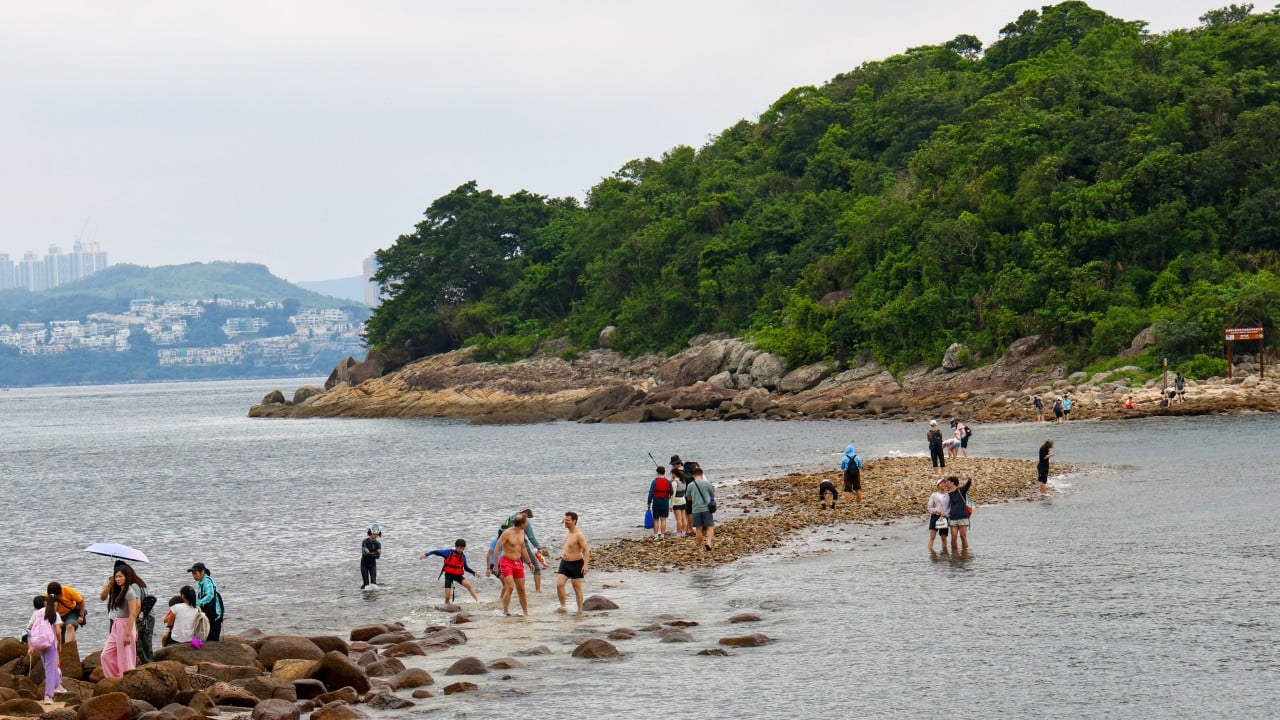
The issuance of 300 verbal warnings to visitors at Sharp Island during the Labour Day holiday reveals a systemic failure in current visitor management protocols. This volume of intervention suggests that the existing communication infrastructure is insufficient to regulate human behavior in ecologically sensitive zones. When 300 distinct interactions are required to enforce basic compliance, the "friction" between tourist intent and conservation requirements has reached a critical threshold.
The Logistics of Compliance Failure
The primary bottleneck in protecting Sharp Island—a key site within the Hong Kong UNESCO Global Geopark—is the misalignment between visitor expectations and the physical reality of the tombolo. The tombolo, a natural sandbar connecting the main island to Kiu Tau, is only accessible during low tide.
Compliance issues generally fall into two categories: safety-related (trapping due to rising tides) and conservation-related (unauthorized removal of "pineapple bun" rocks). The high frequency of warnings indicates that the current deterrents are perceived as low-stakes. A verbal warning carries zero economic or legal cost for the visitor, effectively externalizing the cost of enforcement onto the Agriculture, Fisheries and Conservation Department (AFCD).
The Three Pillars of Regulatory Inefficiency
- Information Asymmetry: Visitors arrive with incomplete data regarding tidal windows. While tidal charts are publicly available, the translation of this data into real-time decision-making on-site is inconsistent.
- Resource Scarcity: Sharp Island lacks the physical barriers or permanent staffing required for hard enforcement. Relying on roving patrols creates a "whack-a-mole" enforcement cycle where violations occur the moment the patrol moves to a different section of the coast.
- Incentive Misalignment: The primary driver for visitors is social media documentation. The aesthetic value of the "pineapple bun" rocks or the tombolo walk outweighs the abstract concept of geological preservation in the mind of a transient visitor.
The Cost Function of Verbal Enforcement
Verbal warnings are the least efficient form of behavioral modification. Each warning requires a one-on-one human interaction, consuming approximately three to five minutes of an officer's time. At a scale of 300 warnings, this represents 15 to 25 man-hours of direct confrontation, excluding transit time and administrative logging.
The AFCD’s reliance on this method signals a lack of scalable technology. In a high-traffic scenario, the marginal cost of the 300th warning is identical to the first, meaning the system does not benefit from economies of scale. To reduce this cost, the department must shift from manual intervention to environmental design and automated signaling.
Structural Bottlenecks in Geopark Preservation
The "pineapple bun" rocks, quartz monzonite boulders weathered into distinctive patterns, are non-renewable geological assets. The mechanism of degradation here is cumulative. While a single visitor standing on a rock or moving a small stone seems negligible, the aggregate pressure of thousands of visitors during a public holiday leads to accelerated erosion and displacement.
The Feedback Loop of Crowding
Crowding creates a psychological phenomenon known as "social proofing" of bad behavior. When a visitor observes dozens of others ignoring signage or walking on restricted areas without immediate consequence, the perceived risk of a verbal warning diminishes. This creates a feedback loop where the volume of visitors exceeds the department's ability to maintain the "sanctity" of the rules.
The Tide as a Hard Constraint
The tombolo's accessibility is governed by the lunar cycle, typically requiring a tide level below 1.4 meters for safe passage. The 300 warnings issued likely clustered around the "shoulder" periods—the 30 minutes before and after the tide makes the path impassable.
During these windows, visitor density spikes. The AFCD faces a logistical paradox: they must clear the path for safety, but the act of clearing the path requires officers to enter the same high-density, high-risk zone. The current strategy of "warning" assumes that visitors have the situational awareness to calculate their return time, which historical data suggests is a false premise.
Behavioral Engineering vs. Manual Patrols
To move beyond the 300-warning threshold, the management of Sharp Island requires a shift from reactive policing to proactive behavioral engineering.
Implementation of Visual Anchors
Human behavior in outdoor spaces is heavily influenced by "nudges." The current signage at Sharp Island is often overlooked because it is static and competes with a high-stimulus environment.
- Dynamic Signaling: Installing solar-powered LED beacons at the start of the tombolo that transition from green to red based on real-time tidal sensors would provide a non-verbal, high-authority signal.
- Physical Zoning: Using naturalistic barriers (e.g., rope lines or specifically placed local timber) to define the "path of least resistance" away from fragile rock formations.
The Digital Perimeter
A significant portion of the enforcement burden could be mitigated before the visitor even boards a sampan from Sai Kung.
- Vessel-Point Information: Mandating that commercial ferry and sampan operators provide a standardized "Current Risk Level" briefing to passengers. This pushes the enforcement responsibility to the point of sale.
- Geofenced Notifications: Utilizing cellular data to push safety alerts to devices entering the Sharp Island vicinity. This reduces the need for physical proximity between officers and visitors.
Quantifying the Geopark’s Carrying Capacity
The issuance of 300 warnings is a proxy measurement for a breached carrying capacity. Carrying capacity is not just a measure of physical space, but a measure of "management capacity." If the AFCD can only effectively monitor 500 visitors at a time but 3,000 arrive, the system is in a state of managed failure.
The "300 warnings" figure should be viewed as a KPI for the inadequacy of the current visitor cap. If the goal is zero-impact conservation, the number of warnings should trend toward zero, even as visitor numbers stay constant. The fact that warnings remain high indicates that the "message" is not being integrated into the visitor's mental model of the island.
Strategic Shift from Warning to Intervention
The AFCD must acknowledge that verbal warnings are a symptomatic treatment for a structural problem. The objective should be the "De-Skilling" of compliance. Compliance should not require a visitor to understand tidal charts or geological history; it should be the easiest and most obvious path available to them.
The geological integrity of Sharp Island is currently protected by the physical presence of humans in uniforms. This is a fragile and expensive defense. A more robust model utilizes the following logic:
- Pre-arrival friction: Increasing the difficulty of visiting during high-risk periods through permit systems or limited ferry quotas.
- Environmental cues: Designing the landscape so that the most "Instagrammable" spots are also the most durable.
- Escalated deterrence: Moving from 300 verbal warnings to 30 targeted fines. The "broken windows" theory suggests that a small number of high-visibility penalties is more effective at shaping group behavior than a large number of invisible warnings.
The management of Sharp Island needs to move toward a "Hard Infrastructure" approach. This involves the installation of permanent, automated monitoring stations and physical pathways that dictate movement without the need for constant human supervision. Until the AFCD transitions from a patrol-based model to a design-based model, the Labour Day statistics will continue to reflect a high-stress, low-efficiency operation. The goal for the next peak period should not be more efficient warnings, but the elimination of the conditions that make them necessary.