The coffee in the basement of a nondiscriminatory suburban church usually tastes like burnt paper and patience. But for the man sitting at the end of the scarred oak table, the caffeine wasn't the point. He is a pastor—let’s call him Elias—who has spent thirty years guiding his flock through the mundane tragedies of life: layoffs, cancer diagnoses, and wayward teenagers. He knows how to speak to the soul when the world feels heavy.
But Elias recently received a briefing that his seminary training never covered. It wasn’t about a budget shortfall or a new community outreach program. It was about what is happening in the skies, and more importantly, what is about to happen in the minds of his congregation.
The message was clear: Prepare your people. The "Others" are not just a Hollywood trope anymore. They are a looming reality that could, within our lifetime, shift from whispered theories to a verified presence.
The Cracks in the Stained Glass
For decades, the topic of Unidentified Anomalous Phenomena (UAP) lived in the fringes. It was the domain of the tinfoil-hatted and the late-night radio enthusiasts. That changed when the United States government began admitting, with uncharacteristic bluntness, that things are flying in our airspace that we cannot identify, track, or replicate.
When the Pentagon stops laughing and starts documenting, the ripples travel far beyond Washington. They land right in the middle of the Sunday morning service.
Rev. Christopher Benek, a prominent voice at the intersection of theology and technology, has been vocal about this shift. He isn't talking about little green men in flying saucers. He is talking about a fundamental ontological shock. If the universe is teeming with intelligence that is not human, what does that do to the story we’ve told ourselves for two millennia?
Consider the weight on a leader like Elias. His role is to provide a "canopy of meaning." If the canopy is suddenly ripped away to reveal a sky full of strangers, the instinct for many is not curiosity. It is terror.
The Silence of the Shepherds
There is a specific kind of silence that falls over a room when you mention "non-human intelligence" to a group of traditional believers. It isn't always skepticism. Often, it is the sound of an internal filing system crashing.
The briefings currently circulating among religious leaders aren't just about disclosure; they are about psychological first aid. They are a recognition that the religious community represents a massive portion of the global population that will look to their faith for a framework when the news breaks. If the church remains silent, people will find their answers in darker corners of the internet.
Elias remembers a woman in his parish, a grandmother who prays the rosary every morning. To her, the universe is orderly. God is at the top, humans are in the middle, and the rest of creation follows. If you introduce a third party—an entity with technology that looks like magic and an origin that defies our geography—you aren't just adding a new fact to her life. You are rewriting her DNA.
The risk is a phenomenon known as "ontological shock." It is the paralyzing realization that your map of reality is fundamentally wrong.
Faith as an Anchor or a Cage
Historically, religion hasn't always handled scientific shifts with grace. We remember Galileo. We remember the courtroom battles over evolution. But there is a quieter history of adaptation that often goes unnoticed.
When we discovered the world wasn't flat, the faith survived. When we realized the Earth wasn't the center of the solar system, the faith survived. The current briefing of pastors suggests that we are at another "Copernican Moment."
The challenge for the modern pastor is to move away from a "human-only" theology toward something more expansive. It requires a humility that many institutions find uncomfortable. It means admitting that the Creator might have a much larger portfolio than we previously dared to imagine.
But why now?
The urgency behind these briefings suggests a narrowing window. It hints at the idea that disclosure isn't a single event, but a slow leak that is about to become a flood. If the government is telling religious leaders to "brace" their communities, they are acknowledging that the truth is no longer a secret they can contain.
The Invisible Stakes of the Unknown
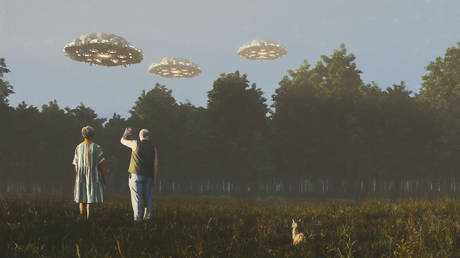
Imagine a Sunday in the near future. The President has made the announcement. The data is indisputable. The "Others" are real.
Elias stands behind his pulpit. He looks out at a sea of faces—young parents holding their toddlers a little tighter, elderly men staring at the floor, teenagers buzzing with a mix of excitement and existential dread.
The questions won't be about propulsion systems or light years. They will be deeply, achingly human.
- Are we still special?
- Do they have a soul?
- Why did God wait so long to tell us?
If the pastor’s only answer is a shrug, the community fractures. This is the "human element" that the technical reports miss. Society is built on shared stories. When the story changes, the society can buckle. The briefing isn't about UFOs; it's about the stability of the human spirit.
A New Kind of Communion
There is a beauty in the unknown, though it is often masked by fear. Some theologians argue that the discovery of non-human intelligence could actually be the greatest catalyst for human unity in history.
In the face of something truly "Other," our internal divisions—race, politics, denomination—begin to look vanishingly small. The borders we’ve bled over for centuries start to look like chalk lines in a rainstorm.
Elias finds himself reading the ancient texts with new eyes. He looks at the descriptions of "messengers" and "wheels within wheels" and wonders if our ancestors were simply trying to describe the indescribable with the vocabulary they had. He realizes that "supernatural" is often just a word we use for "nature we don't understand yet."
The work of preparing a congregation isn't about having all the answers. It’s about building a container strong enough to hold the questions. It’s about teaching people how to stand in the middle of a mystery without losing their footing.
The Weight of the Secret
There is a heavy irony in the fact that the government—an entity usually synonymous with bureaucracy and obfuscation—is now the one urging spiritual transparency.
But perhaps they realize they lack the tools for the fallout. A general can explain a threat. A scientist can explain a signal. But only a community leader can explain what it means to be human in a universe that just got much, much bigger.
The briefings continue. The quiet meetings in church basements and rectory offices are happening more frequently. The pastors are learning to look up.
Elias walked out of his meeting and stood in the parking lot for a long time. The sun was setting, casting long, purple shadows across the asphalt. He looked at the sky, really looked at it, for the first time in years. He felt small. He felt vulnerable.
But he also felt a strange, electric sense of wonder.
He realized that his job wasn't to protect his people from the truth. It was to walk them through it. The world is changing, and the sanctuary doors need to be wide enough to let the whole universe in.
The paper cup of cold coffee sat forgotten on the hood of his car. Above him, the first few stars began to blink into existence, silent and patient, waiting for us to finally see them for what they really are.
The sermon for next Sunday would have to change.
Everything would have to change.