The Metropolitan Police spent £4.5 million in a single day to ensure two heavily polarized groups of protesters did not violently clash in central London. By deploying 4,000 officers, armored vehicles, drones, and live facial-recognition technology, the operation successfully maintained physical separation between Tommy Robinson’s "Unite the Kingdom" march and a concurrent Nakba Day counter-demonstration. However, this massive financial layout highlights a broader, unsustainable trend. British taxpayers are funding an increasingly expensive, high-tech containment strategy for deep-seated political and cultural animosities, effectively treating the symptoms of societal division rather than the cause.
The raw math of the operation reflects a law enforcement apparatus pushed to its logistical limits.
The High Cost of Tactical Containment
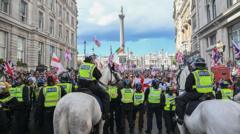
A single afternoon of public order policing in the capital now carries the price tag of a major municipal infrastructure project. The £4.5 million bill incurred by the Met was not spent on passive observation. It funded a highly coordinated, multi-layered containment wall designed to keep up to 50,000 nationalist demonstrators separate from roughly 30,000 pro-Palestinian and anti-fascist protesters.
To achieve this, the Met implemented strict route conditions under public order legislation. Robinson's faction was channeled from Holborn toward Parliament Square, while the Nakba Day rally was restricted to a completely separate corridor through west London ending near Piccadilly.
The strategy was simple. Absolute geographic isolation.
[Holborn -> Parliament Square]       <-- Heavily Policed Buffer -->       [West London -> Piccadilly]
    (Unite the Kingdom March)                                                 (Nakba Day / Counter-Demo)
Maintaining this buffer required a massive diversion of human capital. Four thousand officers were pulled from regular duties, meaning neighborhood policing across London's boroughs was scaled back to skeleton crews. These officers were backed by mounted units, canine teams, and a continuous aerial presence of helicopters and drones.
When a city must spend millions simply to stop its own residents from tearing each other apart on a Saturday afternoon, the traditional model of policing by consent is no longer functioning. It has morphed into an expensive exercise in conflict management.
Automation and Accountability in the Crowd
This specific operation marked a quiet but significant shift in how public assemblies are policed in the United Kingdom. For the first time, the Met utilized live facial recognition (LFR) vans stationed at key transport hubs feeding into the capital.
The technology scans faces in real-time, matching them against a bespoke database of wanted individuals. The justification was clear. The police wanted to intercept known agitators before they could enter the crowd. By early afternoon, the system contributed to several of the day's 31 total arrests, including two men wanted for a previous incident of grievous bodily harm in Birmingham.
But the introduction of LFR into political protests raises serious civil liberties concerns. It transforms a public space into a digital dragnet, creating a chilling effect on legitimate, peaceful protest.
In another unprecedented legal maneuver, the Met made event organizers legally responsible for ensuring that invited speakers did not violate hate speech laws. This shifts the burden of speech monitoring from the state to individual citizens.
It is a clever bureaucratic trick. By threatening organizers with prosecution if a speaker crosses the line, the police force the groups to self-censor.
While this may reduce the immediate workload for police lawyers, it sets a murky precedent. It forces amateur political organizers to act as arbiters of complex public order and hate speech legislation, a role they are fundamentally unequipped to handle.
The Internationalization of Domestic Unrest
The underlying drivers of these protests are no longer purely domestic. They are fueled by international networks and digital infrastructure that operate far beyond the jurisdiction of Scotland Yard.
Tommy Robinson’s movement has built deep financial and ideological ties with global right-wing figures. The rally featured a video address from X owner Elon Musk, demonstrating how American big-tech platforms directly amplify localized European unrest.
The Home Office attempted to counter this international influence by blocking 11 foreign far-right agitators from entering the UK ahead of the march, including US-based political figure Valentina Gomez. Yet, stopping bodies at Heathrow does little to stop the flow of capital and digital reach that makes these rallies possible.
On the other side of the barricades, the Nakba Day demonstration combined with the Stand Up to Racism group, linking domestic anti-fascist movements with broader geopolitical grievances regarding the Middle East.
The result is a dangerous fusion. Local anxieties about immigration, housing, and national identity are being supercharged by global algorithmic algorithms and geopolitical conflicts.
The Reality of the Zero Tolerance Guarantee
Prime Minister Keir Starmer took to the airwaves ahead of the weekend to promise that anyone seeking to "wreak havoc" would face the "full force of the law." It is the kind of tough rhetoric politicians favor when they have no control over the underlying cultural currents.
The reality on the ground is far more nuanced than a simple battle between the state and "violent thugs."
The crowds that descended on central London were diverse in their motivations. Alongside the predictable element of football hooligans and seasoned agitators were thousands of ordinary citizens. Interviews with attendees revealed a complex mix of anxieties. A veteran lamenting the state of the country. A woman in a wheelchair complaining about NHS waiting times. Christians carrying wooden crosses who felt their culture was being erased. Draped among them were Union Jacks, St. George’s Crosses, and occasionally, Israeli flags.
Dismissing these tens of thousands of people as mere racists ignores the genuine socio-economic rot driving their radicalization. When public services crumble and institutional trust vanishes, people look for scapegoats.
The state can spend £4.5 million every weekend to keep these factions apart. It can deploy drones, arrest agitators, and filter crowds through facial recognition software. But it cannot police its way out of a cultural cold war. The physical barriers erected by the Met managed to prevent bloodshed in Parliament Square, but the invisible walls dividing the country remain completely untouched.