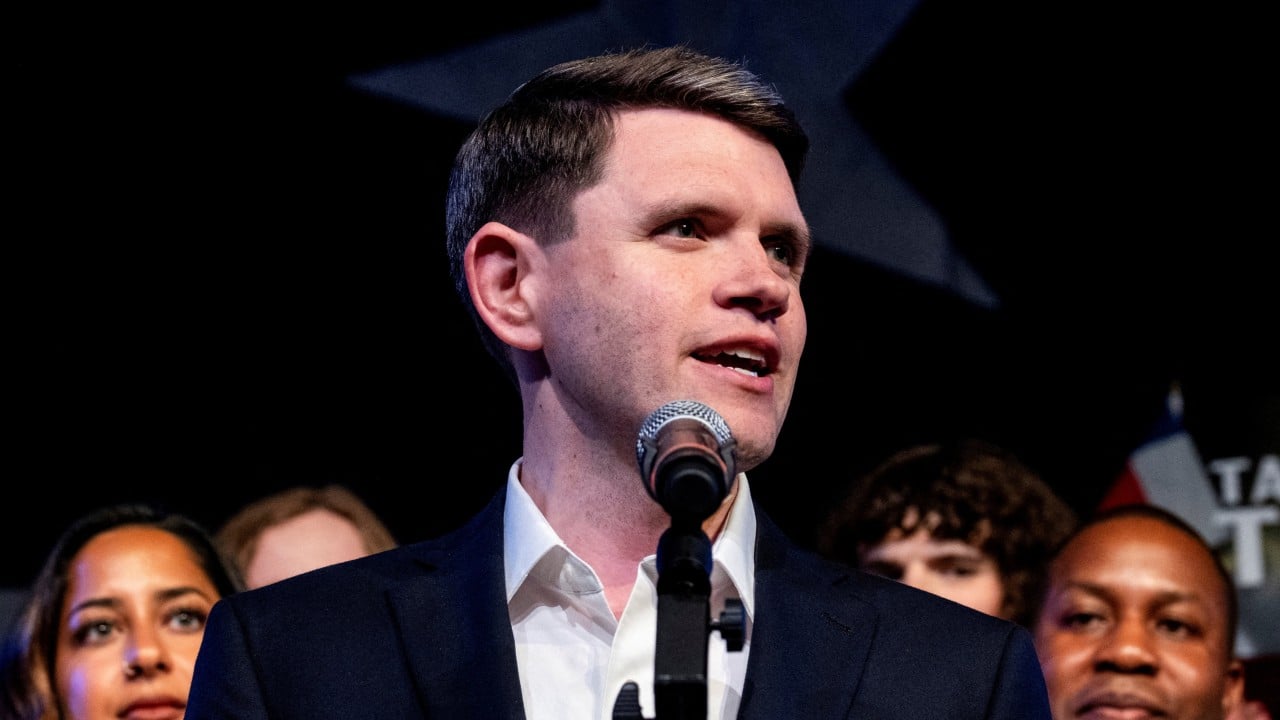
The air inside a Texas middle school cafeteria in mid-August has a specific, heavy scent. It is a mixture of floor wax, industrial-grade cooling fans struggling against a 104-degree afternoon, and the palpable anxiety of three hundred parents wondering if their local public school will survive the next budget cycle. In the center of this sweltering room stands a man who looks less like a political savior and more like the guy you’d trust to return your lost wallet.
James Talarico doesn’t scream. He doesn’t use the jagged, caffeinated rhetoric that has become the oxygen of modern cable news. Instead, he speaks with the measured cadence of a seminarian—which he is—and the patient clarity of a former middle school teacher—which he also is. But as the 2026 midterms loom, this soft-spoken Representative from Austin has become the vessel for a very loud hope.
Democrats in Texas have spent thirty years wandering in a desert of near-misses and heartbreaking "what-ifs." They have tried the celebrities. They have tried the icons of the resistance. Now, they are looking at a thirty-five-year-old in a crisp suit who talks about the "Social Gospel" and wonder if the secret to winning the most stubborn red state in the union isn’t more fire, but a different kind of light.
The Geography of a Soul
To understand why Talarico matters, you have to understand the ground he walks on. Texas is not a monolith; it is a collection of empires. You have the gleaming tech hubs of Austin, the sprawling international energy corridors of Houston, and the deep, dusty traditions of the Panhandle. For decades, the political divide has been drawn in permanent marker: urban versus rural, secular versus sacred.
Talarico is attempting to smudge those lines.
He grew up in Round Rock, a place that embodies the suburban shift defining American politics. It is a landscape of strip malls and high school football stadiums where the "Texas Miracle" of economic growth meets the "Texas Reality" of crumbling infrastructure. When Talarico talks about his time teaching at West Ridge Middle School, he isn't just checking a biographical box. He is describing the moment he realized that the laws written in the state capitol have fingerprints.
He saw students who couldn't focus because they hadn't eaten. He saw teachers spending twenty percent of their meager paychecks on basic supplies. He saw the "invisible stakes" of policy—the way a line item in a 500-page budget translates directly into whether a twelve-year-old feels like their state cares if they succeed or fail.
The Radical Act of Sanity
Politics in 2026 feels like a permanent scream. We are trapped in a cycle where the most extreme voices are amplified by algorithms designed to keep us angry enough to keep scrolling. In this environment, being reasonable is a radical act.
Talarico’s primary weapon is a concept that feels almost fossilized in the current era: the common good. While his colleagues on both sides of the aisle often retreat into partisan bunkers, Talarico has made a name for himself by walking into the "lion’s den"—appearing on conservative talk shows and speaking at evangelical churches—to talk about things like a livable wage and healthcare not as "progressive wish lists," but as moral imperatives.
He often cites the biblical mandate to care for "the least of these." For a Democratic party that has often struggled to speak the language of faith without sounding performative, Talarico is the real deal. He is a student at Austin Presbyterian Theological Seminary. When he quotes Scripture, it doesn’t sound like a focus-grouped talking point. It sounds like a conviction.
This is the bridge. There is a specific type of Texas voter—the suburban mother, the moderate church-goer, the small business owner—who might be tired of the culture wars but is equally wary of what they perceive as "coastal liberalism." Talarico offers them a third door. He speaks to their values without insulting their intelligence. He frames the expansion of Medicaid not as a government takeover, but as a neighborly duty to ensure no family is bankrupted by a cancer diagnosis.
The Mechanics of the Hope
The math for 2026 is brutal. Midterms are notoriously difficult for the party that doesn't hold the White House, and in Texas, the structural advantages for the GOP are a formidable wall of redistricting and deep-pocketed donors. But look closer at the 2024 results. The margins in the "Texas Triangle"—the area between Dallas-Fort Worth, Houston, and San Antonio—are narrowing.
The strategy Talarico represents is one of "Deep Organizing." It’s the belief that you don't win Texas by moving to the center; you win by moving to the human.
Consider a hypothetical voter: let’s call her Elena. She lives in a suburb outside of Fort Worth. She voted for Republicans for twenty years because she valued "family values" and fiscal responsibility. But lately, she sees her local school district losing its best teachers to neighboring states that pay better. She sees her property taxes skyrocketing while the state sits on a multi-billion dollar surplus. She hears the rhetoric coming from the state house about "banning books" and "policing bathrooms" and she wonders when the people in charge started caring more about headlines than her daughter’s education.
When Talarico stands on a stage and says, "A budget is a moral document," he is speaking directly to Elena. He is validating her feeling that something is fundamentally broken. He isn't calling her a "basket of deplorables" for her past votes; he is inviting her to build a future where her daughter’s school is actually funded.
The Risk of the Middle
There is, of course, a danger in being the "face of hope." Hope is fragile. It is easily crushed by the machinery of a multi-million dollar attack ad campaign. The knives are already out for Talarico. He has been labeled a "socialist in sheep’s clothing" by opponents who fear his ability to communicate across the aisle.
Within his own party, there are those who worry his emphasis on faith and moderation might alienate the progressive base that demands fire and brimstone in the face of conservative policy. They ask: Can you really "de-escalate" your way to a majority? Can you win a street fight by quoting the Beatitudes?
Talarico’s answer is usually a quiet, steady gaze. He points to his legislative record—successes in capping the price of insulin and increasing teacher incentives. These aren't "grand slams" in the ideological war, but they are "base hits" that change lives. To Talarico, the "invisible stakes" are the only ones that matter. If a grandmother in Waco can afford her medication because of a bill he co-sponsored with a Republican, the partisan label on the victory is irrelevant.
The Long Walk to November
As the sun begins to set over the Texas Hill Country, casting long, purple shadows across the scrub oak and limestone, the magnitude of the task becomes clear. To turn Texas, or even to make it truly competitive in 2026, requires more than one man. It requires a movement that looks like the state itself—diverse, stubborn, and deeply pragmatic.
But every movement needs a protagonist. It needs someone who can stand in the heat of a middle school cafeteria and make people believe that their neighbor isn't their enemy. It needs someone who can talk about policy as if it were a prayer.
Talarico isn't a silver bullet. He’s a seed.
Whether he thrives depends on whether the soil of Texas is ready for a different kind of harvest. As he shakes the last hand and walks toward his car, he looks tired. Anyone would be. He is carrying the weight of a million "what-ifs" on his shoulders. But there is a lightness to his step that suggests he knows something the pundits don't.
He knows that while anger is a powerful fuel, it burns out quickly. Faith, the kind that shows up on a Tuesday morning to teach long division or stays late to argue over a school board budget, is the kind that lasts.
The 2026 midterms won't just be about who wins a seat in Austin or Washington. They will be a test of a very specific hypothesis: that in an age of noise, the person who speaks the truth in a whisper might be the only one who can actually be heard.
There is a quietness in the Texas air tonight. It isn't the silence of apathy. It’s the silence of a long breath being taken before the real work begins.
Wait. Watch. Listen. The story is just starting to get interesting.