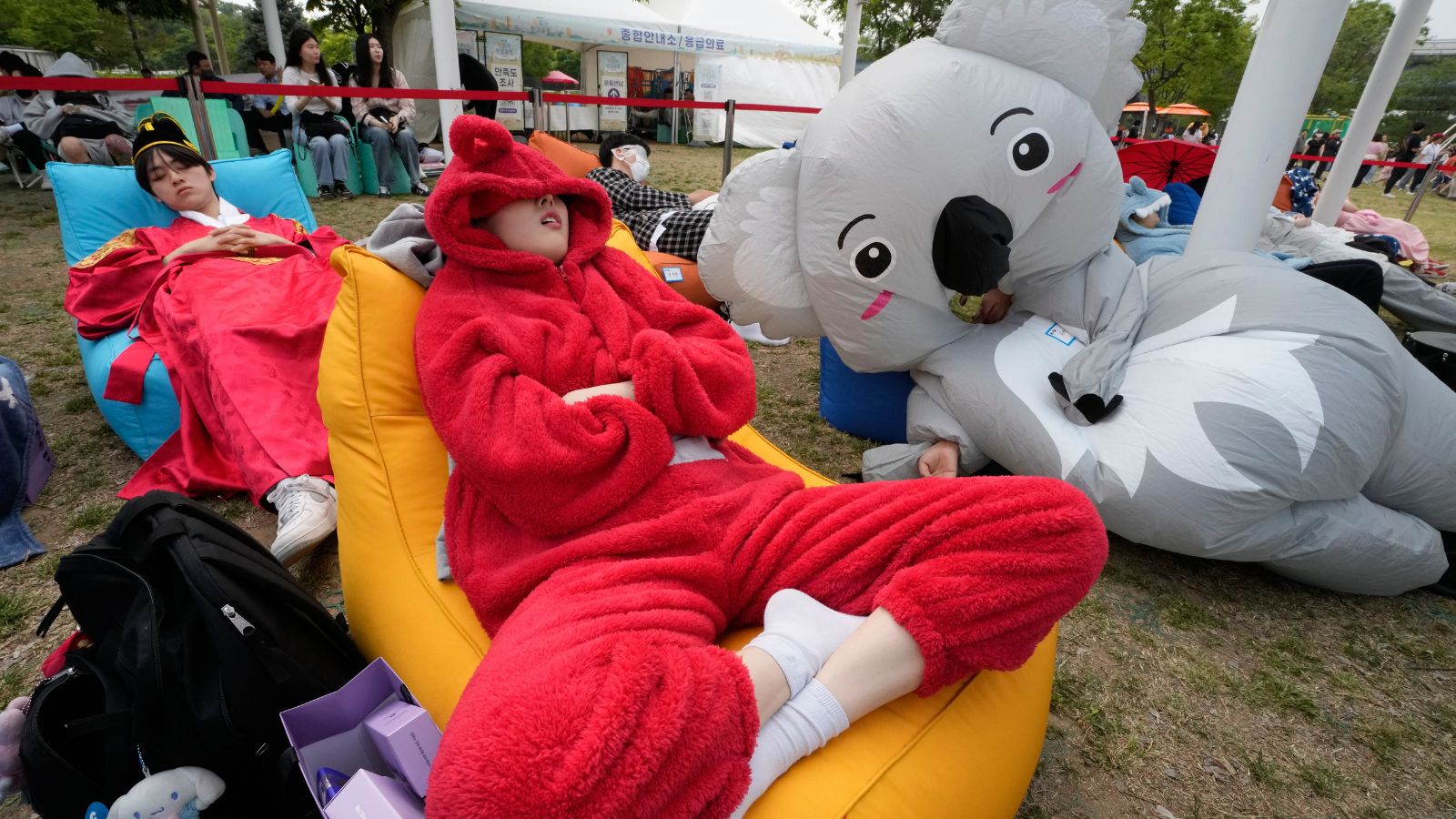
South Korea just hosted a "nap contest" in the middle of Seoul. Hundreds of people gathered to see who could sleep the best in public. The media is framing this as a whimsical response to a national "sleep crisis." They’re calling it a "power nap" revolution.
They are lying to you.
The power nap is not a wellness tool. It is a corporate sedative. When a society starts gamifying sleep deprivation, we aren’t witnessing a cultural breakthrough; we are witnessing a collective surrender. We have reached a point where we treat the basic biological necessity of sleep as a "hack" to be squeezed into a fifteen-minute window between spreadsheets.
Stop calling it a power nap. Start calling it what it is: a tactical retreat from a failing system.
The Myth of the 20-Minute Miracle
The prevailing wisdom—the "lazy consensus" pushed by HR departments and wellness influencers—is that a 20-minute nap is the ultimate reset button. They cite the famous 1995 NASA study where pilots saw a 34% increase in performance after a short nap.
But here is what the "nap-fluencers" won't tell you: those pilots were in a controlled, high-stakes environment where their baseline sleep was already being managed by experts. They weren't napping because it’s "optimal." They were napping because their jobs were literally matters of life and death and they had no other choice.
For the average office worker, the 20-minute power nap is a bandage on a gunshot wound.
Why the Math Doesn't Work
Sleep is governed by two primary forces: Homeostatic Sleep Pressure and the Circadian Rhythm.
- Sleep Pressure: This is the buildup of adenosine in your brain while you are awake.
- Circadian Rhythm: This is your internal 24-hour clock.
When you take a power nap at 2:00 PM, you are clearing out just enough adenosine to feel "fine" for two hours, but you are also sabotaging your ability to fall asleep at 10:00 PM. You are effectively borrowing alertness from your future self at a predatory interest rate. You feel better at 4:00 PM, but you lie awake at midnight. The cycle repeats. You wake up exhausted. You need another nap.
You haven't solved a sleep crisis. You’ve just built a treadmill.
South Korea’s "Nap Contest" is a Dystopian Nightmare
The spectacle in Seoul—where people compete to see who can maintain the lowest heart rate while sleeping on yoga mats—is being treated as "cute." It’s actually a terrifying indictment of modern work culture.
South Korea has the lowest sleep duration among OECD nations. The response shouldn't be a contest to see who can sleep best in a park; it should be an interrogation of why the population is so drained that sleeping in public becomes a competitive sport.
By framing sleep as a contest, we turn a human right into a performance metric. We are telling workers: "You are so exhausted that we will give you a prize for passing out, provided you do it on our terms." It’s the ultimate gaslight. It shifts the burden of systemic overwork onto the individual’s ability to "nap better."
The Science of Sleep Inertia: The Hidden Cost
Everyone talks about the "boost" of a nap. Nobody talks about Sleep Inertia.
When you wake up from a nap, you are often groggy, disoriented, and cognitively impaired. Research shows that sleep inertia can last anywhere from 30 minutes to two hours. If you take a 20-minute nap at 2:00 PM, you might not actually be "functional" until 3:00 PM.
If your job requires high-level executive function, those first sixty minutes post-nap are a wash. You aren't being more productive; you are just moving your "zombie hours" from the afternoon slump to the post-nap recovery phase.
The Staged Sleep Fallacy
There is a precise architecture to sleep. A full cycle—moving from Stage 1 through REM—takes roughly 90 minutes.
- Stage 1 & 2: Light sleep. This is where the "power nap" lives.
- Stage 3: Slow-wave sleep (Deep sleep). This is where the physical repair happens.
- REM: This is where cognitive processing and emotional regulation happen.
The 20-minute nap avoids Stage 3 sleep, which is why you don’t wake up feeling like a lead brick. But it also means you get zero of the restorative benefits that actually matter for long-term health. You aren't repairing your muscles. You aren't clearing metabolic waste from your brain. You are just tricking your receptors into thinking they aren't tired.
It’s the caffeine of sleep. It’s a stimulant masquerading as rest.
Why Companies Love Your Nap
I’ve seen tech companies spend $15,000 on "sleep pods" while simultaneously expecting employees to answer Slack messages at 9:00 PM.
Why? Because a sleep pod is cheaper than a culture shift.
If an employer gives you a place to nap, they aren't being "progressive." They are ensuring you never have an excuse to go home. If you can nap at the office, you can stay at the office. The "nap room" is a psychological anchor that keeps you tethered to the workspace. It’s a way to extract 14 hours of availability by offering 20 minutes of subpar rest.
If your company has nap pods but no policy against after-hours emails, the pods are a trap.
The Counter-Intuitive Truth: Stop Napping
If you want to actually solve your exhaustion, you need to do the one thing the "productivity hackers" hate: Commit to the slump.
When the 2:00 PM crash hits, don't nap. Don't reach for a fourth espresso.
1. The Non-Sleep Deep Rest (NSDR) Alternative
Instead of trying to lose consciousness, use NSDR protocols or Yoga Nidra. You aren't sleeping; you are down-regulating your nervous system. You remain conscious but deeply relaxed. This avoids sleep inertia and doesn't mess with your adenosine levels as aggressively as a nap. It teaches your brain how to switch from "high-beta" stress waves to "alpha" or "theta" relaxation waves without the messy hormonal hangover of a botched nap.
2. The 90-Minute Commitment
If you are truly, biologically depleted, a 20-minute nap is an insult. Take 90 minutes. Go through a full cycle. Yes, it’s harder to fit into a workday. Yes, your boss might hate it. But one 90-minute sleep cycle is worth ten 20-minute naps. It actually provides the Slow-Wave Sleep your brain is screaming for. If you can't afford 90 minutes, you don't have a sleep problem; you have a scheduling problem.
3. The Light Fix
The 2:00 PM crash is often not a "sleep" issue at all—it’s a light issue. Most office workers spend their days in "biological darkness." Standard indoor lighting is pathetic compared to sunlight. Your circadian rhythm is drifting because it doesn't know what time it is. Instead of napping in a dark pod, go outside. Get 15 minutes of direct sunlight. It will suppress melatonin and boost cortisol naturally.
The Brutal Reality of the South Korean Model
We look at South Korea as an extreme case, but they are just the "early adopters" of a global trend. We are moving toward a world where sleep is partitioned, commodified, and managed.
In Seoul, you can now pay to sit in a "healing cafe" where you rent a recliner by the hour. We are literally paying rent for the right to close our eyes because we’ve designed a world where sleep is no longer a natural part of the environment.
The "nap contest" is a symptom of a dying culture. It’s the sound of a society trying to bargain with its own biology. You cannot win a fight against 3 billion years of evolution with a 20-minute timer on your iPhone.
The New Hierarchy of Rest
We need to stop praising the "hustlers" who nap under their desks and start praising the people who have the discipline to go to bed at 10:00 PM.
Real power isn't the ability to function on a 20-minute nap. Real power is the ability to walk away from the screen, ignore the "urgent" notifications, and give your body the eight hours of uninterrupted darkness it evolved to require.
The power nap is for the desperate. It’s for the pilots in the 90s. It’s for the people who have lost control of their time.
If you want to be elite, stop hacking your sleep. Start respecting it. Delete the nap app. Burn the "office pillow." Go home. Sleep.
Anything else is just a slow-motion breakdown disguised as efficiency.