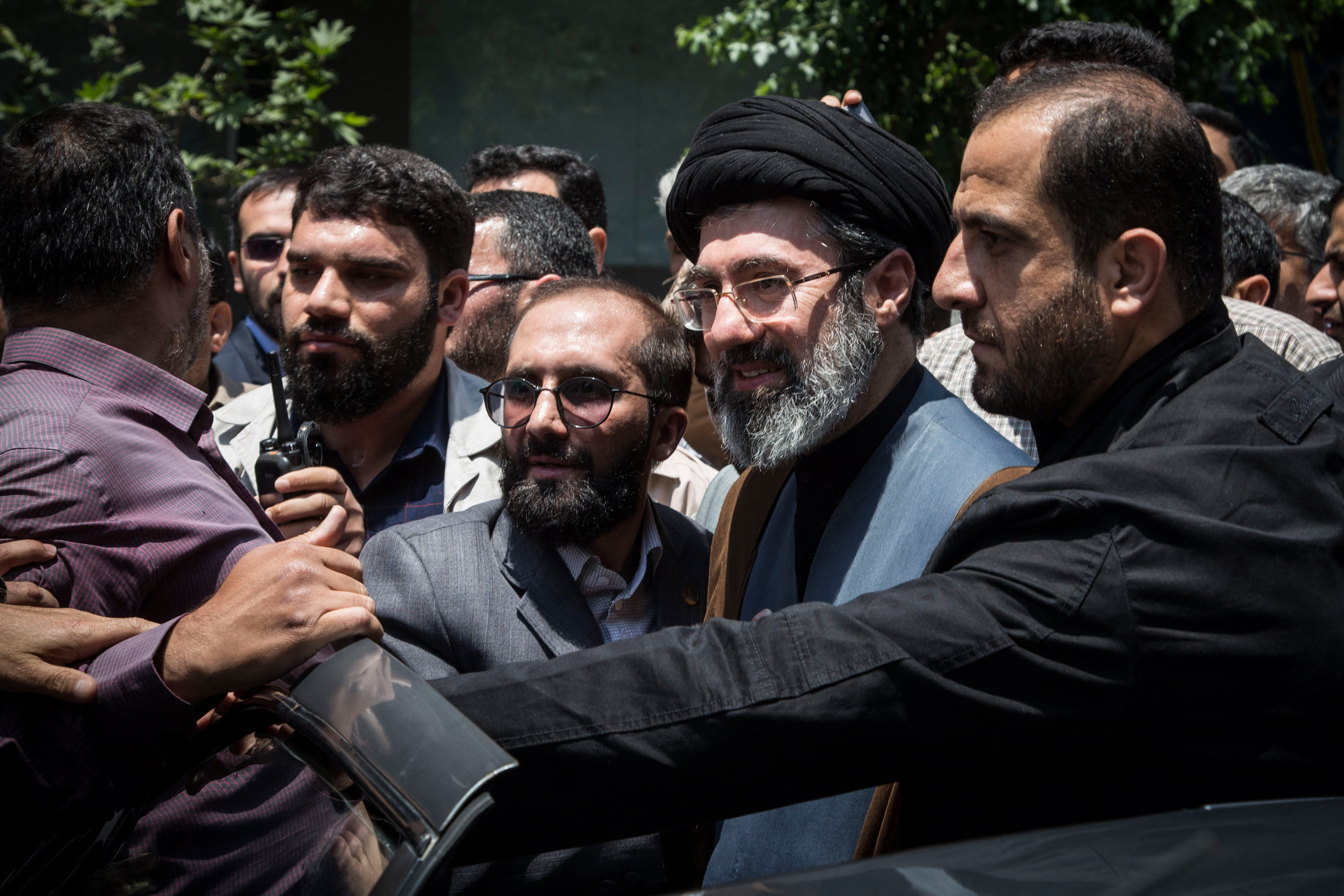
The institutional pivot toward Mojtaba Khamenei as the successor to Supreme Leader Ali Khamenei represents a fundamental shift from revolutionary meritocracy to dynastic consolidation. This transition is not merely a family matter; it is a calculated reconfiguration of the Iranian power structure designed to ensure the survival of the clerical-military complex. By analyzing the intersection of constitutional mechanisms, paramilitary loyalty, and theological legitimacy, we can map the exact trajectory of this succession and the structural bottlenecks that could trigger a systemic crisis.
The Triad of Institutional Legitimacy
To understand the elevation of Mojtaba Khamenei, one must deconstruct the three pillars required to hold the office of Vali-e Faqih (Guardian Jurist). The selection process is governed by a specific cost-benefit analysis performed by the Assembly of Experts, but the actual power is negotiated behind closed doors within three distinct spheres.
- The Theological Requirement: Under Article 5 and 109 of the Constitution, the leader must possess "scholarly qualifications relevant to fatwa." Mojtaba Khamenei has spent the last decade elevating his religious standing, reportedly attaining the rank of Ayatollah and conducting high-level kharij (advanced) jurisprudence seminars in Qom. This is a deliberate "credentialing" phase intended to neutralize mid-level clerical opposition.
- The Praetorian Guard (IRGC): The Islamic Revolutionary Guard Corps acts as the ultimate kingmaker. Unlike his father, who spent years building a rapport with the military after the 1979 revolution, Mojtaba’s influence is rooted in the "Office of the Leader." He has served as a primary liaison between the Leader's household (Beit-e Rahbari) and the IRGC intelligence apparatus. His succession represents a "Security-First" doctrine, prioritizing internal stability over ideological purity.
- Bureaucratic Continuity: The sprawling economic empire managed by the Setad (Execution of Imam Khomeini's Order) and other foundations requires a successor who will not liquidate these assets or redistribute them to rival factions. Mojtaba is the guarantor of the status quo for the current economic elite.
The Mechanism of Shadow Governance
The argument for Mojtaba’s succession is often dismissed as mere nepotism, yet this overlooks the operational reality of the Beit-e Rahbari. Over the last two decades, the Supreme Leader’s office has evolved from a traditional clerical staff into a parallel government that bypasses the presidency and parliament.
Mojtaba Khamenei has functioned as the Chief Operating Officer of this shadow state. His role in suppressing the 2009 Green Movement and his influence over the Basij paramilitary forces demonstrate a command-and-control capability that other candidates—such as those from the traditional judiciary or the Assembly of Experts—cannot match. This creates an Efficiency Premium: the IRGC prefers a known quantity who already manages the levers of the state over a senior cleric who might attempt to reassert constitutional independence.
Structural Bottlenecks and the Risk of "Republic" Backlash
The primary obstacle to this transition is the foundational rhetoric of the 1979 Revolution itself. Ruhollah Khomeini explicitly framed the revolution as an overthrow of the Pahlavi hereditary monarchy. Transitioning to a dynastic model risks a "Legitimacy Deficit" that could be weaponized by both the secular opposition and rival clerics.
- The Hereditary Paradox: If the office of the Supreme Leader becomes hereditary, the "Islamic Republic" effectively reverts to an "Islamic Sultanate." This creates an ideological vacuum that the state’s propaganda machine must fill.
- The Assembly of Experts Friction: While the 88-member body is vetted by the Guardian Council, it contains factions that view the "Quietist" tradition—keeping religion separate from direct political management—as a safer path for the survival of the clergy.
- Public Volatility: The Iranian populace has shown increasing resistance to the clerical establishment through periodic unrest (2017, 2019, 2022). A dynastic succession acts as a catalyst for civil disobedience, as it shatters the illusion of elective representation within the system.
The Elimination of Rival Candidates
A strategic analysis of recent Iranian political history reveals a systematic thinning of the succession field. The sudden death of Ebrahim Raisi in a helicopter crash removed the most viable "formal" candidate—one who held the presidency and had the requisite hardline credentials.
Before Raisi, Sadeq Larijani was sidelined through high-profile corruption investigations targeting his subordinates. Hassan Rouhani has been disqualified from running for the Assembly of Experts. This leaves a vacuum that Mojtaba Khamenei is uniquely positioned to fill. The "Succession Funnel" has been narrowed through a combination of judicial disqualification, political marginalization, and environmental attrition.
The Cost Function of Global Isolation
A Mojtaba Khamenei leadership likely signifies a permanent "Look East" policy. Given his deep ties to the security apparatus, his administration would prioritize:
- Sanction Circumvention: Expanding the "shadow banking" networks and oil smuggling routes managed by the IRGC.
- Asymmetric Leverage: Maintaining the "Axis of Resistance" (Hezbollah, Houthis, PMF) as a forward defense mechanism to prevent direct kinetic conflict on Iranian soil.
- Nuclear Ambiguity: Using the nuclear program not necessarily as a weapon for immediate use, but as a permanent bargaining chip to ensure regime survival.
The risk for international stakeholders is a leader who is less concerned with the "Republic" (the facade of diplomacy) and more committed to the "Revolution" (the survival of the security state).
Scenario Modeling for the Transition Period
The transition will likely follow one of two paths:
- The Managed Succession: Ali Khamenei abdicates or passes away, and the Assembly of Experts immediately confirms Mojtaba in a televised session to prevent a power vacuum. The IRGC floods the streets to preemptively quash dissent. This is the "Continuity Model."
- The Collective Leadership: Fearing public backlash, the Assembly appoints a council of three to five leaders, with Mojtaba acting as the "First Among Equals" or the head of the military wing. This "Transition Model" allows the regime to gauge public reaction before fully committing to a single individual.
Strategic Forecast for the IRGC-Household Alliance
The consolidation of power behind Mojtaba Khamenei is the logical conclusion of Iran’s evolution into a security state. The traditional clerical hierarchy in Qom has been effectively bypassed by the "New Right"—a generation of IRGC officers and Leader's Office bureaucrats who view the survival of the state as a technical and military challenge rather than a theological one.
For the Iranian state, the choice of Mojtaba is a move toward a "Hardened State" model. The objective is to insulate the supreme leadership from the volatility of popular elections and the friction of clerical debate. This strategy assumes that the IRGC can maintain domestic order through technological surveillance and paramilitary force indefinitely.
The final strategic play for the Iranian establishment is the formalization of this transition while Ali Khamenei is still alive to lend his direct "Divine Mandate" to his son. This "Living Succession" would involve Mojtaba taking over a significant portion of the Leader’s public duties, effectively acclimating the public and the bureaucracy to his rule before the official vacancy occurs. This minimizes the "Window of Vulnerability" that accompanies any change in autocratic leadership.
Monitor the frequency of Mojtaba's meetings with foreign dignitaries and his appearances at military exercises; these are the lead indicators of the formal transfer of power. If the regime moves to amend the constitution to explicitly allow a council of leaders or to simplify the clerical requirements further, the dynastic transition is no longer a probability, but a policy.
Would you like me to analyze the specific IRGC factional leaders who would likely serve as Mojtaba's primary deputies in this new administration?