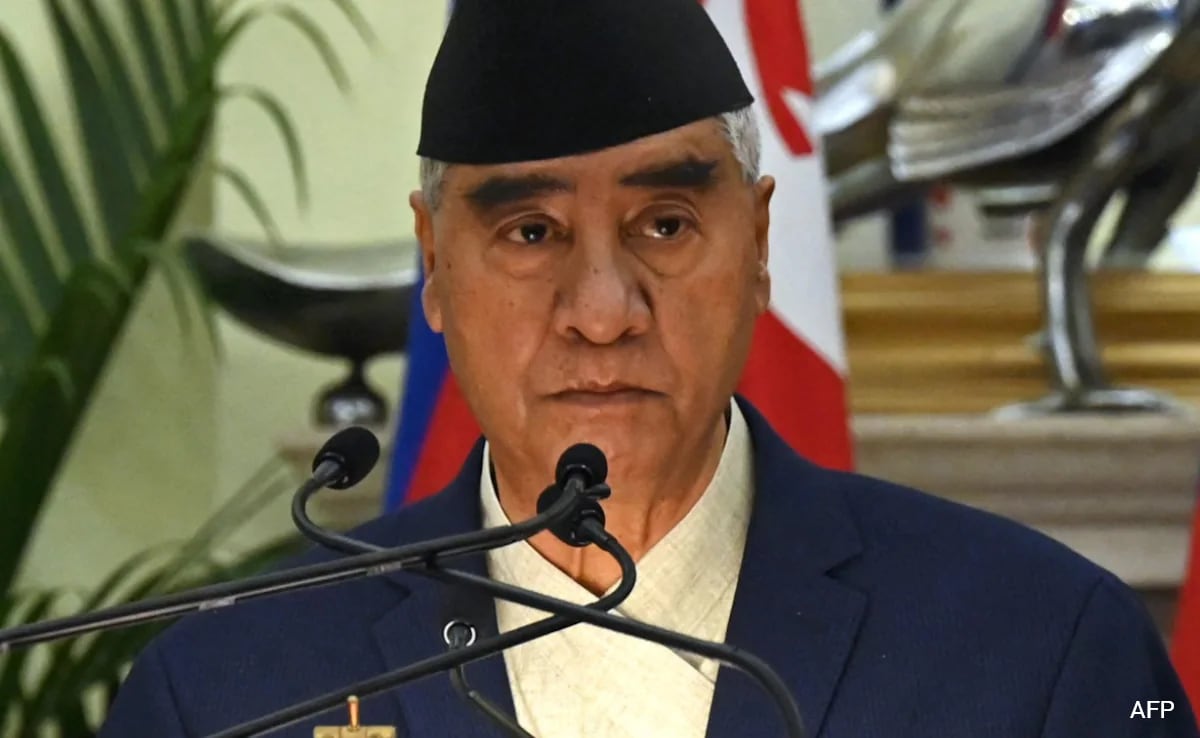
Sher Bahadur Deuba does not win popularity contests, yet he owns the podium of Nepali power. While the public often views his repeated ascensions to the Prime Minister’s office as a failure of the democratic process, it is actually the ultimate expression of a very specific, cold-blooded mechanical mastery of parliamentary mathematics. He has turned the Nepali Congress (NC) into a vehicle for status quo preservation, ensuring that no matter which way the wind blows in Kathmandu, the path to the Singha Durbar eventually runs through his residence in Budhanilkantha.
This isn't about vision. It is about the brutal reality of coalition survival in a country where no single party can grasp a majority. Deuba’s longevity is built on the ruins of ideological consistency. By treating every political rival as a potential temporary spouse, he has rendered the concept of "opposition" obsolete, creating a cycle where the faces at the top never change, even as the country's economic indicators stagnate.
The Architecture of the Five Time Prime Minister
To understand Deuba, you have to stop looking at his speeches and start looking at his ledgers. He operates less like a statesman and more like a high-stakes actuary. He knows exactly what every lawmaker is worth, what every faction leader fears, and how long a promise needs to last before it can be safely broken.
His career began in the fires of the anti-Panchayat movement, a pedigree that gives him a "democratic shield" he uses to deflect criticism. But the radical student leader of the 1970s bears no resemblance to the man who has spent the last three decades managing the decline of Nepal's institutional strength. His methodology is built on three pillars that his rivals—both the aging communists and the fiery new populists—have failed to dismantle.
First, he has mastered internal party asphyxiation. Within the Nepali Congress, Deuba has built a patronage network so deep that challenging his presidency is a form of professional suicide. He doesn't just defeat opponents; he absorbs their networks or starves them of resources until they become irrelevant. This internal control is the bedrock of his national power. Without a unified party behind him, he would be just another aging politician; with it, he is the gatekeeper of the largest democratic bloc in the country.
Second is his ideological fluidity. Deuba is remarkably unburdened by the weight of conviction. He has formed governments with the same Maoists who once had a price on his head and with royalists who supported his imprisonment. To Deuba, an alliance isn't a marriage of values; it’s a short-term lease on a building. This allows him to pivot faster than any other player in the room. When the CPN-UML and the Maoist Center fall out, Deuba is always standing in the middle with a pen and a coalition agreement, ready to sign.
Third is the management of geopolitical anxieties. Kathmandu is a playground for regional powers, specifically India and China, with the United States increasingly active through development compacts. Deuba has positioned himself as the "predictable" choice for New Delhi and Washington. Unlike the unpredictable nationalist rhetoric of K.P. Sharma Oli or the revolutionary baggage of Prachanda, Deuba offers a brand of quiet compliance that external actors find comforting. He is the devil they know.
The Cost of the Budhanilkantha Consensus
While Deuba excels at the game of thrones, the country pays the "stability tax." This tax is measured in the thousands of young Nepalis who depart through Tribhuvan International Airport every single day. The "Budhanilkantha Consensus"—the unspoken agreement between top-tier leaders to rotate power among themselves—has created a policy vacuum.
When the primary goal of a government is its own survival for the next six months, long-term economic planning becomes impossible. We see this in the chronic under-expenditure of the capital budget. Billions of rupees meant for roads, bridges, and power lines sit idle because the bureaucracy is paralyzed by constant ministerial turnover. Every time Deuba or his rivals shuffle the cabinet to satisfy a coalition partner, the administrative machinery resets. Projects that should take three years take thirteen.
The Myth of the New Wave
In the last elections, the rise of the Rastriya Swatantra Party (RSP) was framed as the beginning of the end for the "old guard." The media painted a picture of a tech-savvy, youth-led insurgency that would sweep Deuba and his contemporaries into the dustbin of history.
That hasn't happened.
Instead, Deuba has watched with practiced detachment as the newcomers have been lured into the same coalition traps that have defined his career. By inviting these "disruptors" into the tent, the established elite effectively neuters them. Once a "revolutionary" minister is forced to defend a compromised budget or justify a shady procurement deal, their brand is tarnished. Deuba understands that the best way to destroy an enemy is to make them a partner in a failing enterprise.
The Judiciary and the Constitutional Safety Net
A significant part of Deuba’s survival strategy involves his relationship with the third branch of government. Nepal’s Supreme Court has, at several critical junctures, acted as the final arbiter of his political life. The most famous instance was the 2021 intervention that overturned the dissolution of Parliament by K.P. Sharma Oli and essentially ordered Deuba’s appointment as Prime Minister.
While hailed as a victory for the constitution, it also highlighted a dangerous trend. The political class, led by Deuba, has outsourced its conflicts to the courts. This has led to the politicization of the judiciary, where appointments to the bench are often viewed through the lens of party loyalty. When the line between a legal ruling and a political maneuver blurs, the foundational trust in the state erodes. Deuba doesn't mind the erosion as long as the immediate ruling keeps him in the game.
The Business of Politics in a Remittance Economy
Follow the money, and you find the true source of Deuba’s resilience. Nepal’s economy is propped up by remittances, which account for nearly 25% to 30% of the GDP. This flow of cash from workers in the Gulf and Southeast Asia provides a cushion that prevents total economic collapse, regardless of how poorly the government performs.
This "remittance trap" suits Deuba’s style of governance perfectly. It creates a passive population—the most frustrated and energetic segment of the workforce is physically absent from the country. This reduces the pressure for genuine reform. The political elite, including the NC under Deuba, have become adept at managing the "broker state," where the government acts as a middleman between foreign labor markets and the domestic consumer base.
The business interests that fund the NC are not industrialists looking for better factories; they are importers, manpower agents, and contractors who thrive on the very instability and patronage Deuba provides. A stable, rule-of-law-based economy would actually threaten the monopolies held by the "crony-capitalist" class that surrounds the leadership.
The Succession Vacuum
At nearly 80 years old, the question of "after Deuba" should be the most pressing topic in Nepali politics. Yet, the NC has no clear succession plan. Deuba has meticulously ensured that no second-generation leader gains enough independent stature to challenge him.
Potential successors like Gagan Thapa or Bishwa Prakash Sharma are kept in a perpetual state of "youth leadership," despite being in their 40s and 50s. They are given titles but denied the actual levers of party finance and district-level patronage. This creates a bottleneck. The party's rank and file are increasingly disillusioned, but they lack the structural means to force a change.
This is Deuba’s final, and perhaps most damaging, masterstroke. He has made himself synonymous with the party's existence. The fear is that without his "transactional genius" to hold the factions together, the Nepali Congress would splinter into a dozen warring fiefdoms. He rules through the threat of the void.
The Coming Collision
The 2027 elections loom, and the math is getting harder. The emergence of a more vocal, albeit fractured, urban middle class is beginning to grate against the old-school backroom dealings of Budhanilkantha.
However, betting against Deuba has historically been a losing proposition. He does not need to be loved; he only needs to be the only available option when the clock strikes midnight on a failed coalition. He thrives in the gray areas of the constitution, in the late-night meetings where ministries are traded like commodities, and in the silence of a public that has grown weary of hoping for change.
The tragedy of Sher Bahadur Deuba is not that he is a "bad" politician in the traditional sense. By the standards of Machiavelli, he is a brilliant one. The tragedy is that his brilliance is entirely inward-facing. It is a talent for survival that serves the survivor alone, leaving the state he leads in a state of permanent, managed exhaustion.
If you want to understand the future of Nepal, stop watching the protest marches and start watching the seating charts of the next high-level dinner in Kathmandu. Deuba will likely be at the head of the table, not because he was invited, but because he owns the chairs.
Ask yourself if a democracy can survive when its most successful practitioner has no interest in its outcomes, only its mechanics.