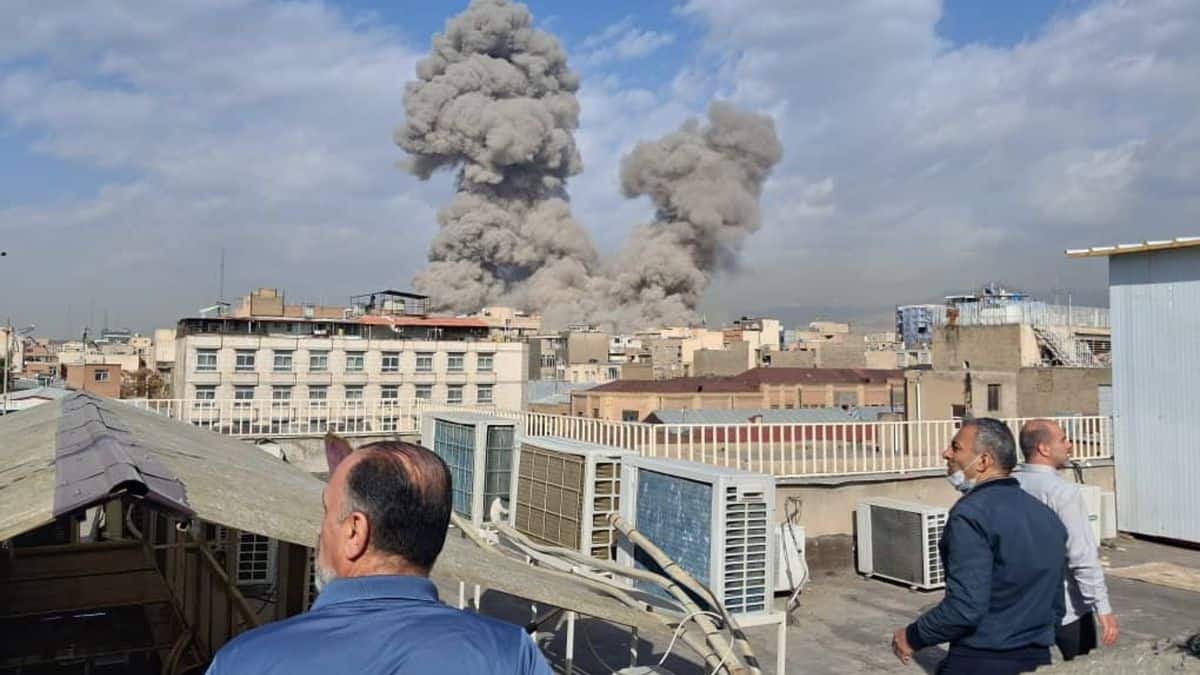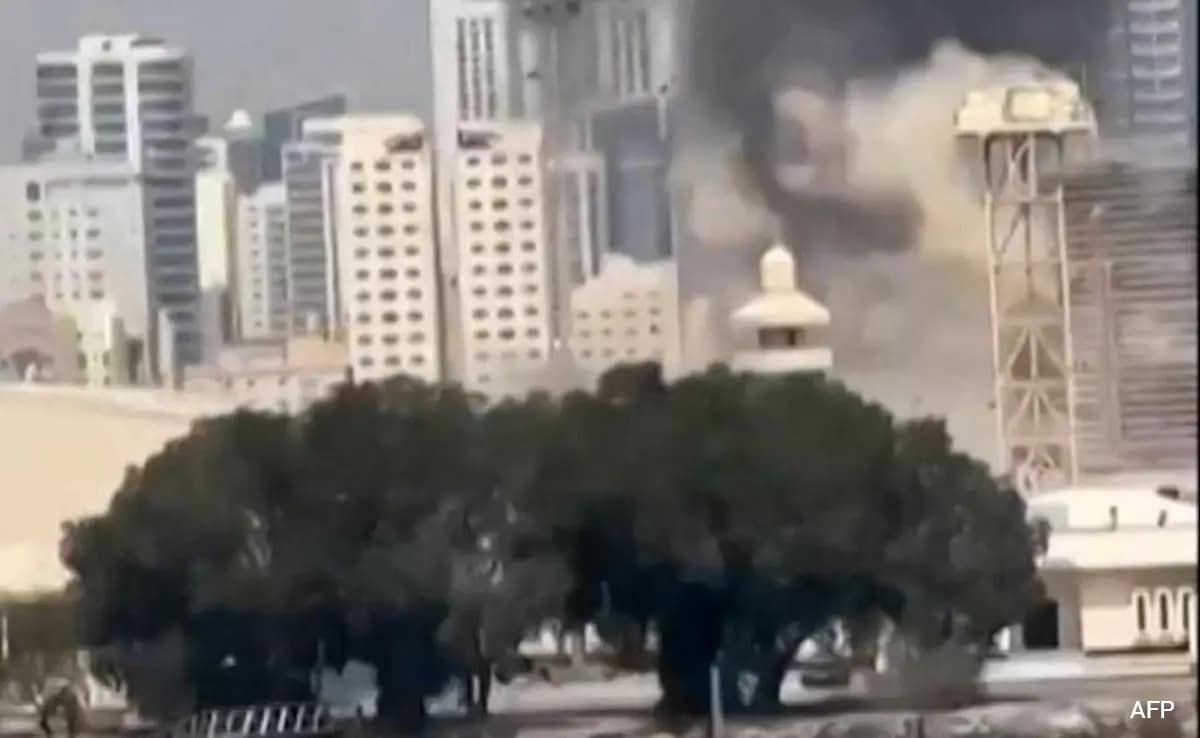
The air in Manama usually tastes of salt and expensive gasoline. It is a city that hums with the quiet confidence of a global crossroads, where the skyline glitters like a jeweler’s display case against the dark velvet of the Persian Gulf. But on a Tuesday that started like any other, that confidence was punctured by a sound that doesn't belong in a modern metropolis. It was the low, lawnmower-like drone of an engine that costs less than a used sedan, carrying a payload designed to shift the geopolitics of the entire century.
When the Iranian Revolutionary Guard Corps (IRGC) claimed they had successfully struck a U.S. base in Bahrain with a swarm of drones and missiles, the world didn’t just witness a military maneuver. We witnessed the death of distance.
For decades, the presence of the U.S. Fifth Fleet in Bahrain was seen as an unshakeable fact of life, a steel umbrella held over the world’s most critical oil arteries. You could see the gray hulls of the ships from the shore, symbols of a power so vast it felt abstract. But power is no longer measured solely by the displacement of a carrier’s hull. It is measured by the ability of a $20,000 piece of carbon fiber and plastic to find a specific window in a specific building from hundreds of miles away.
The Ghost in the Machine
Consider a young radar technician stationed at the Naval Support Activity Bahrain. Let’s call him Miller. Miller isn't a character in a movie; he represents the thousands of twenty-somethings whose literal job is to stare at a glowing screen and distinguish a flock of migrating birds from a suicide drone.
The terrifying reality of modern asymmetric warfare is that the drone doesn’t look like a threat until it is a catastrophe. It flies low. It moves slow. It hides in the "clutter" of the sea waves and the coastal heat haze. When the IRGC claims a strike, they aren't just bragging about a physical explosion. They are bragging about their ability to make Miller’s high-tech sensors look obsolete.
The reports filtering through state media and regional Telegram channels paint a picture of a synchronized "swarm." This isn't just one missile flying a predictable arc through the stratosphere. It is a coordinated dance of dozens of small, expendable machines designed to overwhelm. If you throw ten rocks at a man, he might catch one and dodge two. If you throw a thousand, he’s going down.
The math of this conflict is brutal and lopsided. A single interceptor missile used by the U.S. to knock a drone out of the sky can cost $2 million. The drone it is killing? Often less than $30,000. We are watching a high-stakes poker game where one player has a mountain of gold and the other has a seemingly infinite supply of pocket change. Eventually, the gold runs out or the player gets tired of the cost of staying in the game.
A Geography of Anxiety
Bahrain is an island nation, barely a speck compared to its neighbors, yet it sits at the very heart of the "hidden world." Most people don't think about the Strait of Hormuz until their gas prices spike or a war breaks out, but for the people living in the shadow of the Fifth Fleet, the tension is a physical weight.
When news of a strike breaks, the first reaction isn't political—it’s visceral. It’s the sound of a phone vibrating on a nightstand at 3:00 AM. It’s the sudden, eerie silence of the harbor when the usual commercial traffic stalls.
The IRGC’s strategy relies on this psychological friction. By claiming a direct hit on a base in Bahrain—the sovereign home of a U.S. ally—Tehran is sending a message that transcends the damage of any single blast. They are saying: Nowhere is a sanctuary. No alliance is a shield. Your technology is a facade.
But there is a deeper layer to this story that the dry headlines miss. To understand why this is happening now, we have to look at the evolution of the "Shahed" style drone. These are not the sophisticated, multi-million dollar Reapers used by the United States. They are the "Model T" of the sky. They are simple, rugged, and increasingly autonomous.
Imagine a swarm of these devices equipped with basic AI image recognition. They don't need a pilot. They don't need a constant satellite link that can be jammed. They are launched, they "see" the silhouette of a base or a ship, and they commit to their final, violent purpose. This shift from remote-controlled aircraft to autonomous hunters is the real story beneath the IRGC’s claims. It is the democratization of precision destruction.
The Cost of the Invisible War
We often talk about "strikes" as if they are points on a scoreboard. But every claim of an attack creates a ripple effect that changes how the world functions.
Insurance companies in London immediately reassess the risk of every tanker moving through the Gulf. Shipping lanes shift. Algorithms in New York and Tokyo react to the perceived instability, moving billions of dollars out of emerging markets and into "safe" havens. The "invisible stakes" aren't just about military casualties; they are about the fragility of the global nervous system.
If a drone can penetrate the most heavily defended airspace in the Middle East, what does that mean for a power plant in Europe? What does it mean for a water treatment facility in California? The IRGC isn't just fighting a war against the U.S. Navy; they are beta-testing a new reality for every nation on Earth.
There is a profound sense of uncertainty that comes with this type of warfare. In the old days, you knew when you were at war because the tanks were crossing the border. Today, you are at war when a "technical glitch" causes a fire at a refinery, or when a "claimed" drone strike turns out to be a sophisticated piece of psychological operations meant to bait a response.
The truth in the Gulf is often found in the silence between the explosions. The U.S. military is notoriously tight-lipped about the effectiveness of its defensive systems, while the IRGC is prone to exaggerating its successes for domestic consumption and regional posturing. Between these two poles of propaganda lies a terrifying gray zone.
The Horizon of the New World
This isn't a story that ends with a peace treaty or a final battle. It is the beginning of a permanent state of high-tension competition. We have entered an era where the "cheap" can challenge the "elite," and where the geography of a small island like Bahrain becomes the most important square on the global chessboard.
As the sun rises over the Gulf, the residents of Manama go back to their lives. The malls open. The pearl divers—now mostly a memory for tourists—give way to the offshore bankers. But the skyline looks different now.
You find yourself looking up. You listen for that low-frequency hum. You wonder if the blinking light in the distance is a star, a commercial flight, or a machine with a singular, lethal intent.
The sky used to be a void, a space between points A and B. Now, it is a crowded, contested territory. The IRGC’s claim, whether fully verified or partially fabricated, has served its primary purpose: it has planted a seed of doubt in the mind of every sailor, every citizen, and every strategist. It has proven that in the modern age, a giant doesn't need to be killed to be defeated; it just needs to be bled by a thousand tiny, plastic cuts.
The gray ships still sit in the harbor, but the water feels colder. The salt in the air feels a little more like grit. We are all living in the afterglow of that red sky, waiting to see which machine will scream across the horizon next.
The message was never about the base. It was about the fact that the walls we built are no longer high enough.
Would you like me to analyze the specific technical evolution of the drone models used in these regional conflicts?