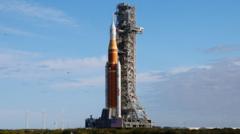
The orange giant is no longer a blueprint or a dream. It is a four-million-pound physical reality, a tower of metal and liquid hydrogen that looks more like a cathedral than a vehicle.
Late last night, the crawler-transporter—a machine so massive it makes a house look like a toy—began its agonizingly slow trek. Four miles. That is the distance between the safety of the Vehicle Assembly Building and the edge of the Atlantic Ocean at Launch Complex 39B. At a top speed of one mile per hour, the journey is a test of patience. It is a mechanical funeral march for the status quo and a wedding procession for the future.
When the Space Launch System (SLS) rocket finally locked into place on the pad, the silence of the Florida marshland felt different. It felt heavy. For the first time in over fifty years, we aren't just sending sensors and high-resolution cameras into the black. We are preparing to send ourselves.
The Weight of Four Lives
We often talk about rockets in terms of thrust, payload capacity, and orbital mechanics. Those are the cold facts. But look closer at the Orion capsule perched atop that 322-foot stack. Inside that cramped, sophisticated pressure vessel, there are four seats.
They aren't occupied yet. But soon, Reid Wiseman, Victor Glover, Christina Koch, and Jeremy Hansen will strap into those chairs. They will feel the vibration of those twin solid rocket boosters through their spines. They will be the first humans to see the far side of the Moon with their own eyes since 1972.
Consider the psychological weight of that four-mile crawl to the pad. For the engineers who spent a decade tightening bolts and debugging millions of lines of code, this move is the ultimate exposure. On the pad, the rocket is vulnerable to the salt air, the lightning, and the relentless scrutiny of a world that has grown cynical about space flight.
One of those engineers, let’s call him Elias—a composite of the thousands who have poured their lives into Artemis—stood near the fence line as the crawler lurched forward. He remembers the early days when the program was just a series of shifting mandates and political uncertainty. He remembers the "gray-beards" from the Apollo era shaking their heads, wondering if we still had the stomach for the risk.
To Elias, this isn't just a "mega-rocket." It is a decade of missed birthdays, late-night cold pizza, and the terrifying knowledge that if one valve freezes, four families change forever.
Why the Moon Matters Again
A common question echoes through the halls of power and the dinner tables of the disillusioned: Why go back? We’ve been there. We planted the flag. We hit the golf ball.
The answer lies in the difference between a visit and a residency. Artemis II is not a repeat of Apollo; it is the construction of a bridge. If the Moon was a playground in the 60s, today it is a proving ground. We are going back to learn how to live on a world that wants to kill us.
The stakes are invisible but absolute. If we cannot master the three-day trip to the Moon, the seven-month journey to Mars remains a death sentence. We are looking for water ice in the shadowed craters of the lunar south pole. We are testing radiation shielding that will protect human DNA from the solar storms that howl through deep space.
This rocket is the only machine on Earth capable of doing this in a single toss. The SLS generates 8.8 million pounds of maximum thrust. To put that in perspective, imagine the power of 160,000 Corvette engines screaming in unison. It is a brute-force solution to the gravity well of our home planet.
The Anatomy of the Giant
The rocket sitting on the pad today is a strange hybrid of the past and the future. The core stage, painted that iconic, burnt-orange color, is derived from the Space Shuttle’s external tank. The boosters are longer versions of the ones that lifted the Shuttle into orbit for thirty years.
But the "brains" are entirely new.
The Orion spacecraft is a masterpiece of redundancy. It has to be. When the crew of Artemis II swings around the lunar far side, they will be further from Earth than any human in history. At that moment, they will be truly alone. No mission control can reach them through the bulk of the Moon. They will rely on the software, the heat shield, and each other.
The transition from the assembly building to the pad is the moment the hardware becomes a mission. It is the transition from "it could work" to "it must work."
A Symphony of Logistics
Moving a 322-foot rocket isn't as simple as turning a key. It is a choreographed dance involving hundreds of people.
- The Jacking System: The crawler must keep the rocket perfectly level as it climbs the five-percent grade of the ramp at the pad. A tilt of even a few degrees would put catastrophic stress on the airframe.
- The River of Stone: The crawler-way is made of Alabama river rock. Why? Because the rocks act like ball bearings, crushing under the weight of the crawler to prevent sparks and distribute the load.
- The Umbilicals: Once at the pad, the rocket is "plugged in." These lines provide power, data, and eventually, the cryogenic fuels—liquid oxygen and liquid hydrogen—chilled to hundreds of degrees below zero.
There is a specific smell to the pad on a morning like this. It is a mix of sea salt, hydraulic fluid, and the ozone of a Florida storm. It is the smell of the frontier.
The Human Heart of the Machine
We often get lost in the "mega" of it all. Mega-rocket. Mega-budget. Mega-timeline.
But the most important part of Artemis II isn't the metal. It’s the audacity. We live in an era where we can see the entire world through a five-inch screen in our pockets. We have become comfortable. We have become used to the idea that the "great things" were done by our grandparents.
Artemis II is a rejection of that comfort. It is an admission that we are still explorers, still capable of doing things that are frighteningly difficult.
When the sun rises over the launch pad tomorrow, it will catch the light on the Orion capsule. Inside that capsule, the air is still. The seats are empty. But the ghost of the mission is already there. It is in the smudge of a fingerprint left by a technician on a console. It is in the signature of a welder hidden deep inside the engine section.
We aren't just launching a rocket. We are launching a question: Can we still do this?
The rocket on the pad is the answer. It is a physical "Yes" standing against the horizon. It is a reminder that while the Earth is our cradle, we were never meant to stay in the cradle forever.
The countdown hasn't officially started, yet the clock has been ticking for half a century. The four miles are finished. The quarter-million miles are next.
The giants are back, and this time, they’ve come to stay.
Standing at the edge of the water, watching the steam rise from the vents of the pad, you realize that the most powerful thing about the SLS isn't the fire at the bottom. It's the hope at the top.
The ocean breeze ripples the water of the lagoon, reflecting the orange tower against the dark sky. The rocket waits. The crew waits. The Moon waits.
We are ready to stop looking at the stars and start walking among them again.