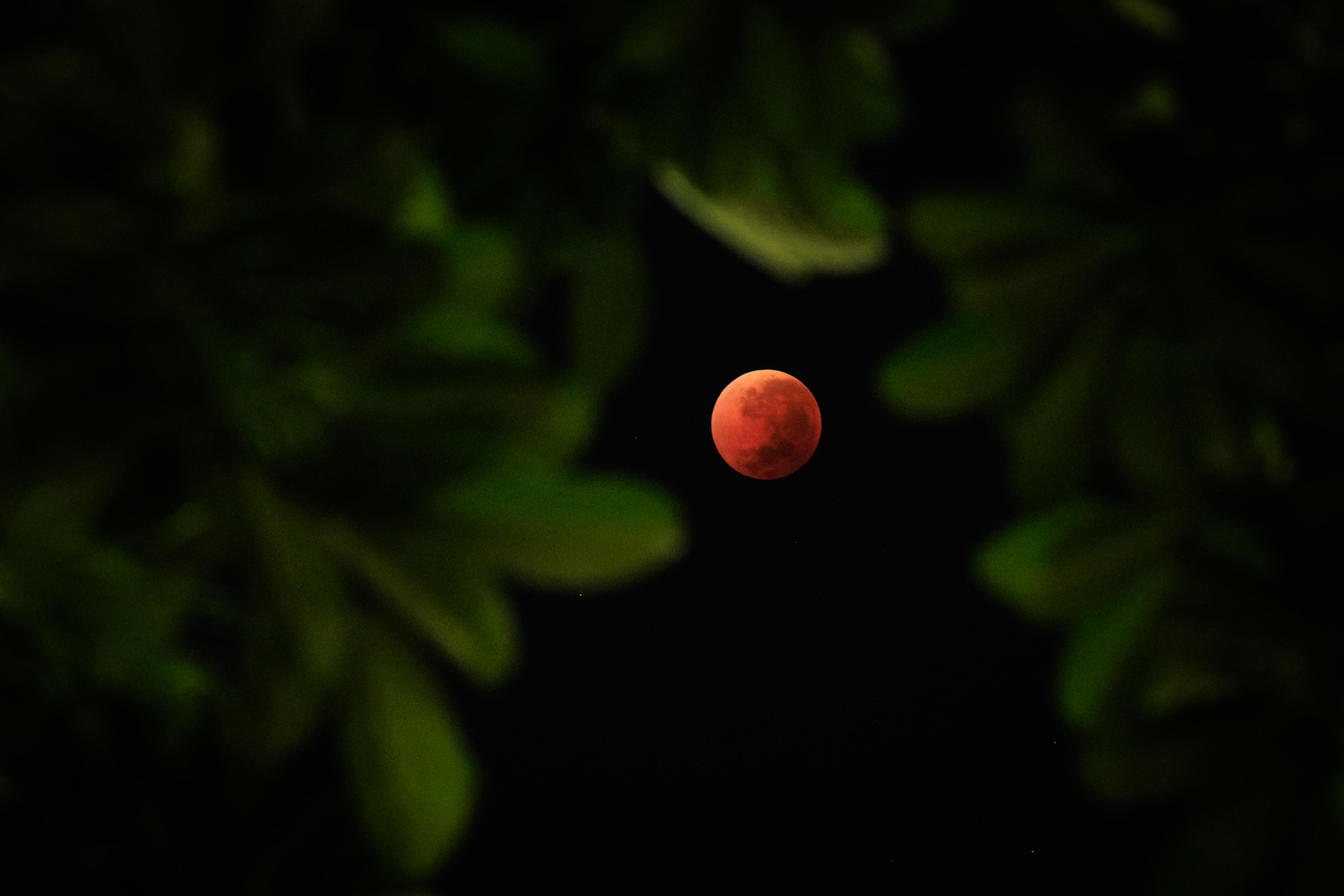
Across the sprawling geography of Canada, from the jagged coast of Newfoundland to the dense forests of British Columbia, millions of people spent the early hours of this morning staring at a sky that seemed to break the rules of physics. What NASA identifies as a total lunar eclipse—popularly branded as a "Blood Moon"—is more than just a fleeting viral moment or a lucky break for amateur photographers. It is a massive, continent-wide synchronized event that exposes the raw mechanics of our solar system.
A total lunar eclipse happens when the Earth moves directly between the Sun and the Moon, casting its shadow across the lunar surface. To see it, you don't need a high-end telescope or a degree in astrophysics. You just need a clear view and a bit of patience. For Canadians, the peak of this event occurred while most were sleeping, yet the sheer volume of data and imagery flooding the wires suggests that a significant portion of the population chose sleep deprivation over missing a rare celestial alignment.
The Physics of the Copper Glow
The term "Blood Moon" is a bit of a misnomer. The Moon does not actually turn red; it reflects the sunlight that is filtered and refracted through the Earth’s atmosphere. Think of it as every sunrise and sunset on Earth being projected onto the lunar surface at the exact same time.
The science behind this is known as Rayleigh scattering. It is the same phenomenon that makes the sky blue during the day and red at dusk. As sunlight passes through our atmosphere, the shorter blue wavelengths are scattered away, while the longer red wavelengths are bent inward toward the Moon.
The specific shade of red—ranging from a bright, coppery orange to a dark, charcoal brown—depends entirely on the current state of our own atmosphere. If there has been recent volcanic activity or significant wildfires, the extra dust and ash in the air will make the Moon appear much darker, almost disappearing from view. This morning, observers reported a deep, brick-red hue, suggesting a relatively clear but active atmosphere across the mid-latitudes.
Why the Timing Matters for Canada
Canada occupies a unique position for these types of events. Because of the country’s high latitude and vast longitudinal spread, the "viewing window" varies wildly from the Atlantic to the Pacific. While those in Halifax saw the eclipse begin as the Moon set, observers in Vancouver had a front-row seat for the entire duration of totality.
The logistical challenge of viewing an eclipse in Canada usually comes down to two factors: weather and light pollution. In urban centers like Toronto or Montreal, the orange glow of the city can compete with the subtle shifts of the eclipse. However, because the Moon is eclipsed by a shadow and not by the sun (as in a solar eclipse), it remains perfectly safe to view with the naked eye. This accessibility is what drives the massive public interest. You don't need special glasses; you just need to look up.
The Geometry of the Syzygy
In astronomical terms, this alignment is called a syzygy. It sounds like a word from a science fiction novel, but it describes the straight-line configuration of three celestial bodies in a gravitational system.
- The Outer Shadow (Penumbra): The Moon first enters the Earth’s faint outer shadow. Most people won't even notice this stage. The Moon looks slightly dimmer, as if a thin veil has been pulled across it.
- The Inner Shadow (Umbra): This is when the "bite" appears to be taken out of the Moon. The Earth’s dark, central shadow begins to creep across the lunar craters.
- Totality: The entire Moon is submerged in the umbra. This is the moment the red color becomes vivid.
The Industry of the Night Sky
There is a growing economic engine behind these events that often goes unmentioned in standard news blurbs. Dark-sky tourism is a booming sector in Canada. National parks like Jasper in Alberta or Grasslands in Saskatchewan have spent years limiting artificial light to attract "astrotourists."
When NASA or the Canadian Space Agency (CSA) announces a Blood Moon, these regions see a massive spike in bookings. This isn't just about people with hobbyist cameras. It's about a fundamental human desire to reconnect with a version of the world that isn't illuminated by LED streetlights. The industry analysts see this as a pivot toward "experiential travel," where the destination isn't a city, but a specific coordinate in time and space.
The Equipment Arms Race
While you don't need a telescope, the rise of computational photography in smartphones has changed how we document these events. Modern phones now use artificial intelligence to stack multiple frames, reducing noise and enhancing the red saturation of the Moon.
Professional astronomers often look down on these digital "enhancements," arguing that they provide a false representation of what the eye actually sees. There is a tension there. On one hand, technology allows more people to share the experience. On the other, it risks turning a profound natural event into just another filtered image in a social media feed.
The Scientific Utility of a Shadow
It is easy to dismiss a lunar eclipse as a mere "pretty sight," but for researchers, these events are data-rich environments. During an eclipse, the temperature on the lunar surface drops at an incredible rate.
Without the sun’s direct radiation, the lunar regolith (the layer of loose, rocky material on the surface) cools down rapidly. By measuring how fast different areas of the Moon cool, scientists can determine the physical properties of the soil. Hard, dense rocks hold heat longer than fine, powdery dust. This thermal mapping is crucial for future lunar missions, including the upcoming Artemis phases, as it helps engineers understand where it is safe to land and where the surface might be too unstable.
Furthermore, these eclipses allow scientists to study the Earth’s own atmosphere from a distance. By analyzing the light that reaches the Moon, researchers can measure the amount of ozone and aerosols in our stratosphere. The Moon, in this case, acts as a giant mirror reflecting the health of our planet back to us.
Beyond the Spectacle
The fascination with the Blood Moon often borders on the superstitious, a hangover from an era when such events were seen as omens. Even today, the media leans heavily into the "Blood Moon" branding because it evokes a sense of drama.
But stripped of the hyperbole, the event serves a more grounded purpose. It forces a momentary pause. In a country as geographically fractured as Canada, there are very few things that occur simultaneously for a farmer in the Prairies and a tech worker in Kitchener. The shadow of the Earth is one of them.
The next time the Moon enters the umbra, the atmosphere will be different. The alignment will be slightly off-center. The dust in the air will have shifted. Every eclipse is a unique fingerprint of that specific moment in our history.
If you missed the peak this morning, you are looking at a wait of several years before the geometry aligns so perfectly again for the northern hemisphere. The cosmos doesn't operate on a 24-hour news cycle. It moves with a slow, grinding precision that cares very little for our schedules. We are simply the observers, lucky enough to be standing in the right place when the lights go out.
Check the local transit of the Moon tonight; even as it emerges from the last traces of the penumbra, the clarity of the Canadian winter air often provides a crispness to the lunar surface that you won't find during the humid summer months. Grab a pair of binoculars and look at the craters along the terminator line, where the light meets the dark. That is where the real scale of the Moon becomes apparent.