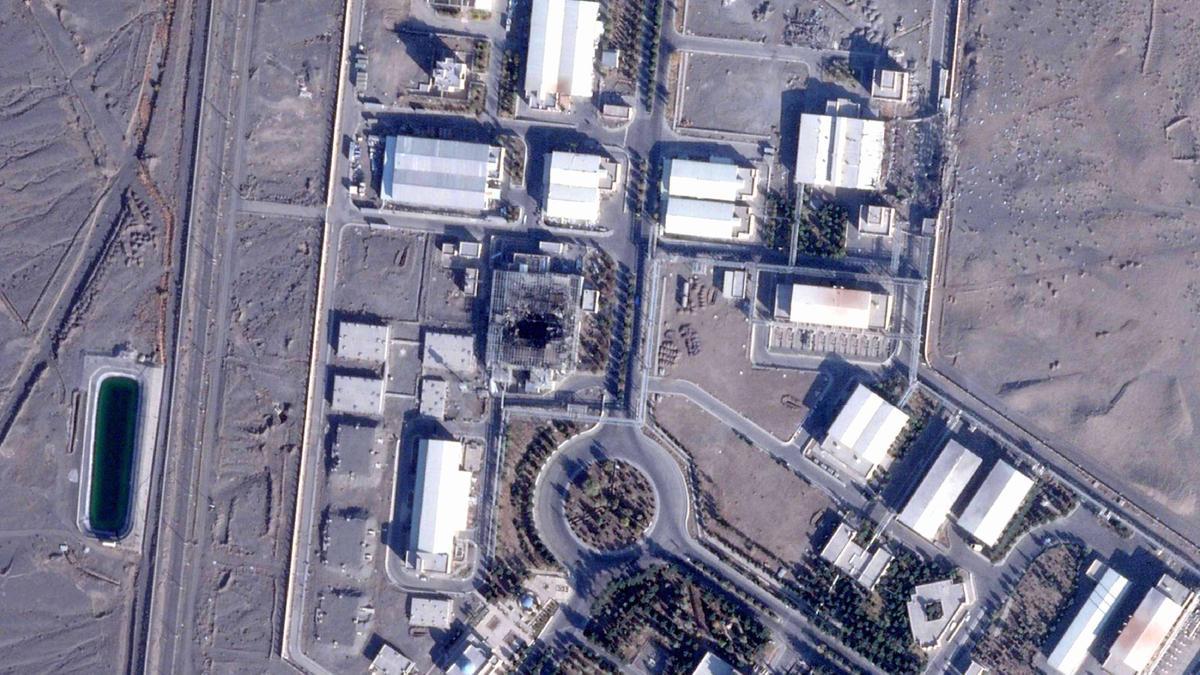
The International Atomic Energy Agency (IAEA) has confirmed that the physical entrances to Iran’s primary uranium enrichment facility at Natanz have been struck. This is not a minor operational hiccup. It is a calculated demolition of the "red lines" that have governed Middle Eastern proxy warfare for a decade. While the official narrative focuses on the structural damage to the surface access points, the real story lies in the sophisticated coordination required to bypass Iranian air defenses and the immediate, irreversible impact this has on the Joint Comprehensive Plan of Action (JCPOA) framework. This strike effectively ends the era of "strategic patience" and signals a transition into a period of kinetic containment.
The Physicality of the Breach
Natanz is not a single building. It is a sprawling complex buried deep within the central Iranian desert, protected by layers of reinforced concrete and sophisticated surface-to-air missile batteries. The IAEA inspectors, who maintain a regular presence at the site under the Nuclear Non-Proliferation Treaty (NPT) safeguards, documented specific, high-intensity damage to the portal structures. These are the heavily fortified transition zones where personnel and equipment move from the surface into the subterranean centrifuge halls.
By targeting the entrances rather than attempting to penetrate the mountain itself, the attackers achieved a specific strategic objective. They didn't need to destroy the centrifuges to stop the enrichment. They simply made it impossible to service them. If you cannot rotate crews, deliver raw $UF_6$ (uranium hexafluoride) gas, or remove enriched product, the facility becomes a high-tech tomb.
The precision of the strikes suggests the use of low-signature munitions, likely launched from close proximity or delivered via high-altitude drones that managed to spoof the local radar net. This indicates a massive intelligence failure on the part of the Islamic Revolutionary Guard Corps (IRGC). Someone knew exactly where the structural weak points were located. They knew the shift change schedules. They knew the blind spots in the perimeter sensors.
The Technology of Centrifuge Destruction
Uranium enrichment is a delicate dance of physics. In the underground halls of Natanz, thousands of IR-1, IR-4, and IR-6 centrifuges spin at speeds exceeding 60,000 revolutions per minute. At these velocities, the margins for error are non-existent.
The enrichment process follows a basic principle of isotopic separation. Natural uranium consists of roughly 0.7% of the fissile isotope $^{235}U$. To create fuel for a power reactor, that concentration must be raised to roughly 3-5%. To create a weapon, it must exceed 90%.
The centrifuges are arranged in "cascades," where the output of one machine becomes the input for the next.
$$F = P + W$$
In this standard mass balance equation, the feed ($F$) must be constant. If a strike on the entrance structures cuts off the power supply or the cooling systems—even for a few seconds—the resulting "crash" of the centrifuges is catastrophic. When a rotor spinning at supersonic speeds loses its vacuum or its balance, it doesn't just stop. It disintegrates, turning into a cloud of jagged metal that shreds every other machine in the cascade.
The IAEA’s confirmation of damage to the entrances implies that the internal infrastructure is now at risk of a "systemic stall." Without immediate access for technicians, the thermal gradients within the halls will shift, potentially causing the $UF_6$ gas to solidify inside the pipes. That is a nightmare scenario for any nuclear engineer. It means the entire hall may have to be decommissioned and treated as a hazardous waste site.
The Intelligence Gap and the Proxy War
This operation was not a lone-wolf act of sabotage. It bears the hallmarks of a state-level intelligence operation. For years, the "shadow war" between Israel and Iran was fought through cyberattacks—most famously the Stuxnet worm—and targeted assassinations of scientists. This move into overt kinetic strikes on sovereign infrastructure marks a departure from the "plausible deniability" model.
The timing is also critical. Iran has been steadily increasing its stockpile of 60% enriched uranium, a level that has no credible civilian use. By reaching this threshold, Tehran was attempting to build leverage for sanctions relief. This strike removes that leverage. It tells the Iranian leadership that their "breakout capacity" is a mirage because the physical infrastructure required to achieve it can be dismantled at will.
Furthermore, the strike exposes the limitations of Russian-made defense systems currently deployed in Iran. The S-300 batteries, long touted as a shield against such incursions, were evidently bypassed or suppressed. This creates a crisis of confidence within the Iranian military establishment. If they cannot protect Natanz, their most prized and hardened asset, they cannot protect anything.
The Failed Logic of Containment
Western policy toward Iran has been built on the idea that the nuclear program could be "managed" through a combination of economic pressure and technical monitoring. The IAEA's role was to be the impartial referee. However, the referee is now documenting the wreckage of a facility that was supposed to be the centerpiece of a diplomatic grand bargain.
The core problem is that enrichment is a "dual-use" technology. The same machines that make fuel for a bus-sized reactor can make the core for a suitcase-sized bomb.
"There is no such thing as a peaceful centrifuge once the knowledge of the fuel cycle has been mastered."
🔗 Read more: The Invisible Reach Across the Mediterranean
This quote, often whispered in the halls of the Vienna International Centre, captures the futility of the current diplomatic path. Once a nation knows how to build and balance a rotor, you cannot "un-know" it. You can only delay the inevitable.
The strike on the Natanz entrances is a blunt admission that the diplomatic path has reached a dead end. If the goal was to stop the program, the "soft" methods failed. This is the "hard" method. It is messy, it risks regional escalation, and it forces Iran’s hand.
The Economic Aftershocks
Inside Iran, the news of the Natanz strike has sent the Rial into another tailspin. The Iranian public, already exhausted by years of hyperinflation and systemic corruption, sees the nuclear program as a black hole that consumes national wealth without providing security.
The government now faces a brutal choice. It can double down, diverting even more resources to rebuild the entrances and harden the site further, or it can attempt to pivot back to the negotiating table from a position of extreme weakness. Rebuilding is not just a matter of pouring more concrete. It requires replacing specialized components—sensors, valves, and vacuum pumps—that are subject to strict international sanctions.
Every time a facility like Natanz is hit, the "cost per gram" of enriched uranium skyrockets. It becomes the most expensive material on earth, not because of its rarity, but because of the kinetic tax imposed by its enemies.
The Inspection Stalemate
The IAEA's position is now precarious. Its inspectors are on the ground, but their ability to verify the "peaceful nature" of the program is hampered by the very damage they are reporting. If Iran moves its enrichment operations to even deeper, more clandestine sites in response to this attack—such as the mountain facility at Fordow—the IAEA will lose the visibility it currently possesses.
We are moving toward a "black box" scenario. In this reality, the international community will have no choice but to assume the worst. When the lights go out at Natanz, the drums of war beat louder.
The strike on the entrances didn't just break the doors. It broke the last remaining link of trust between Tehran and the global watchdog. Without that link, the IAEA is merely a witness to a slow-motion collision.
Investigate the seismic data from the region to determine if the "entrance strikes" were actually cover for deep-penetration bunker busters targeting the lower levels.


