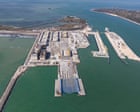
The Venice Experimental Electromechanical Module (MOSE) operates on a binary logic—up or down—that fails to account for the fluid dynamics of a rapidly accelerating climate reality. While the system was engineered to protect Venice from exceptional high tides, its operational threshold of 110cm is becoming a structural bottleneck. The current trajectory suggests that the city’s primary defense mechanism will soon be rendered obsolete by its own frequency of use. If the barriers are raised too often, the lagoon’s ecosystem suffocates; if they are raised too infrequently, the city’s architectural foundation dissolves. This creates a zero-sum game between ecological preservation and urban survival.
The Triad of Infrastructure Obsolescence
The failure of the current Venetian flood strategy is not a mechanical breakdown of the gates themselves, but a misalignment between three specific variables:
- Relative Sea Level Rise (RSLR): The combination of eustatic sea-level rise and local land subsidence.
- Lagoon Flushing Hydraulics: The necessity of tidal exchange to remove pollutants and oxygenate the water.
- Port Authority Logistics: The economic cost of closing the Malamocco, Chioggia, and Lido inlets to commercial and cruise traffic.
MOSE was designed based on climate projections from the 1980s and 1990s. Those models underestimated the rate of Arctic melt and thermal expansion. When the gates stay up for extended periods, the lagoon transforms from a tidal estuary into a stagnant pond. This accumulation of agricultural runoff and untreated sewage creates an anoxic environment, effectively killing the salt marshes that act as the city’s natural wave breaks.
The Cost Function of Defensive Persistence
Every time the MOSE system is deployed, it costs approximately 300,000 EUR in energy, personnel, and maintenance wear. However, the hidden economic cost is found in the disruption of the "Blue Economy."
The maritime industry requires predictable access. When the frequency of tide levels exceeding 110cm moves from an occasional winter event to a weekly occurrence, the harbor effectively closes. A study of the port's throughput indicates that if the barriers are raised 30 to 50 times a year—a scenario projected for the mid-2030s—the Port of Marghera loses its status as a viable Mediterranean hub. Logistics firms will reroute to Trieste or Ravenna, stripping Venice of its last non-tourism-based economic pillar.
The city is currently trapped in a sunk-cost fallacy. Having spent over 6 billion EUR on a system that took 40 years to complete, leadership is hesitant to admit that the "experimental" phase of MOSE has ended in a realization of its inadequacy. The barriers are a tactical success but a strategic failure.
Structural Decay and the Capillary Effect
Flood protection is not merely about preventing waves from entering the Piazza San Marco. The more insidious threat is the permanent saturation of the city's masonry. Venice is built on millions of Istrian pine piles driven into the caranto (a thick layer of clay). Above these piles sit layers of brick and Istrian stone.
The "Plan B" currently under discussion must address the capillary rise of salt water. When the tide stays consistently high—even if it doesn't overtop the sidewalks—saltwater is absorbed into the porous bricks. As the water evaporates, salt crystals expand, shattering the brick from the inside out. This process, known as salt crystallization, is accelerated by the MOSE system’s inability to lower the average water level; it only clips the peaks of the highest tides.
A viable strategy requires a shift from External Barrier Reliance to Internal Urban Hardening. This includes:
- Polderization of Low-Lying Zones: Creating localized, permanent waterproof perimeters around critical areas like the Basilica di San Marco, which sits at just 64cm above sea level.
- Permeable Pavement Revision: Replacing traditional masegni (volcanic stone) with drainage systems that utilize gravity-fed check valves to prevent backflow from the canals.
- The 10cm Margin: Engineering solutions that can mitigate a 110cm tide down to a 100cm impact, reducing the frequency of MOSE activation by an estimated 40%.
The Hydraulic Limit of the Lagoon
The lagoon is an open system that requires a specific volume of water—the tidal prism—to move in and out twice daily. MOSE interferes with this volume. The "Plan B" advocated by environmental scientists and engineers involves the "gradual closure" method, but this is a logistical nightmare.
If the gates are raised partially to allow some water flow, the turbulence created at the base of the barriers causes massive seabed erosion. This scouring effect threatens the structural integrity of the concrete housings that hold the gates. Therefore, the choice remains binary: total isolation or total exposure.
The "Plan B" must contemplate the "Inlet Narrowing" strategy. By physically narrowing the inlets with fixed underwater structures, the velocity of the incoming tide is increased while the total volume is restricted. This provides a passive reduction in tide height without the mechanical overhead or ecological shock of a full MOSE closure.
Quantification of the Transition Window
The window for a secondary strategy is narrowing. Based on current IPCC (Intergovernmental Panel on Climate Change) RCP 8.5 scenarios, the Mediterranean could rise by 60cm to 100cm by 2100. At the 50cm mark, the MOSE barriers would need to be closed almost daily.
At this frequency, the biological life of the lagoon ceases to function. The oxygen levels drop, and the sulfur-reducing bacteria begin to emit hydrogen sulfide, which further corrodes the very metal gates meant to protect the city. This creates a feedback loop of maintenance and decay.
The current "Plan B" is not a replacement for MOSE but a necessary accompaniment. It involves raising the city's ground level—insulamento—which was the traditional Venetian response to rising waters for centuries. By raising the pedestrian walkways and quays to a uniform 120cm, the city buys itself time. However, this requires a massive upheaval of the city’s social and commercial fabric, as ground-floor entries would essentially become basements.
Strategic Allocation of Capital
Investment must move away from "Hard Engineering" (gates and walls) toward "Soft Engineering" and "Dynamic Management." This includes the restoration of the "barene" (salt marshes). These marshes act as a sponge, absorbing the energy of the tide and reducing the height of the water through friction.
Currently, the lagoon is losing its marshes at an alarming rate due to the wake of large vessels and the altered hydrodynamics caused by the deep-water channels dug for industrial ships. Reclaiming these marshes is not an aesthetic choice; it is a vital component of the hydraulic defense of the city.
The strategic pivot for Venice involves a three-stage implementation:
Phase 1: Localized Sealing (Years 0-5)
Immediate completion of the glass barriers around the San Marco basin and the installation of high-capacity pumps in the lowest-lying insulae. This decouples the most vulnerable 5% of the city from the 110cm MOSE threshold.
Phase 2: Morphological Restoration (Years 5-15)
The systematic infilling of deep industrial channels (like the Canale dei Petroli) that act as highways for the incoming tide. By reducing the depth of these channels, the "wave speed" of the tide is slowed, allowing more time for the MOSE gates to react and reducing the peak height of the surge.
Phase 3: The Permanent Inflow Regulation (Years 15+ )
Transitioning from pivoting gates to a system of fixed, submerged reefs at the inlets. These reefs would be designed to allow 70% of tidal flow during normal conditions but use fluid dynamics—not mechanical movement—to restrict flow during high-velocity storm surges.
The reliance on a 20th-century solution for a 21st-century acceleration is a high-risk gamble. The data suggests that MOSE is a bridge, not a destination. The city must now prioritize the "Plan B" of internal resilience and morphological restoration or accept that its future will be defined by a stagnant, toxic lagoon and a crumbling foundation. The move from active, mechanical defense to passive, structural resilience is the only path that maintains both the architectural integrity and the ecological health of the Venetian basin.