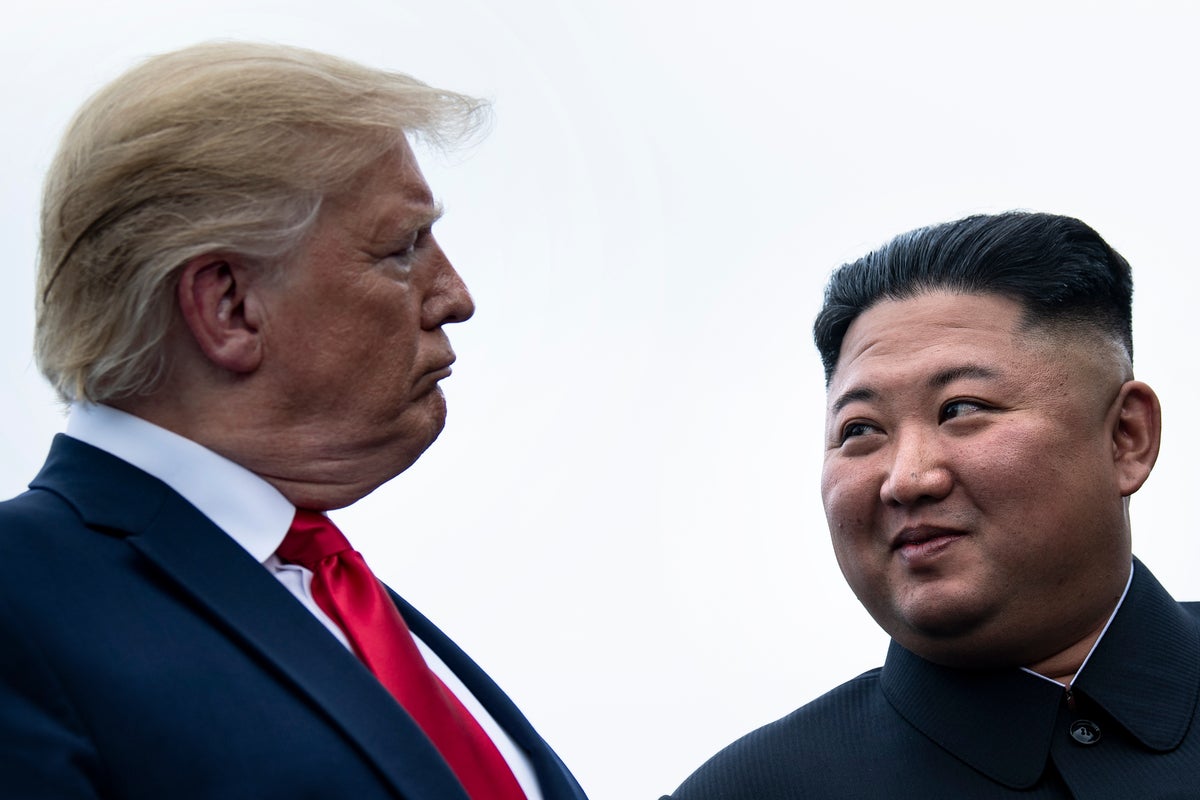
The foreign policy establishment is addicted to the "linkage" myth. You’ve seen the headlines. They suggest that as the Middle East burns, Donald Trump—should he return to the Oval Office—will use the chaos as a springboard to drag Kim Jong Un back to the table. The logic is as flimsy as a paper umbrella in a monsoon. The argument goes like this: Trump shows "strength" against Tehran, Kim gets spooked by the display of American kinetic power, and suddenly the "Great Successor" is ready to trade his ICBMs for a few franchised steakhouses in Pyongyang.
It’s a fantasy. It’s a fundamental misunderstanding of how revisionist powers actually operate in a multipolar world.
If you think Iran strikes pave the way for a North Korean breakthrough, you aren't paying attention to the math of the New Cold War. War in the Middle East doesn't pressure North Korea; it provides North Korea with a structural insurance policy.
The Myth of the "Symmetric Deterrent"
Mainstream analysts love to pretend that Kim Jong Un watches Tomahawk missiles hitting Houthi warehouses and thinks, "I’m next." In reality, Kim watches those strikes and thinks, "I’m glad I have a hydrogen bomb."
The "Lazy Consensus" suggests that U.S. military action acts as a universal deterrent. History screams the opposite. Look at the 2003 invasion of Iraq and the 2011 intervention in Libya. Pyongyang didn't look at Muammar Gaddafi’s grisly end and think about reform; they looked at it as a cautionary tale of what happens when a dictator gives up his nuclear program for "integration" into the global community.
Every time the United States engages in a hot war or a significant strike in the Middle East, it reinforces the North Korean doctrine of Byungjin—the simultaneous development of the economy and nuclear weapons. Except now, the "economy" part of that equation is being subsidized by the very chaos the West is trying to contain.
The Arsenal of Autocracy is a Growth Industry
While the beltway pundits talk about "diplomatic openings," they ignore the hardware. North Korea is no longer a hermit kingdom begging for food aid; it is a critical node in a burgeoning military-industrial complex that spans from Moscow to Tehran.
When Iran strikes or gets struck, the demand for affordable, "good enough" ballistics and drone technology spikes. North Korea is the ultimate sub-vendor. We are seeing a shift from a world where the U.S. could isolate "Rogue States" to a world where those states have formed their own closed-loop supply chain.
- Russian Artillery Needs: Pyongyang has shipped millions of shells to Russia for the war in Ukraine.
- Iranian Missile Lineage: The technological DNA of Iranian Shaho and Emad missiles often traces back to North Korean Nodong designs.
- The Proxy Feedback Loop: Every time an Iranian-backed proxy uses a system that North Korea helped design, Pyongyang gets free R&D data.
Why would Kim Jong Un trade away his leverage to Donald Trump when he can sell that leverage to Vladimir Putin and Ali Khamenei? The "Art of the Deal" fails when the counterparty has a better offer from someone who doesn't care about human rights or denuclearization.
Trump’s "Personal Diplomacy" is a Dead Variable
The obsession with the "bromance" between Trump and Kim is a distraction. In 2018 and 2019, there was a brief window where Kim felt he could perhaps bypass the U.S. State Department and secure a deal that left his nuclear status intact while lifting sanctions.
That window has been bricked over.
The geopolitical environment of 2026 is radically different from 2018. Back then, China and Russia were still, at least performatively, cooperating with the UN Sanctions Regime. Today, that cooperation is a corpse. Russia has openly used its veto power to kill the UN panel monitoring North Korean sanctions. China provides a massive back-door for North Korean labor and coal.
If Trump returns, he isn't walking into a room where he holds all the cards. He’s walking into a room where Kim Jong Un has already been "paid out" by the Kremlin.
The Cost of Logic: Why This Sucks for the West
Admitting this is uncomfortable. It means acknowledging that the era of "Global Policeman" is over.
- Sanctions are failing: When you sanction everyone (Russia, Iran, North Korea), you eventually create a "Sanctioned-Zone" economy that functions independently of the Dollar.
- Extended Deterrence is fraying: Seoul and Tokyo are watching the U.S. get bogged down in Middle Eastern skirmishes and are asking themselves if Washington would really trade San Francisco for Seoul.
- The "Big Deal" is a delusion: There is no version of a nuclear-free North Korea that doesn't involve a regime change that nobody has the stomach for.
The Intelligence Failure of "Signals"
We love to talk about "sending signals."
"We struck a base in Syria to send a signal to Pyongyang."
This is the peak of Western hubris. It assumes the recipient of the signal interprets it through your lens. Kim Jong Un doesn't see a "signal of resolve." He sees a U.S. military that is overstretched, a U.S. Congress that is divided, and a U.S. public that is weary of "forever wars."
Every Tomahawk fired in the Middle East is one fewer Tomahawk available for the Pacific theater. In a world of finite industrial capacity—where the U.S. is struggling to produce enough 155mm shells for its own allies—Kim Jong Un knows that the more the U.S. "asserts" itself in the Levant, the thinner it spreads its actual power in the East.
Stop Asking if Talks Will Restart
The question "Will Iran strikes restart nuclear talks?" is the wrong question. It’s a category error.
The real question is: "Does North Korea even need to talk anymore?"
The answer is a resounding no. Kim has achieved what his father and grandfather could only dream of: a functional, diversified nuclear triad and a seat at the table of a new anti-Western bloc. He doesn't need a photo op in Singapore. He doesn't need a "big deal" from a populist president.
He needs the Middle East to stay exactly as it is—chaotic, distracting, and expensive for the Americans.
The idea that Trump can walk back into the room and "fix" this through sheer force of personality is a vanity project. The structural realities of the 2020s—the death of the unipolar moment—mean that Kim Jong Un is no longer a "problem" to be solved. He is a permanent fixture of the landscape, and he’s currently winning.
The status quo isn't waiting for a "spark" from a Middle Eastern war to ignite diplomacy. It’s using that war as a shield to finish the job of becoming a permanent, untouchable nuclear power.
If you’re waiting for a grand bargain, you’re not reading the map. You’re reading a fairy tale.
Get used to a nuclear North Korea. It’s the only part of this situation that isn't a bluff.


