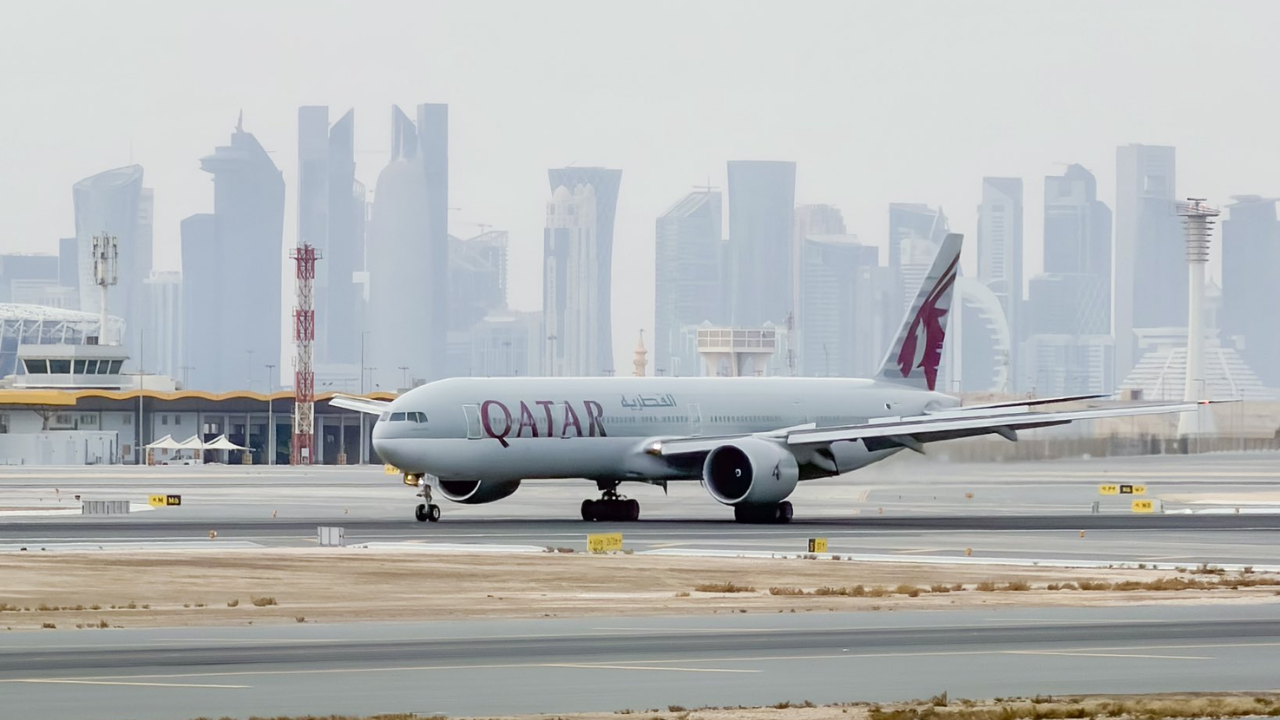
The suspension of Qatar Airways flight operations into specific conflict zones is not merely a reactive safety measure; it is a calculated optimization of the carrier’s Risk-Yield Function. When a National Aviation Authority (NAA) or a carrier’s internal security apparatus identifies a "continued airspace closure," the decision to extend a suspension involves a complex interplay between passenger safety, asset preservation, and the structural integrity of the global hub-and-spoke network. In the current geopolitical environment, these extensions signal that the probability of a "Kinetic Event"—an active engagement or accidental shoot-down—exceeds the carrier's internal risk tolerance threshold, which is historically lower for state-backed flagship carriers than for private entities.
The Triple Constraint of Airspace Management
Airlines operating in volatile regions must balance three competing variables that dictate the feasibility of a route. When one variable fails, the entire route becomes a liability.
- Sovereign Regulatory Mandates: This is the "Hard Stop." If a country closes its FIR (Flight Information Region) or if a regulatory body like the FAA or EASA issues a NOTAM (Notice to Air Missions) prohibiting overflight, the carrier has no legal path.
- Hull Insurance and War Risk Premiums: The economic viability of a flight is tied to insurance. As regional tensions escalate, underwriters increase premiums for "War Risk" coverage. At a certain price point, the marginal cost of the insurance premium outweighs the ticket revenue generated by the flight, forcing a suspension regardless of whether the skies are technically "open."
- Operational Contingency Buffers: A carrier like Qatar Airways operates on a "Time-Certain" model. If an alternate route requires a 90-minute detour to bypass closed airspace, the aircraft may lack the fuel reserves for a safe diversion or may miss its subsequent arrival slot in Doha (DOH), causing a cascade of missed connections across the global network.
The Cost of Rerouting Logic
When a suspension is announced or extended, the immediate secondary effect is the reconfiguration of the "Great Circle" route. This is the shortest distance between two points on a sphere. Airspace closures force aircraft onto sub-optimal paths.
The physics of this rerouting creates a Fuel-Payload Tradeoff. An aircraft forced to fly 500 miles out of its way must carry more fuel. Because every aircraft has a Maximum Takeoff Weight (MTOW), every extra kilogram of fuel loaded to bypass a conflict zone is one less kilogram available for high-yield cargo or passengers. For long-haul carriers, this often results in "weight shedding," where the airline must intentionally leave seats empty to remain within safety parameters for the longer, less efficient route.
Strategic Vulnerabilities in Hub-and-Spoke Networks
Qatar Airways utilizes a "Super-Connector" strategy, centered on the Hamad International Airport hub. This model is hyper-sensitive to regional instability for two structural reasons:
- The Geographic Chokepoint: Unlike carriers based in the United States or China, which have vast domestic airspace, Qatar is geographically small and surrounded by FIRs controlled by other nations. A closure in a neighboring FIR (such as Iran, Iraq, or Saudi Arabia) can effectively "hem in" the carrier, requiring complex diplomatic and technical coordination to maintain a single exit/entry corridor.
- Connection Density: If flights to a specific region—for example, the Levant—are suspended, the impact isn't limited to that destination. It degrades the load factor on "Feeder" flights from London, New York, or Bangkok. If 30% of a London-to-Doha flight is composed of passengers connecting to a now-suspended destination, the London-to-Doha leg may also become unprofitable, leading to a broader contraction of the flight schedule.
Quantifying the Kinetic Risk
The technical justification for an extension usually stems from an assessment of Surface-to-Air Missile (SAM) capabilities within the closed region. Aviation analysts categorize these risks into two tiers:
- Tier 1: High-Altitude Integrated Air Defense Systems (IADS). These systems, such as the S-300 or Patriot, can target commercial aircraft at cruising altitudes (FL300 and above). The presence of active IADS in a conflict zone during "high-alert" status makes civilian overflight an unacceptable risk, as seen in the MH17 and PS752 incidents.
- Tier 2: MANPADS (Man-Portable Air-Defense Systems). These are shorter-range threats. While they cannot hit an aircraft at 35,000 feet, they represent a terminal threat during the takeoff and landing phases. If a destination airport cannot guarantee a "clean" perimeter of at least 10-15 kilometers, the airline cannot safely operate the approach or departure.
The Logistics of Passenger Displacement
Extending a suspension triggers a massive logistical "re-accommodation" engine. This is not a manual process; it is managed by Passenger Service Systems (PSS) that use algorithms to prioritize passengers based on:
- Yield and Loyalty Tier: High-value frequent flyers and business class passengers are re-routed onto partner Oneworld alliance carriers (like British Airways or American Airlines) first.
- Interline Agreements: Qatar Airways must pay other airlines to carry their displaced passengers. This represents a direct "Cash Outflow" to competitors, turning a potential profit into a settled debt.
- Duty of Care Liabilities: Under regulations like EU261, airlines may be responsible for hotel and meal costs for passengers stranded at mid-points in their journey. For a global carrier, a multi-day suspension can result in millions of dollars in non-operational overhead.
Structural Limitations of the Suspension Strategy
While suspensions protect assets, they create a "Credibility Gap" in the market. Consistent reliability is the primary product of a premium airline.
- Network Erosion: Frequent travelers may shift their loyalty to carriers that have more stable geographic footprints or those whose home governments maintain "neutral" airspace agreements.
- Cargo Chain Disruption: Modern electronics and perishables rely on "belly cargo" in passenger planes. A suspension disrupts just-in-time supply chains, forcing freight forwarders to move to dedicated cargo carriers or sea-freight, which are harder to win back once the airspace reopens.
The Recovery Horizon
The decision to resume flights is rarely a binary "Yes/No" based on the cessation of hostilities. It follows a Verification and Validation (V&V) protocol. First, the carrier must perform a "Proving Flight" or a technical assessment of the ground infrastructure to ensure that Air Traffic Control (ATC) radar, ground handling, and emergency services are fully functional. Second, the carrier must wait for the "War Risk" insurance rating of the destination to be downgraded to a manageable level.
The persistence of airspace closures in the Middle East and Eastern Europe suggests a shift toward a "Permanent Contingency" state. Carriers are no longer looking for a return to the 2010-era status quo; they are instead investing in digital twins of their networks to simulate "Instantaneous Rerouting" capabilities. This allows them to switch between pre-planned Flight Plan A, B, and C within minutes of a NOTAM being issued.
Airlines must now prioritize "Airspace Agility" over "Route Density." The strategic play for Qatar Airways involves diversifying its transit corridors and deepening its codeshare agreements with carriers outside the immediate conflict zone. By offloading the operational risk of the "final leg" to regional partners while maintaining the long-haul "trunk" routes, the carrier can insulate its balance sheet from the volatility of localized airspace closures. The extension of a suspension is not an admission of defeat; it is a tactical withdrawal to preserve the fleet's operational capacity for more stable, high-margin markets.