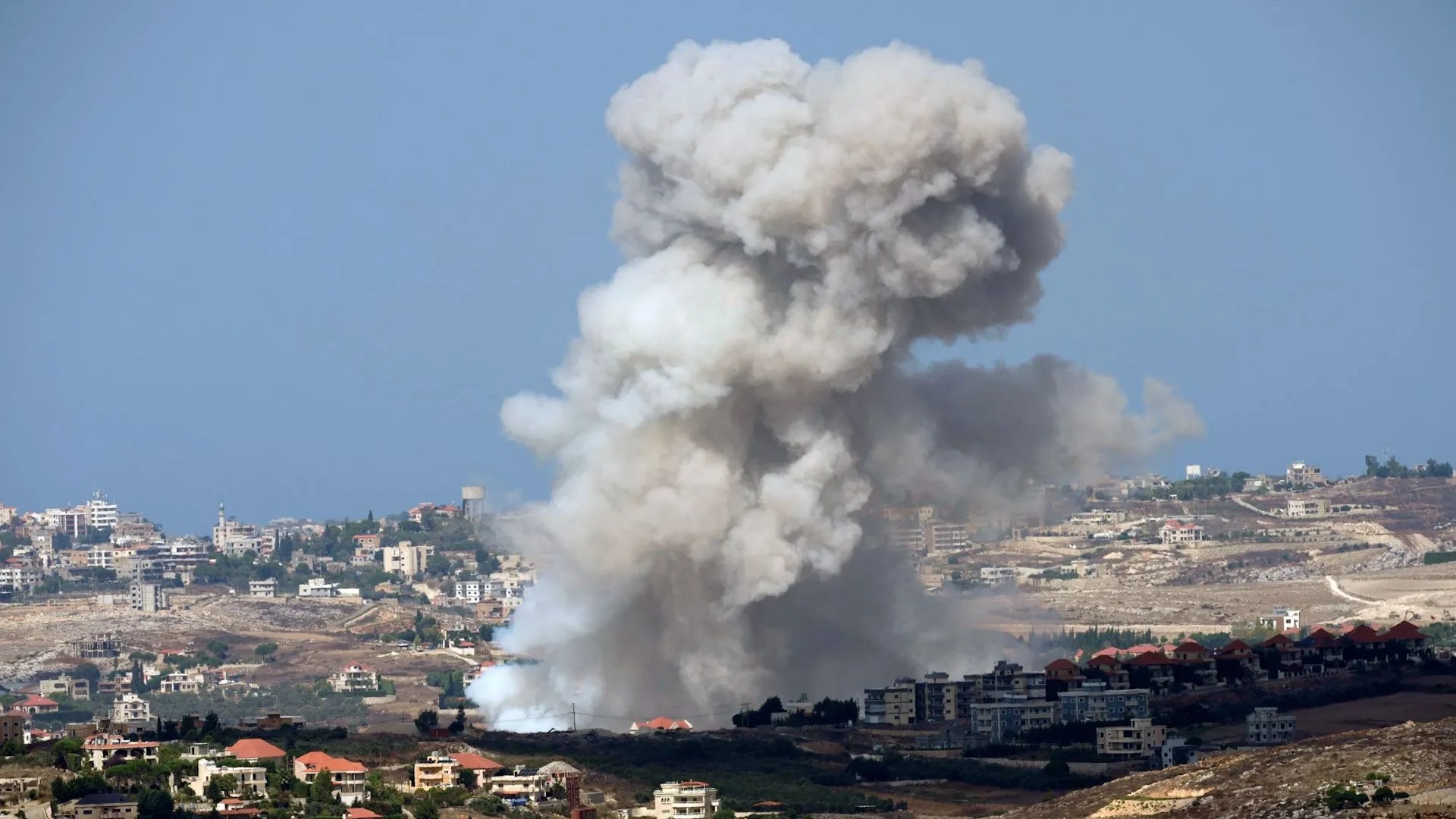
The current expansion of Israeli military operations from direct engagement with Iranian assets to secondary and tertiary fronts represents a calculated shift in regional attrition modeling. While surface-level reporting focuses on the immediate devastation of air strikes, the underlying strategic logic reveals a deliberate effort to dismantle the "Ring of Fire" architecture. This doctrine relies on exhausting an adversary’s interceptor stockpiles, degrading their command-and-control (C2) nodes, and forcing a recalibration of their risk-reward calculus through asymmetric kinetic pressure.
The Triad of Deterrence Erosion
Israel’s recent strikes against sovereign Muslim states following its direct exchange with Tehran are not isolated incidents of aggression. They function as components of a broader strategy to decouple regional proxies from their primary benefactor. This strategy rests on three distinct pillars:
- Node Decapitation: Targeting mid-level operational commanders who bridge the gap between Iranian strategic intent and local tactical execution.
- Logistical Interdiction: Identifying and destroying the "Land Bridge" infrastructure—warehouses, transport hubs, and border crossings—that facilitate the flow of precision-guided munitions (PGMs).
- Sovereignty Taxation: Forcing host governments to choose between the internal stability of their regime and the continued presence of paramilitary groups that draw Israeli fire.
The failure of previous "mowing the grass" strategies necessitated a transition to "structural uprooting." In this model, the objective is not to kill every combatant but to render the environment so hostile to specialized hardware—such as radar arrays and drone launch pads—that the cost of maintaining the presence exceeds its strategic utility for Tehran.
The Cost Function of Regional Engagement
Military engagement in a multi-front theater is governed by a strict resource constraint. For Israel, the primary variable is the Intercept-to-Impact Ratio. Every missile fired by a proxy forces Israel to expend a Tamir (Iron Dome) or Arrow interceptor. These interceptors are exponentially more expensive to produce than the unguided rockets they destroy.
To solve this economic imbalance, Israel has shifted toward Preemptive Neutralization. By striking launch sites and storage facilities in neighboring countries before a launch sequence is initiated, the IDF effectively resets the cost function.
- Fixed Costs: Maintaining a standing air force and intelligence apparatus.
- Variable Costs: The price of munitions used in a specific raid.
- Opportunity Costs: The diplomatic capital spent and the risk of triggering a total regional war.
The current strikes demonstrate that the IDF high command believes the opportunity cost of inaction—allowing proxies to harden their positions—now outweighs the diplomatic fallout of violating the airspace of neighboring nations.
Information Asymmetry and Intelligence Dominance
The precision of these strikes suggests a profound breach in the internal security of the targeted entities. Effective kinetic operations against mobile targets like truck-mounted launchers require real-time, actionable intelligence with a latency period of less than five minutes. This indicates that Israel has achieved Signal Hegemony.
This dominance is achieved through the integration of:
- ELINT (Electronic Intelligence): Monitoring high-frequency communications and burst transmissions.
- HUMINT (Human Intelligence): Local assets providing visual confirmation of high-value targets (HVTs).
- AI-Driven Pattern Recognition: Algorithms that identify "anomalous movement" patterns in civilian infrastructure, signaling the hidden transport of weaponry.
When an Israeli strike hits a specific floor of a building or a specific vehicle in a convoy, it serves a psychological function beyond the physical damage. it signals to the adversary that their internal communications are transparent. This creates a "Paranoia Loop," where the target spends more time purging its own ranks for informants than planning offensive maneuvers.
The Geography of Escalation
The expansion of conflict into a second and third Muslim nation is dictated by the Transversal Threat Map. Military planners do not view borders as legal boundaries but as terrain features that offer either concealment or exposure.
The Northern Arc
Strikes in this sector target the depth of the logistical chain. If weapons arrive via air at international airports, those airports become legitimate military targets under the "Dual-Use Infrastructure" doctrine. The logic is simple: if a civilian facility facilitates the movement of military hardware, it loses its protected status.
The Southern Corridor
Operations here focus on maritime security and the prevention of blockade tactics. The goal is to ensure that shipping lanes remain open, as the Israeli economy is highly dependent on sea-borne trade. Any state allowing its territory to be used as a launchpad for anti-ship missiles becomes a focal point for "Response Dominance."
Limitations of Kinetic Solutions
While air superiority allows for high-impact destruction, it possesses inherent structural limitations.
- The Reconstitution Rate: Militias can often rebuild underground facilities faster than an air force can map them.
- Political Backlash: Sustained bombing campaigns can radicalize neutral populations, providing a fresh recruitment pool for the very groups being targeted.
- The Interceptor Bottleneck: While Israel's offensive capabilities are near-limitless, its defensive inventory (Interceptors) is finite and dependent on US manufacturing timelines.
Strategic Forecast: The Shift to Territorial Buffers
We are entering a phase where "Stand-off" strikes will no longer be sufficient to meet Israeli security objectives. The logical progression from high-intensity bombing is the establishment of Active Buffer Zones.
This involves:
- Automated Kill Zones: Utilizing AI-monitored sensors and remote weapon stations to prevent movement within 5-10km of the border.
- Economic Disincentivization: Systematically targeting the financial assets and "shadow businesses" that fund regional militancy.
- Direct Attribution: Moving away from fighting "proxies" and instead holding the host nation or the primary sponsor (Iran) directly accountable for every projectile fired.
The immediate strategic play for regional actors is the "Hardening of the Interior." However, as Israeli intelligence continues to bypass physical fortifications through cyber and signal penetration, the only viable long-term defense for these nations is the total removal of non-state military assets from their soil. Failure to do so will result in a permanent state of "Kinetic Friction," where the infrastructure of the state is systematically dismantled to reach the hidden hardware of the insurgent.