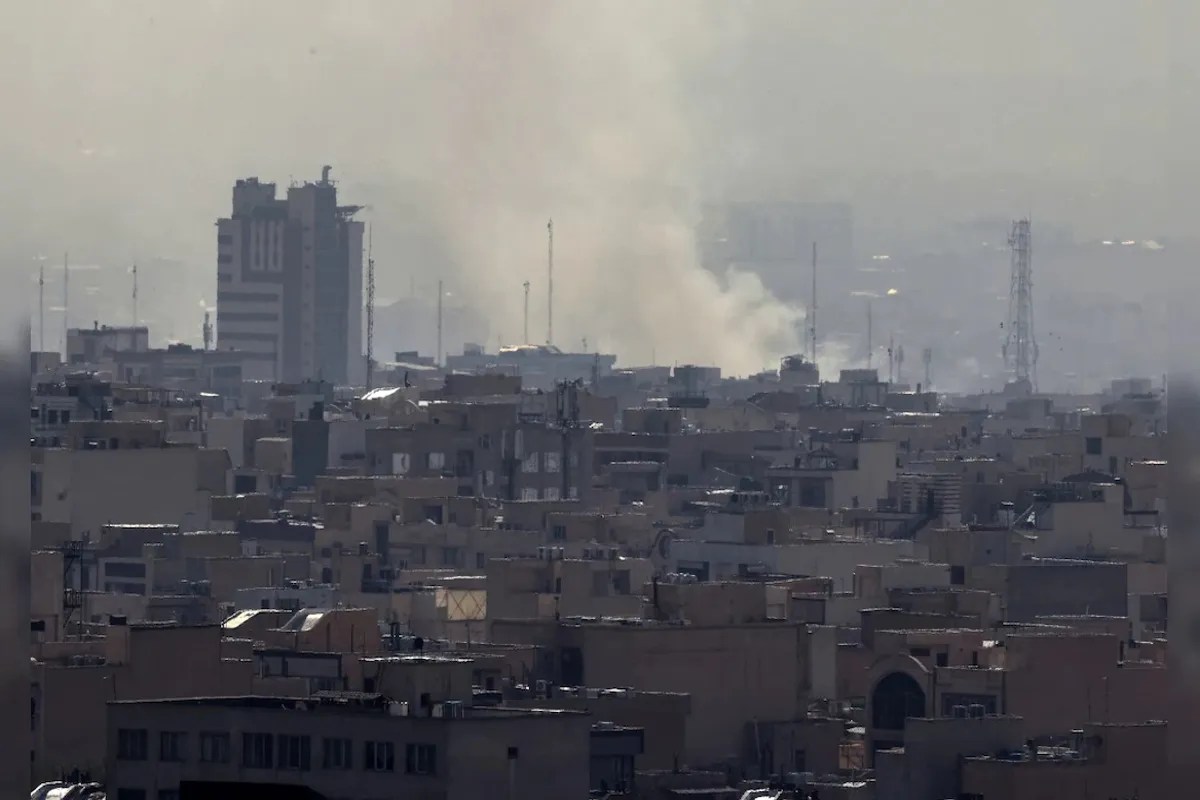
The survival of the Iranian clerical establishment currently rests on a precarious calculation of "Escalation Dominance"—the ability to increase the stakes of a conflict in a way that forces an opponent to de-escalate. Tehran’s vow of a "crushing response" following the October 2024 Israeli strikes is not merely rhetorical bravado; it is a strategic necessity to restored a collapsed deterrence framework. When Israel successfully bypassed Iranian integrated air defense systems (IADS) to neutralize missile production facilities and S-300 batteries, it effectively devalued Iran’s primary defensive currency. To understand the trajectory of this conflict, one must analyze the kinetic variables, the structural limitations of Iranian proxies, and the shifting threshold of US intervention.
The Triad of Iranian Deterrence
Iran’s national security architecture has historically relied on three distinct but interconnected pillars. The failure of any single pillar places asymmetric pressure on the remaining two.
- Strategic Depth via Non-State Actors: The "Axis of Resistance" (Hezbollah, Hamas, Houthis, and Iraqi militias) serves as a forward-deployed deterrent. By positioning thousands of rockets on Israel’s borders, Iran ensured that any direct strike on its soil would result in a multi-front saturation of Israeli missile defenses.
- The Missile and Drone Ecosystem: Lacking a modern air force, Iran invested in the Middle East’s largest ballistic missile arsenal. The technical objective is "Saturation Logic"—firing enough projectiles to overwhelm the Iron Dome, David’s Sling, and Arrow systems through sheer volume.
- The Threshold of Nuclear Latency: By maintaining a breakout time measured in weeks rather than months, Iran creates a "hedging" effect. This forces Western powers to calibrate their kinetic responses to avoid pushing Tehran into a final sprint toward a weaponized device.
The degradation of Hezbollah’s leadership structure and the depletion of its mid-range missile inventory have severely compromised the first pillar. This leaves Tehran with a binary choice: accept a new status quo where its territory is vulnerable, or utilize its second pillar—direct ballistic strikes—at the risk of a total regional war that could threaten the regime's domestic stability.
The Calculus of Kinetic Exchange
The October 26 Israeli strikes, dubbed "Operation Days of Repentance," targeted the specific industrial bottlenecks required for Iran’s solid-fuel missile production. Specifically, the destruction of planetary mixers used to create rocket propellant serves as a "force decelerator." These machines are highly specialized, subject to international sanctions, and have long lead times for replacement.
By targeting these, Israel did not just strike back; it engaged in Counter-Value Attrition. The logic is as follows: If Iran launches its remaining inventory, it cannot replenish that inventory at the previous rate. This creates a "Depletion Trap."
The Depletion Trap Variables
- Inventory Velocity: The rate at which Iran can move missiles from hardened silos to launch positions.
- Interception Ratios: The cost-exchange ratio between an Iranian Fattah-1 missile (est. $100,000 - $200,000) and an Israeli Arrow-3 interceptor (est. $2,000,000 - $3,500,000).
- Success Probability ($P_s$): The likelihood of a warhead penetrating the terminal phase of defense.
Even if the cost-exchange ratio favors Iran financially, the absolute scarcity of interceptors versus missiles determines the winner of a prolonged exchange. Israel’s reliance on US resupply (the deployment of the THAAD system and its operators) indicates that the "interceptor ceiling" is the primary vulnerability in the Western defense model.
Structural Vulnerabilities in Iranian IADS
The "crushing response" promised by Supreme Leader Ali Khamenei must account for the demonstrated transparency of Iranian airspace. The neutralization of the S-300 PMU2 batteries—Russia’s premier export air defense system—revealed a critical failure in electronic warfare and radar integration.
Iranian air defense operates on a "Point Defense" philosophy rather than a "Networked Area" philosophy. This creates "Shadow Zones" where low-observable (stealth) aircraft, such as the F-35I Adir, can operate with near-impunity. For Iran to execute a meaningful response, it must solve the problem of Return-Fire Vulnerability. Any launch of a massive missile wave provides a heat signature that triggers immediate counter-battery fire. Without functioning S-300s or the indigenous Bavar-373 performing at peak levels, the launch sites themselves become "Sinkholes" for Iranian assets.
The Role of US Power Projection as a Friction Multiplier
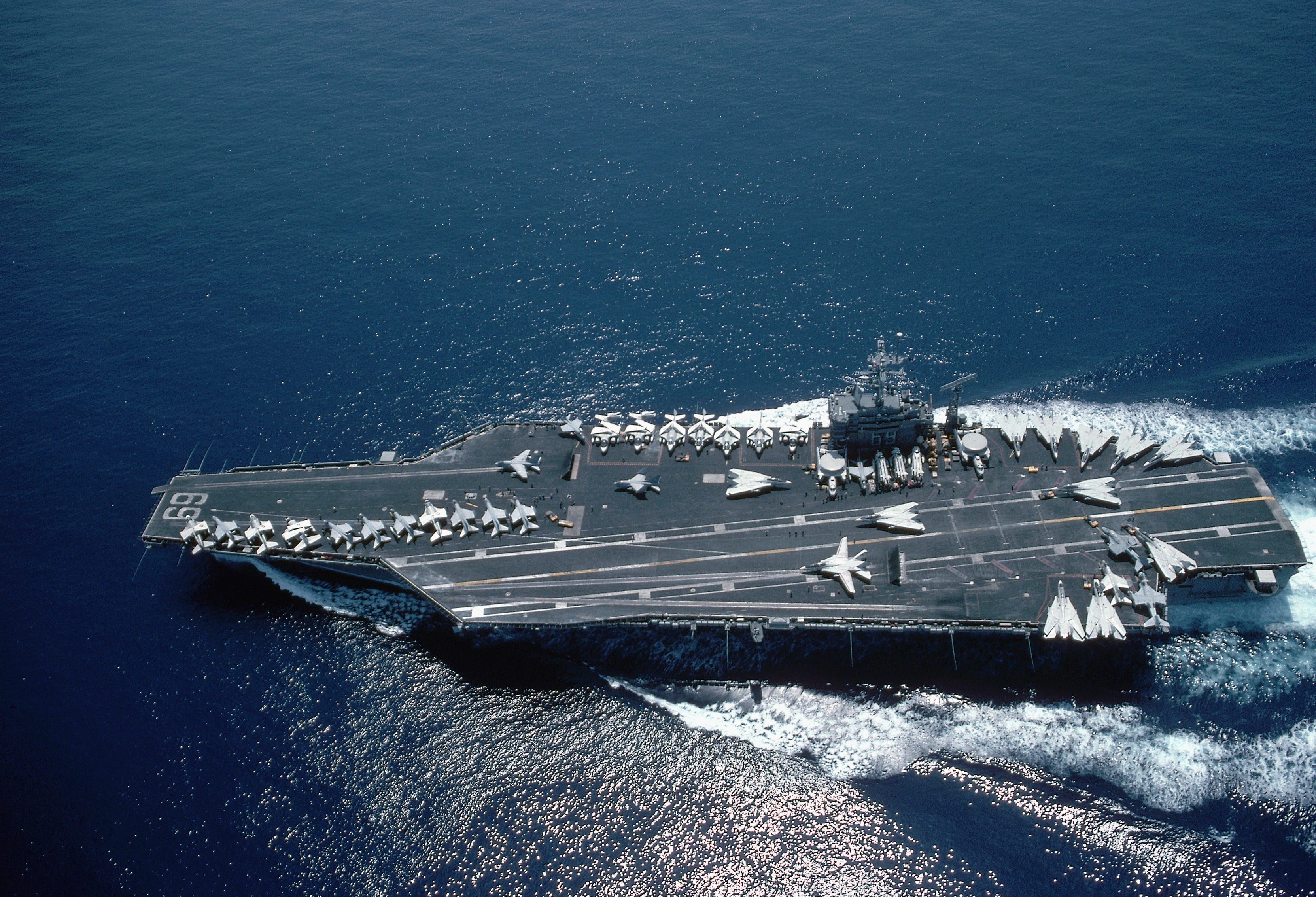
The involvement of the United States is no longer restricted to diplomatic signaling. The movement of B-52 Stratofortress bombers to the region and the integration of the THAAD (Terminal High Altitude Area Defense) system into Israel’s grid change the math of Iranian planners.
US intervention introduces Functional Complexity to Iran's targeting.
- If Iran strikes US assets, it triggers a direct conflict with a superpower, which the IRGC (Islamic Revolutionary Guard Corps) is not equipped to win.
- If Iran ignores US assets and focuses solely on Israel, it must bypass a joint US-Israeli sensor net that provides 360-degree, multi-layered telemetry.
This creates a "Strategic Bottleneck." To achieve a "crushing" blow, Iran needs to increase the volume of its fire. However, increasing volume increases the time required for fueling and preparation, which in turn increases the window for a pre-emptive "Left of Launch" strike by Israeli or US forces.
Economic and Domestic Constraints on Total War
A data-driven analysis must include the internal pressures facing the Iranian state. The Iranian Rial’s volatility is directly correlated with the rhetoric of war. Every time a "crushing response" is promised, the capital flight from Tehran accelerates.
The Iranian leadership faces a Regime Survival Trade-off:
- Kinetic Escalation: Increases nationalist fervor but risks the destruction of critical energy infrastructure (Abadan refinery, Kharg Island), leading to total economic collapse and internal rioting.
- Strategic Patience: Preserves infrastructure but signals weakness to the "Axis of Resistance," potentially leading to the fracturing of proxy loyalty and domestic hardline dissent.
The "crushing response" is therefore likely to be calibrated to maximize optical impact while minimizing "Red Line" triggers that would invite an attack on oil or nuclear facilities. This often manifests in "Symbolic Saturation"—launching high volumes of older-generation missiles at high-value military targets (like the Nevatim airbase) to claim a propaganda victory regardless of the actual damage assessed by satellite imagery.
The Intelligence Asymmetry
A critical factor often ignored in standard reportage is the "Intelligence Gap." The precision of the October 26 strikes suggests a deep penetration of the Iranian military-industrial complex. Israel’s ability to locate and destroy specific mixing buildings while leaving adjacent structures intact indicates a high-fidelity target set provided by human intelligence (HUMINT) and signals intelligence (SIGINT).
For Iran to respond effectively, it must first "Purge the System." An effective counter-strike requires operational security (OPSEC) that Tehran currently lacks. If the plan for a "crushing response" is known to Israeli intelligence 48 hours before the first engine ignites, the response will be intercepted or neutralized before it reaches the "Kinneret Line."
The Emerging Architecture of Middle Eastern Conflict
The conflict has moved beyond the "Shadow War" phase into a "High-Intensity Attrition" phase. The previous rules of engagement, which dictated that direct attacks on sovereign soil were avoided, have been discarded. We are now seeing the implementation of Dynamic Deterrence.
In this model, deterrence is not a static state of "no war," but a constant process of calibrated violence used to signal limits. The danger of this model is "Signal Noise"—the possibility that one side misinterprets a "limited" strike as a "total" strike, triggering an unintended climb up the escalation ladder.
The Iranian strategy will likely pivot toward a "Multi-Domain Saturation" attempt. This would involve:
- Cyber-Kinetic Coordination: Attempting to disable Israeli civil or military infrastructure via cyberattacks seconds before a missile arrival to delay emergency response.
- Sub-Regional Distraction: Utilizing Iraqi militias or the Houthis to launch "decoy" waves to deplete interceptor stocks before the primary Iranian salvo arrives.
- The "Dead Man's Switch" Signaling: Explicitly moving nuclear-capable assets or changing the public nuclear doctrine to warn the US and Israel that further escalation will result in a permanent shift in Iran’s non-proliferation status.
The operational reality is that Iran’s "crushing response" is limited by the physical degradation of its propellant production and the exposure of its air defense gaps. Any response that does not fundamentally change the "Transparency" of Iranian airspace is merely a tactical delay of an inevitable strategic realignment.
The move for Tehran is no longer about winning a kinetic exchange, but about surviving the transition to a post-proxy era. The strategic play for the West and Israel is the continued "Salami Slicing" of Iranian capabilities—removing pieces of the deterrent triad one by one until the regime is forced to negotiate from a position of systemic vulnerability or face internal collapse as the "Shield of the Revolution" is proven to be porous.