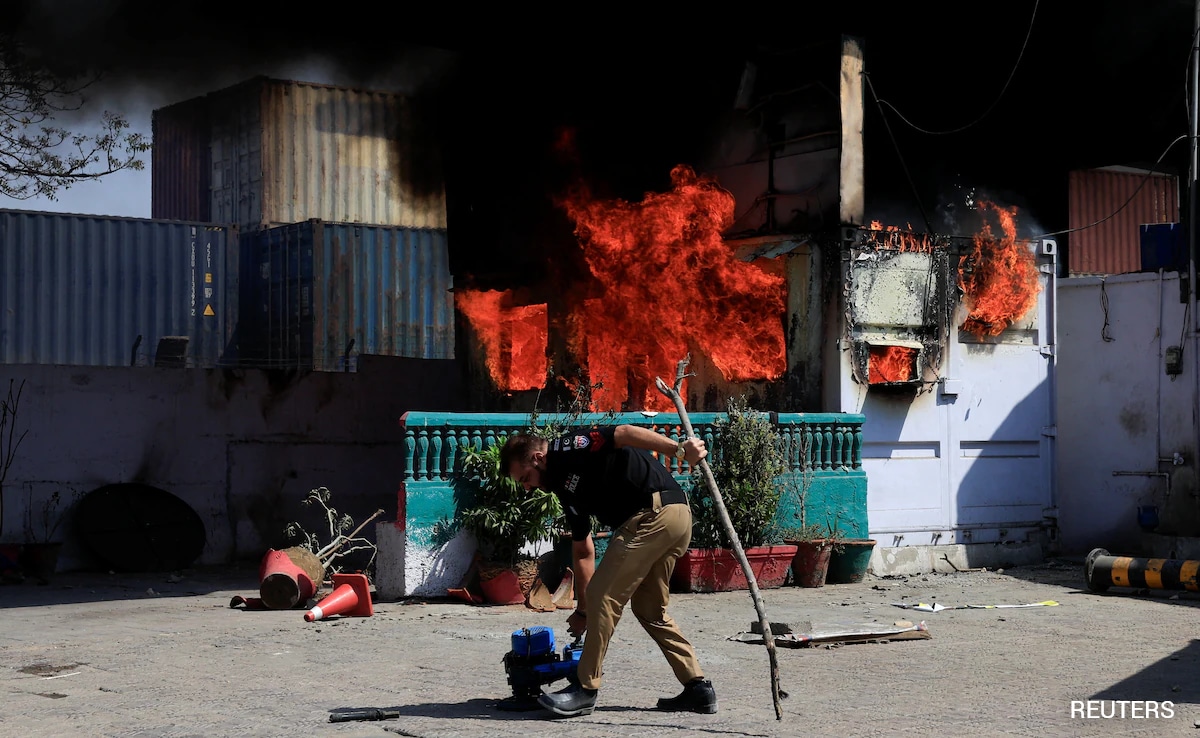
The Department of State’s decision to mandate the departure of non-essential consular staff from Karachi and Lahore functions as a calibrated reduction of the "exposure surface" in a high-volatility environment. This is not a reactive gesture to a singular event but a calculated adjustment of the Risk-Resource Equation. When the cost of securing personnel exceeds the diplomatic utility of their physical presence, the State Department shifts from an "Active Engagement" posture to a "Critical Operations" framework.
The current withdrawal operates under the logic of Strategic Consolidation. By thinning the footprint in regional hubs like Karachi—Pakistan’s financial center—and Lahore—its cultural heart—the United States centralizes its defensive capabilities at the Embassy in Islamabad. This creates a more defensible perimeter while maintaining a "skeleton key" of core diplomatic functions. If you liked this article, you might want to check out: this related article.
The Triad of Threat Assessment
Diplomatic security officials utilize a tripartite framework to justify a departure order. This framework moves beyond vague "security concerns" and identifies specific failure points in the host nation’s protective environment.
- Host Nation Capacity Degradation: The fundamental assumption of diplomatic presence is that the host country can and will provide "Outer Ring" security. If local law enforcement is overstretched by internal political unrest or a surge in domestic militancy, the host nation’s ability to fulfill its obligations under the Vienna Convention on Consular Relations diminishes.
- Specific Intelligence Thresholds: Departure orders typically follow the crossing of a "tripwire"—a specific, credible, and non-specific threat that targets soft spots in the diplomatic infrastructure. Non-essential staff and family members represent the highest volume of "soft targets" with the lowest operational ROI.
- Proximity to Volatility Triggers: Karachi and Lahore are high-density urban environments where the "flash-to-bang" time for civil unrest is near zero. Unlike the more insulated Green Zone-style configurations of Islamabad, these consulates are embedded in the urban fabric, making extraction logistics exponentially more complex during a crisis.
The Economic and Operational Cost Function
Reducing staff is an expensive and logistically intensive maneuver. The decision is governed by a Cost-Benefit Ratio where $C$ is the cost of evacuation and $R$ is the residual risk of staying. For another perspective on this development, check out the latest coverage from USA Today.
- The Logistical Friction: Moving staff requires the suspension of visa services, American Citizen Services (ACS), and trade missions. This creates a massive backlog that can take months or years to clear.
- The Intelligence Gap: Physical presence is the primary driver of "Human Intelligence" (HUMINT) and local political reporting. When the U.S. shutters floors of a consulate, it loses the granular, street-level pulse of the region, effectively "going dark" on local dynamics.
- The Signaling Cost: A departure order is a potent piece of non-verbal communication. It signals to the international community and the Pakistani government that the U.S. lacks confidence in the current stability trajectory. This often triggers a "cascade effect" where other Western missions and multinational corporations follow suit, leading to capital flight.
Structural Constraints of the Pakistan Mission
The U.S. presence in Pakistan faces a unique set of structural constraints that make "Ordered Departure" a frequent tool in the State Department's kit.
The Urban Guerilla Variable
In Karachi, the threat profile is a mix of organized crime, sectarian violence, and anti-Western militancy. The geography of the city—a sprawling megacity with limited choke points—means that even a standard commute for a consular officer involves a high degree of "unmanaged transit risk."
The Political Flux Coefficient
Pakistan’s internal political cycle often uses anti-American sentiment as a populist lever. When political rhetoric shifts toward "Sovereignty Protection," the physical safety of U.S. personnel is directly correlated to the volume of the political discourse. This creates a cyclical need for staff reductions during periods of high political heat.
The Hierarchy of Departure Orders
To understand the severity of the current situation, one must distinguish between the varying levels of State Department directives:
- Authorized Departure (AD): Voluntary. The State Department pays for the travel of those who wish to leave. This is a "warning shot."
- Ordered Departure (OD): Mandatory. This is the current status for Karachi and Lahore. Non-essential personnel must leave. This indicates that the risk level has moved from "elevated" to "unacceptable."
- Suspension of Operations: The complete shuttering of a post. This is a final stage, usually preceding a total break in local diplomatic activity.
The shift to Ordered Departure specifically for Karachi and Lahore while maintaining Islamabad at a higher staffing level suggests that the threat is geographically concentrated or that the defensive posture of the consulates is deemed inferior to the Embassy’s fortified structure.
Operational Impact on Bilateral Relations
The immediate result of this drawdown is the stagnation of soft power. Consular staff in Lahore and Karachi manage educational exchanges, cultural programs, and small-business grants. Removing these individuals severs the "connective tissue" between the two nations.
The remaining "Essential Personnel" are forced to pivot exclusively to "Hard Power" concerns: counter-terrorism, intelligence sharing, and high-level military liaison. This narrows the bilateral relationship to a purely transactional security lens, stripping away the nuanced layers of civilian engagement that provide long-term stability.
Strategic Forecast and Implementation
The U.S. is currently moving into a "Fortress Diplomacy" phase. This involves a three-step tactical pivot:
- Remote Processing: Visa and administrative functions will be shifted to regional hubs (such as Dubai or Doha) or handled via secure telepresence. This mitigates physical risk but increases the "Bureaucratic Lag."
- Hardened Extraction Readiness: With fewer personnel on the ground, the remaining "Essential" staff can be evacuated via a much smaller, faster footprint (e.g., a single rotary-wing lift) if the situation degrades further.
- Intelligence Outsourcing: The State Department will increasingly rely on technical means (SIGINT) and third-party local contractors to fill the information void left by the departing consular officers.
The strategic play for the Pakistani government is to demonstrate a "Security Reset" by providing high-visibility protection to the remaining assets in Islamabad. Failure to do so will likely result in a secondary drawdown at the Embassy itself. For the United States, the move signals a transition from "Partnership Building" to "Risk Containment." The immediate focus must be the hardening of the Islamabad perimeter and the establishment of a "virtual consulate" model to maintain essential services without the physical vulnerability of distributed staff.


