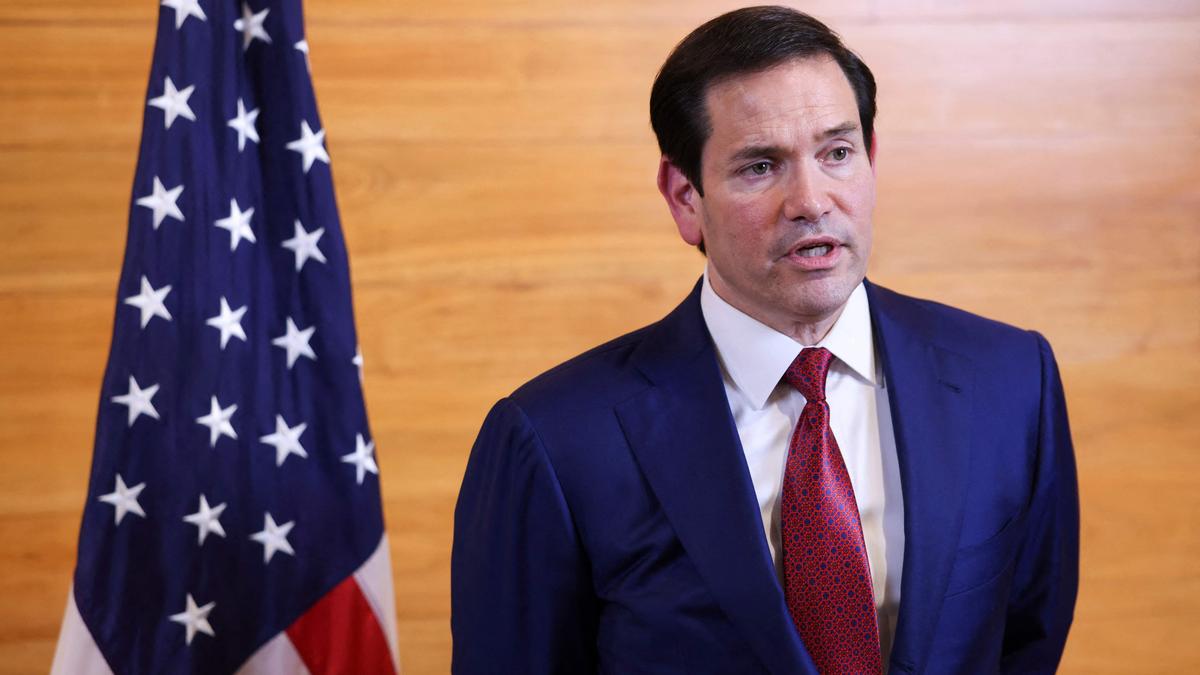
The post-Cold War era didn't just end. It collapsed under the weight of its own assumptions. When Secretary of State Marco Rubio took the stage at the National Defense University, he wasn't there to give a standard diplomatic speech filled with the usual pleasantries about "global cooperation." He came to deliver an autopsy. Rubio's message was blunt: the world we knew for the last thirty years is gone, and if the United States doesn't move fast to build something sturdier, we're going to get left behind in a much more dangerous century.
Rubio didn't mince words about the failures of the past. For decades, the prevailing wisdom in Washington was that bringing adversaries into the global trade system would eventually make them look more like us. We thought capitalism would naturally lead to democracy. We thought economic interdependence would make war unthinkable. We were wrong. Instead of Westernizing the world, we ended up hollowed out, while our rivals used our own markets to build the very weapons now pointed at us.
Why the old rules don't work anymore
The core of Rubio’s argument centers on the fact that our adversaries aren't playing the same game we are. While the West focused on "win-win" scenarios and consumer prices, nations like China and Russia focused on national power and strategic dominance. They didn't see global trade as a way to peace. They saw it as a tool for leverage.
Look at our supply chains. We outsourced our industrial base to the very people who now want to displace us. Rubio pointed out that you can't be a Great Power if you can't even manufacture your own basic medicine or the components for your missiles. The "Old World" was built on the idea that where things were made didn't matter as long as they were cheap. In the "New World," where things are made is a matter of national survival.
This isn't just about economics. It’s about the reality of hard power. The international institutions we built after 1945—the UN, the WTO, the various treaties that were supposed to keep the peace—are showing their age. They’re often paralyzed by the very regimes they were meant to constrain. Rubio’s stance is clear: we can’t keep relying on 20th-century bureaucracy to solve 21st-century threats.
Rebuilding the West from the ground up
So, what does Rubio’s "New Western Order" actually look like? It’s not about isolationism. It’s about a more muscular, selective engagement. It’s a vision that prioritizes national interest over globalist theory.
Industrial policy is national security
One of the most striking shifts in Rubio’s rhetoric—and the broader Republican foreign policy shift—is the embrace of industrial policy. This used to be a dirty word in conservative circles. Not anymore. Rubio argues that the government must play a role in ensuring we have the domestic capacity to win a long-term conflict.
This means:
- Moving critical manufacturing back to the U.S. or to "friend-shored" allies.
- Aggressively protecting intellectual property from state-sponsored theft.
- Investing in "frontier technologies" like AI, quantum computing, and advanced robotics before China does.
- Cutting the red tape that makes it impossible to build mines or factories in America.
Alliances based on reality not nostalgia
Rubio wants to rethink how we handle our friends. The old way was to treat every alliance as a permanent, unchanging commitment regardless of how much the partner actually contributed. The new way is much more transactional in a healthy sense. It’s about asking what each partner brings to the table.
We need allies who are willing to spend on their own defense and who share our strategic goals regarding China. Rubio isn't interested in subsidizing the security of wealthy nations that then turn around and sign massive trade deals with our primary adversaries. It’s a "tough love" approach to diplomacy that emphasizes shared sacrifice.
The China challenge is the only challenge that matters
Everything Rubio talked about eventually leads back to Beijing. He sees the competition with the Chinese Communist Party (CCP) not as a temporary spat over trade, but as a fundamental struggle between two different ways of organizing human society. One is based on individual liberty and the rule of law; the other is based on high-tech totalitarianism.
He’s right to be worried. The CCP has spent the last two decades systematically preparing for this moment. They’ve built a blue-water navy, cornered the market on rare earth minerals, and integrated their military and civilian tech sectors in a way that the U.S. has struggled to match. Rubio’s "New Order" requires us to treat this threat with the same urgency we felt during the height of the Cold War, but with the understanding that the battlefield is now everywhere—from your smartphone to the bottom of the ocean.
The domestic front of the new world order
You can't have a strong foreign policy if your own country is falling apart. Rubio touched on the "internal rot" that threatens our ability to lead. This includes the political polarization that makes it impossible to pass long-term budgets, but it also goes deeper than that.
He’s talking about a loss of national confidence. If we don't believe that our system is worth defending, we won't do the hard work required to defend it. This is why Rubio often links foreign policy to the "common good" at home. He wants a foreign policy that works for the American worker, not just the American multi-national corporation. If the "rebuilding of the Western order" doesn't result in better jobs and more stable communities in the Heartland, it’s going to fail.
Stopping the slide into irrelevance
Critics will say Rubio is being too "hawkish" or that he’s risking a "New Cold War." That’s a fundamental misunderstanding of the situation. The Cold War is already here. Our adversaries started it years ago; we’re just finally waking up to it. Ignoring the problem won't make it go away. It’ll just make us weaker when the inevitable confrontation happens.
The "Old World" Rubio described was a world of comfortable illusions. We thought we had reached the "end of history." We thought everyone wanted to be like us. We were lazy. Now, the bill is coming due.
Building a new order isn't going to be cheap or easy. It’s going to require a level of national discipline that we haven't seen in generations. It means making hard choices about where we spend our money and how we live our lives. It means admitting that "cheap" isn't always "better."
The first step is a massive audit of our dependencies. We need to know exactly where our vulnerabilities are. That means every major corporation needs to map its supply chain down to the raw materials. If those materials come from a country that wants to see us fail, we need a plan to move them. We need to start building. Now. Not in five years. Not after the next election. Rubio’s speech was a warning shot. Let's hope someone was actually listening.