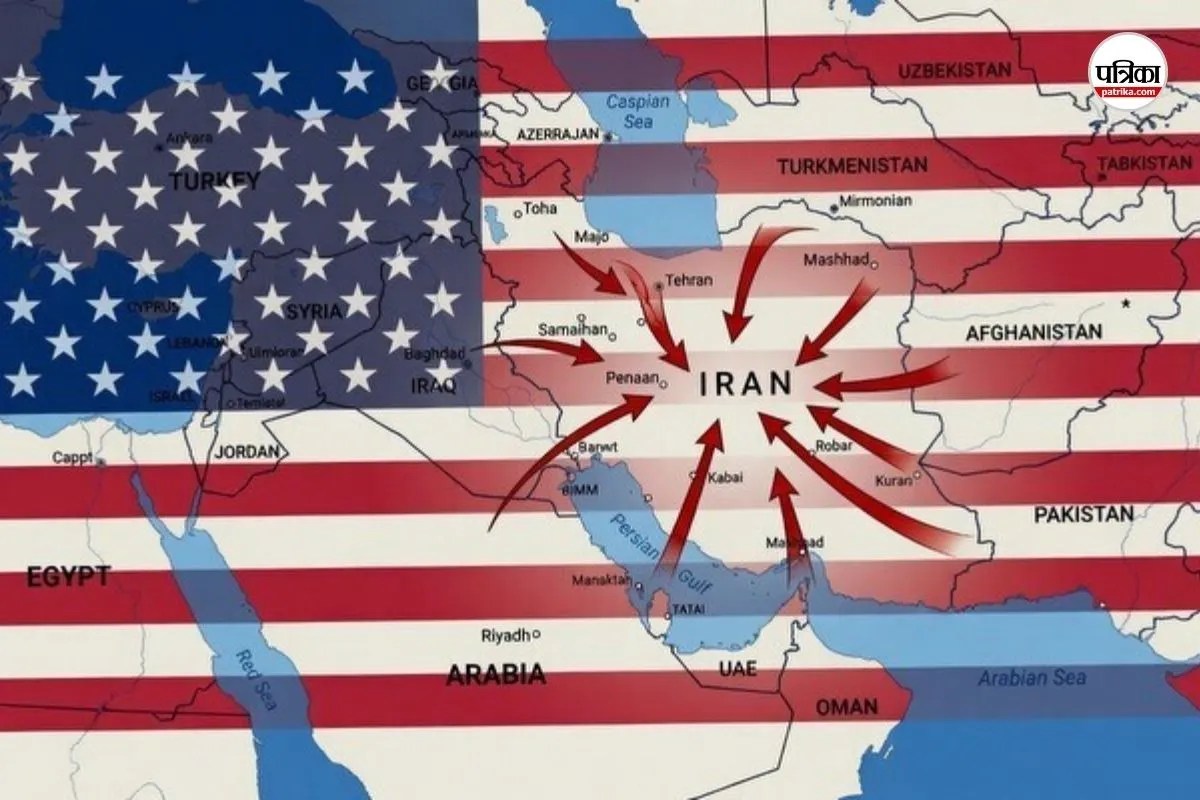
A red arrow drawn on a map in Washington does not equal a declaration of war. Yet, the moment Donald Trump flashes a graphic showing strategic vectors pointing toward Tehran, the global media apparatus slips into a predictable frenzy. They scream about an impending Third World War. They analyze troop movements that are actually routine rotations. They mistake psychological warfare for an operational blueprint.
The lazy consensus among foreign policy commentators is that the United States is on the precipice of a full-scale military invasion of Iran. This narrative is flat-out wrong. It completely ignores the structural realities of modern geopolitics, economic constraints, and the actual mechanics of deterrence.
I have spent years analyzing Middle Eastern defense architecture and crisis simulation models. If there is one thing I have learned from watching billions of dollars wasted on flawed intelligence projections, it is this: the loudest threats are usually the ones designed to avoid actual conflict. Washington is not preparing for an invasion. It is executing a high-stakes theatrical performance.
The Flawed Premise of the Red Arrow Panic
Mainstream analysis operates on a childish assumption. They believe that because a political leader highlights a threat vector on a television screen, a physical attack is imminent. This is a fundamental misunderstanding of strategic communication.
Maps with bold red lines are tools of coercion, not operational orders. In the lexicon of international relations, this is known as "extended deterrence via public posturing." The goal is to force an adversary to expend resources preparing for an attack that will never come, thereby draining their economic reserves and altering their regional behavior.
Let us dismantle the core argument of the alarmists. They claim that US rhetoric mirrors the run-up to the 2003 Iraq War. This comparison fails under basic scrutiny. Iraq in 2003 was economically choked by a decade of comprehensive sanctions, possessed a degraded conventional military, and lacked a network of regional proxy forces capable of asymmetric retaliation. Iran is an entirely different beast.
The Geography of a Military Nightmare
Imagine a scenario where a Western coalition attempts a conventional amphibious or airborne assault on Iranian soil. It would instantly become the most disastrous military campaign in modern history.
Iran is not a flat desert plateau like Western Iraq. It is a natural fortress. The country is ringed by the Zagros Mountains to the west and the Elburz Mountains to the north. The center of the country is a massive, arid depression.
[Persian Gulf] -> [Narrow Coastal Plains] -> [Zagros Mountain Wall] -> [Tehran Basin]
To reach the political heart of the country, ground forces would have to fight through narrow mountain passes that neutralize the US advantage in armored warfare and air superiority. It would require a mobilization force twice the size of the 2003 coalition just to secure the perimeter, let alone hold territory.
Furthermore, Iran has spent three decades optimizing its military for asymmetric defense. They do not intend to fight the US Navy ship-for-ship or the US Air Force plane-for-plane. They rely on anti-access/area-denial (A2/AD) capabilities. This means thousands of anti-ship cruise missiles hidden in subterranean silos along the Persian Gulf, swarms of fast-attack explosive boats, and sophisticated air defense networks purchased from Moscow.
The Pentagon knows this. The Joint Chiefs of Staff have run countless war games simulating a conflict in the Strait of Hormuz. In almost every unclassified iteration, the US suffers catastrophic losses in the first 48 hours. No American president is going to sign off on a campaign that results in a carrier strike group sitting at the bottom of the Gulf just to satisfy a rhetorical stance.
The Economic Suicide of a Gulf Conflict
The true deterrent against a US attack on Iran is not the Iranian army; it is the global energy market.
The Strait of Hormuz is the world's most critical oil chokepoint. Roughly 20% of the world's petroleum passes through this narrow body of water every single day. If a single missile hits a commercial tanker, or if Iran drops naval mines into the shipping lanes, global insurance rates for maritime transport will skyrocket overnight.
- Oil prices would surge past $150 a barrel within days.
- Supply chains, already fragile, would freeze.
- Inflation would spike globally, triggering a massive domestic recession in the United States.
A president's chief political vulnerability is the domestic economy. Rising gas prices ruin reelection campaigns and destroy legislative agendas. The White House will not risk a domestic economic implosion to wage an elective war against a country of 85 million people. The red arrows on the map are designed to lower oil prices by scaring OPEC into compliance, not to start a fire that burns down the global economy.
Dismantling the "People Also Ask" Assumptions
When people search for information on this potential conflict, they ask fundamentally flawed questions because they have been fed a diet of sensationalist media. Let us correct the record with brutal honesty.
Is the US legally allowed to attack Iran without Congress?
The short answer is no, but the practical answer is complicated. Commentators often point to the War Powers Resolution of 1973, arguing a president cannot sustain a war without a congressional declaration. This misses the point. Modern conflicts are not declared; they are initiated via kinetic actions labeled as "self-defense." However, the political cost of initiating a major theater war without bipartisan consensus is a barrier no current administration can cross.
Can Iran's nuclear facilities be destroyed by air strikes alone?
This is the ultimate fantasy of the armchair generals. They think a few stealth bombers dropping bunker-busters can erase Iran's nuclear program. It cannot. Facilities like Fordow are buried hundreds of feet beneath solid rock inside mountains. Air strikes might delay the program by 18 to 24 months, but they would also guarantee that Iran kicks out international inspectors, builds a bomb in secret, and unleashes its proxy network from Lebanon to Yemen. The cost outweighs the benefit.
The Proxy Reality Check
We must look at the network of non-state actors operating across the Levant and the Arabian Peninsula. If Washington launches an attack on Iranian territory, the response will not be confined to the borders of Iran.
The Islamic Revolutionary Guard Corps (IRGC) operates an integrated network of partners including Hezbollah, Kata'ib Hezbollah, and the Houthis. These groups possess hundreds of thousands of precision-guided rockets aimed directly at US bases in Iraq and Syria, as well as critical infrastructure across the Gulf states.
An attack on Tehran means rockets rain down on regional energy hubs, desalination plants, and commercial airports. The entire region turns into a kinetic free-for-all. The US military presence in the Middle East is currently configured for counter-terrorism and maritime security, not a multi-front regional war against highly motivated, dug-in insurgencies.
The Risk of Our Own Blind Spots
To be fair, the contrarian view has its own vulnerabilities. The biggest risk to this thesis is the wild card of miscalculation.
History is filled with wars that nobody wanted, started because one side misread a bluff. If the US flies surveillance drones too close to Iranian airspace to project strength, and a nervous local Iranian commander shoots it down, the escalatory ladder becomes very difficult to climb down. The danger is not a planned invasion; it is an accidental escalation cycle driven by mutual paranoia.
But an accidental skirmish is miles apart from a planned invasion.
Stop looking at the red lines on presentation boards as a sign of upcoming troop deployments. They are a substitute for troop deployments. The map is a tool of diplomacy by other means—a loud, public show designed to project strength precisely because the costs of an actual war are too high to bear.
The next time a cable news pundit points to a map and tells you an invasion is weeks away, look at the price of oil and the typography of the Zagros Mountains. Then turn off the television.