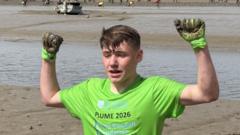
The local press loves a wunderkind. When a sixteen-year-old sprints across the Blackwater estuary to claim the Maldon Mud Race title, the narrative is predictable. We get stories of grit, youthful vigor, and "community spirit." We celebrate a teenager for being the fastest person to navigate 400 meters of stinking, grey sludge.
But here is the reality nobody wants to print: The Maldon Mud Race isn't an athletic achievement. It is a mass-participation experiment in immunological recklessness. While the headlines focus on the podium, they ignore the biological cost of sprinting through a cocktail of agricultural runoff, untreated sewage, and ancient riverbed silt.
If you think this is about "getting dirty," you have been sold a romanticized version of a public health nightmare.
The Myth of the Mud
Most participants view the mud as a heavy, inconvenient obstacle. They see it as a physics problem—how to maintain traction on a surface with a friction coefficient approaching zero.
That is the wrong lens.
The Blackwater estuary isn't just mud; it is an active microbial environment. When you have hundreds of people churning up sediment that has sat undisturbed for a year, you aren't just racing. You are aerosolizing pathogens. In any other context, if you told a teenager to jump into a mixture of silt and localized pollution, social services would be called. In Maldon, we give them a trophy.
Let’s talk about the mechanics of the "race." You aren't running. You are dragging. The physical strain on the hip flexors and lower back is immense, but the real danger is the ingestion risk. When you are gasping for air at maximum heart rate, your mouth is open. You are inhaling droplets of water and mud.
Pathogens in the Podium
Common riverbed contaminants often include:
- Leptospirosis (Weil’s Disease): Carried in animal urine, particularly rats, which frequent riverbanks.
- Escherichia coli (E. coli): A staple of agricultural runoff and overflow systems.
- Campylobacter: The leading cause of bacterial food poisoning, often found in tidal mudflats.
The "victory" of a sixteen-year-old isn't a testament to superior training. It is a testament to a young, resilient immune system that hasn't yet been worn down by decades of environmental stressors. We are cheering for a child who just won a game of Russian Roulette with a gut parasite.
Why Experience Trumps Youth (Everywhere Else)
In actual endurance sports, peak performance usually hits in the late twenties or early thirties. Why does a teenager win Maldon? Because the race is too short to be a test of stamina and too chaotic to be a test of skill. It is a sprint of desperation.
I have spent years analyzing regional "traditional" sports. From cheese rolling to bog snorkeling, these events share a common DNA: they prioritize spectacle over safety. They survive because they are "quaint." If a modern tech company tried to launch an event where people crawled through river sludge for charity, the health and safety audits would kill it in the cradle.
We allow Maldon to exist because of the "Charity Shield." We tell ourselves that because money is being raised for good causes, the risk is justified. This is a logical fallacy. You can raise money for cancer research without inviting a localized outbreak of gastroenteritis.
The Cost of the "Experience"
The spectator sees the "fun." They see people in fancy dress—superheroes and brides—caked in grey goo. What they don't see is the decontamination tent. They don't see the participants scrubbing their skin raw to get the smell of sulfur and decay out of their pores.
The Biological Load Breakdown
Imagine a scenario where a participant has a small, unnoticed abrasion on their leg.
- The Entry: The moment they hit the mud, the wound is exposed to anaerobic bacteria.
- The Agitation: The physical movement of the race forces these microbes deeper into the tissue.
- The Incubation: By the time the "hero" is holding their trophy, the infection has already started its journey into the bloodstream.
This isn't alarmist; it’s microbiology. We have sanitized our lives to such a degree that we now crave "authentic" filth, but we have forgotten that the filth of the past was what killed our ancestors.
The Logistics of a Bad Idea
Organizers point to the "tradition" which dates back to a pub bet in 1973. Relying on the wisdom of a 1970s pub bet is like taking medical advice from a tobacco advertisement. The environment of the Blackwater has changed. Urbanization, increased rainfall leading to sewage overflows, and industrial changes mean the mud of today is not the mud of fifty years ago.
The "lazy consensus" says this is a harmless bit of British eccentricity. The logic is that "nobody has died yet, so it’s fine." This is the same logic used by people who refuse to wear seatbelts until they fly through a windshield.
Stop Glorifying the Grime
We need to stop asking "who won?" and start asking "why are we doing this?"
If the goal is a physical challenge, there are thousands of ways to test human limits that don't involve the risk of Leptospirosis. If the goal is charity, there are more efficient ways to collect funds than by forcing volunteers to hose down muddy teenagers.
The sixteen-year-old winner didn't conquer the mud. He survived a bio-hazard. He should be at home with a bottle of antibacterial soap and a round of preventative antibiotics, not on the front page of the local rag.
The Maldon Mud Race is a relic of a time when we didn't understand the invisible world. Now that we do, continuing the tradition isn't "eccentric." It’s negligent.
Clean up the river. Keep the kids on the grass.