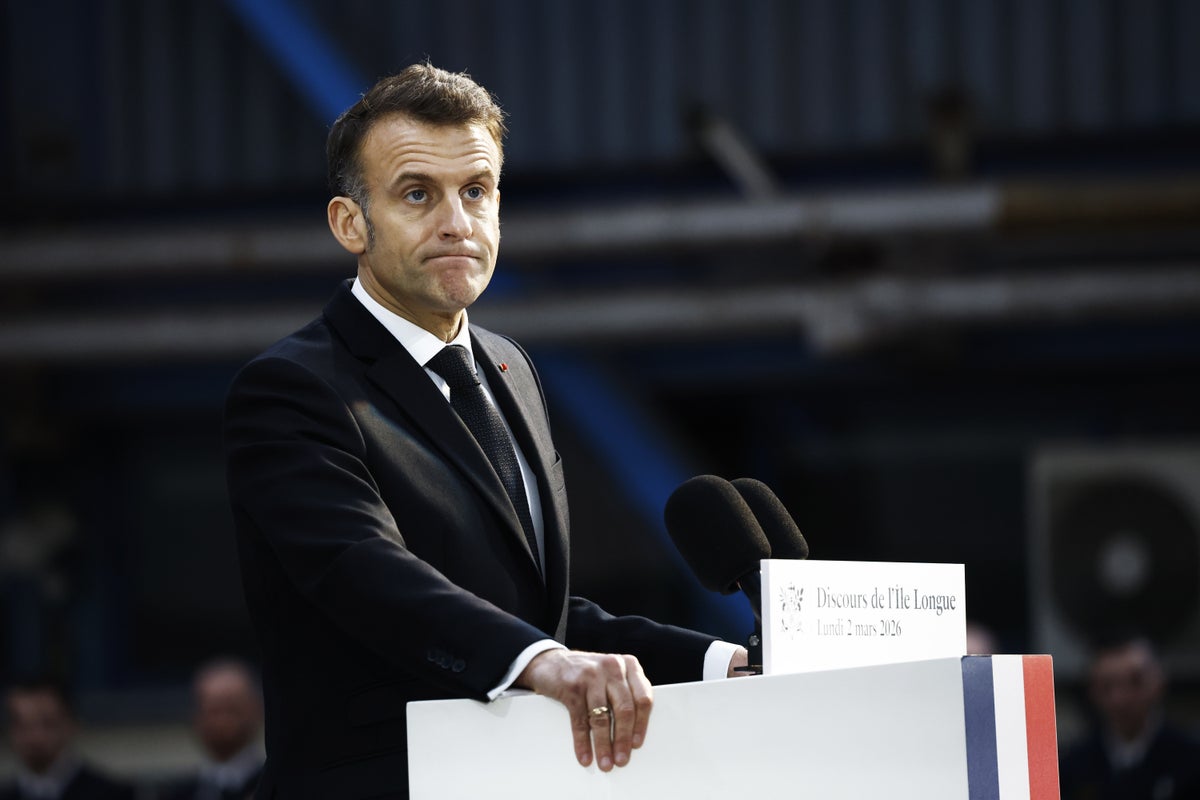
France is officially ending its decades-long era of nuclear restraint. President Emmanuel Macron’s recent directive to expand the French atomic arsenal isn't just a reaction to current border tensions; it is a fundamental rewrite of the European security contract. For the first time since the Cold War, a major Western power is publicly pivoting from a policy of "strict sufficiency"—having just enough to deter—to a policy of "active credibility," which necessitates a larger, more modern stockpile. This shift signals that Paris no longer trusts the old guardrails of international diplomacy to keep the lights on in Europe.
The math of the French deterrent is changing because the math of the opposition has already changed. For years, the Force de Frappe rested on roughly 290 warheads. It was a static number, intended to signal that France was a defensive power. But as Russia integrates tactical nuclear weapons into its conventional battlefield doctrine and China rapidly scales its silo counts, Macron has calculated that being "sufficient" is now synonymous with being vulnerable.
The Death of Minimal Deterrence
The doctrine of minimal deterrence functioned on the assumption that the world was moving toward a shared understanding of risk. That assumption is dead. France is now staring at a reality where nuclear blackmail is a standard tool of statecraft. By announcing an increase in warhead production, Macron is attempting to restore a balance of fear that he believes has tilted too far in favor of the Kremlin.
This isn't just about building more bombs. It is about the industrial capacity to sustain them. The French military-industrial complex, led by giants like Dassault and Thales, is being told to move to a "war economy" footing. This means the slow, bureaucratic procurement cycles of the last thirty years are being scrapped. France is reinvesting in its enrichment facilities and its specialized missile manufacturing lines at a pace not seen since the 1980s.
The technical core of this expansion revolves around the M51 submarine-launched ballistic missile and the ASMPA-R supersonic cruise missile. These aren't just hardware upgrades. They represent a move toward "dual-capable" flexibility. If France has more warheads, it can distribute them across more delivery platforms, making it nearly impossible for an adversary to wipe out their retaliatory capability in a first strike.
The European Umbrella Problem
There is a glaring subtext to this buildup: the declining reliability of the United States. Macron has long preached about "strategic autonomy," the idea that Europe must be able to defend itself without a phone call to Washington. By increasing the French nuclear count, he is effectively auditioning for the role of Europe’s primary protector.
This creates a massive friction point within the EU. Germany, traditionally allergic to nuclear proliferation, now finds itself in a corner. Do they continue to rely on a wavering American "nuclear sharing" agreement, or do they look toward a French-led European deterrent? Macron is betting that when the pressure mounts, Berlin will choose the neighbor they can see over the ally across the Atlantic.
The Cost of Sovereignty
Power is expensive. The French state is already grappling with significant debt and a restless public, yet the nuclear budget is being shielded from every round of austerity. We are looking at an investment that will swallow billions of euros over the next decade.
- Infrastructure: Rebuilding the aging research reactors that produce the tritium necessary for modern warheads.
- Modernization: Transitioning the entire Rafale fleet to the F4 standard, capable of carrying the next generation of nuclear-tipped missiles.
- Submarine Superiority: Accelerating the development of the third-generation nuclear-powered ballistic missile submarines (SNLE 3G).
Critics argue this money would be better spent on conventional forces—tanks, drones, and artillery—which are actually being used in modern conflicts. But the Elysee Palace views conventional forces as the "how" of war and nuclear forces as the "why not." In their view, without a terrifying nuclear shadow, conventional forces are just targets.
Hardening the World
Macron’s use of the word "hardening" is a deliberate choice of vocabulary. It suggests a world that is becoming less fluid, more rigid, and more dangerous. It is a world of blocks and barriers. In a hardened world, soft power is a luxury. Hard power is the only currency that clears.
This buildup is also a message to the "Global South" and emerging powers. France is asserting that it remains a top-tier power, unwilling to be relegated to the status of a mid-sized museum piece. It is a rejection of the idea that the future belongs solely to the U.S.-China duopoly.
However, the risk of a new arms race is tangible. When one nation increases its count, its neighbors rarely sit still. We are entering a cycle where the threshold for nuclear use is being lowered, not through malice, but through the sheer density of the weapons in play. The "firebreak" between a conventional skirmish and a nuclear exchange is thinning.
The New Atomic Reality
We have to look at the personnel involved. The French military command is being restructured to prioritize "high-intensity" conflict. This means training for scenarios that were previously dismissed as unthinkable. The psychological shift among the officer corps is as significant as the physical increase in warheads. They are preparing for a world where the deterrent might actually have to be used, or at least moved into a state of high readiness more frequently.
The French public's reaction will be the ultimate test of this policy. Historically, there has been a broad consensus in France regarding the nuclear deterrent—a sense of national pride in the Force de Frappe. But that consensus was built on the idea that the weapons would never be used and that the cost was manageable. As Macron ramps up production and the rhetoric sharpens, that social contract will be pushed to its limit.
France is no longer content to play the role of the diplomatic mediator who happens to have a few nukes in the basement. They are stepping into the light as a nuclear-first power. It is a high-stakes gamble that assumes the only way to prevent a war is to be the most prepared to fight one.
The move to increase the stockpile is a admission that the post-1991 world order has collapsed. There is no going back to the era of treaties and handshakes. From here on out, the security of the continent will be measured in megatons and delivery speeds.
The next time a diplomatic crisis hits the European border, the French president won't just be bringing a seat to the table. He will be bringing a larger, more modernized, and far more lethal arsenal to the conversation. Whether that makes the world safer or simply more brittle is a question that will be answered in the coming decade.
Review your own country's defense spending and ask if the "nuclear umbrella" you rely on is made in Washington or Paris. It matters more than you think.


