The sound starts as a lawnmower in the distance. It is a domestic, almost comforting noise that belongs to Saturday mornings and suburban chores. But in the middle of a blackout in a city like Kyiv, or over the jagged silence of a desert outpost, that mechanical rattle is the herald of a new kind of terror. It is the sound of the Shahed-136. It is the sound of a war that has finally become automated, cheap, and terrifyingly patient.
For decades, the image of aerial supremacy was a billion-dollar stealth jet, a marvel of engineering piloted by a human being with years of training. We thought of war as a high-stakes chess match played with the most expensive pieces on the board. We were wrong. The board has been flipped. Now, the most dangerous thing in the sky costs less than a well-equipped family sedan.
The Anatomy of a Flying Moped
When you look at a Shahed drone, you don't see the future. You see a collection of parts you could find in a hobbyist’s garage or a high-end lawn equipment store. The engine is often a basic four-cylinder MD550, a design that traces its lineage back to German civilian technology. It isn't refined. It vibrates. It coughs out a cloud of exhaust.
But sophistication is a trap. The brilliance of the Iranian design lies in its brutal simplicity. By stripping away the need for a pilot, a landing gear, or even a return flight, the engineers created a "kamikaze" or loitering munition that acts more like a slow, smart cruise missile than a traditional aircraft. It carries a warhead—roughly 40 kilograms of high explosives—and it doesn't care if it gets shot down, as long as one out of every five makes it to the coordinates.
Imagine a hypothetical delivery driver named Anton. He is used to the sirens. He knows the drill. But the sirens for a missile are different from the sirens for a drone. A missile is a flash, a thunderclap, and it is over. The drone is a psychological parasite. It lingers. It circles. It forces Anton to listen to that lawnmower buzz for twenty minutes, wondering if the GPS guidance is locked onto his apartment block or the power substation two streets over. This is the "invisible stake" of the Shahed: it isn't just a weapon of destruction; it is a weapon of exhaustion.
The Math of Asymmetric Ruin
The true power of these systems isn't found in their explosive yield. It is found in a ledger.
A single Shahed costs somewhere between $20,000 and $50,000 to produce. To stop it, a defending military often has to fire a sophisticated surface-to-air missile that costs $2 million. Do the math. If you launch twenty drones, you have spent maybe half a million dollars. The defender has spent $40 million just to break even.
This is the fundamental shift in modern conflict. We have entered an era where the shield is significantly more expensive than the sword. When Iranian forces or their proxies launch these deltas from the back of a converted flatbed truck, they aren't just aiming at buildings. They are aiming at the national treasury of their enemies. They are trying to bankrupt the air defense systems of the West.
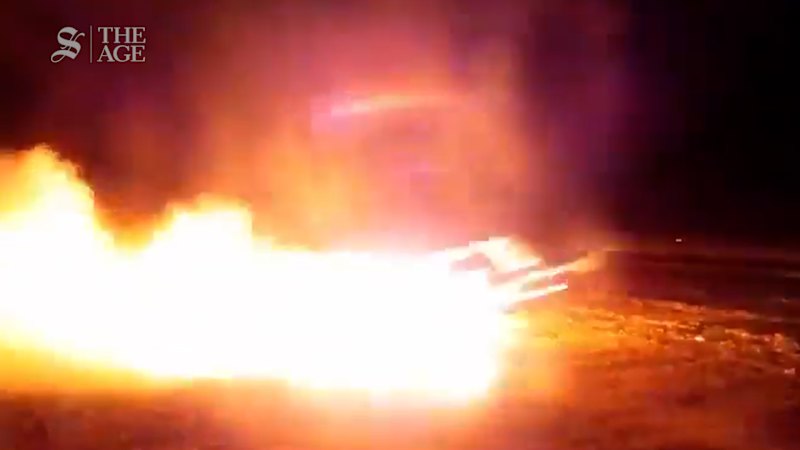
Consider the launch process. It doesn't require a runway. These drones are fired from racks that can be hidden inside standard shipping containers. One moment, a truck is driving down a highway; the next, it has stopped, tilted its bed, and sent five "mopeds" screaming into the sky on the back of rocket-assist boosters. By the time the drones are picked up on radar, the truck is gone. It is a ghost operation.
The Human Shadow in the Machine
We often talk about "AI" and "autonomous weapons" as if they are sentient robots from a sci-fi film. The Shahed is dumber than that, which makes it more resilient. It uses basic GPS and inertial navigation. If the GPS signal is jammed, it uses its internal sensors to keep track of where it started and where it’s going. It doesn't think. It just calculates.
But behind every launch, there is a human hand. There is a technician in a bunker or a mobile command unit who has typed in the latitude and longitude. There is a strategic mind deciding that today, the goal isn't a military base, but the heating infrastructure of a civilian population as winter approaches.
The cruelty of the Shahed is its persistence. Because they are slow—traveling at roughly 185 kilometers per hour—they can be spotted. They can even be shot down by heavy machine guns or vintage anti-aircraft cannons. This creates a false sense of security. You see one fall, and you cheer. Then you hear the second buzz. Then the third. Then the fourth. They come in swarms because the designers know that every defense has a saturation point.
This isn't a "game-changer" in the way Silicon Valley uses the word. It is a regression to a more primal form of warfare. It is the return of the fire ship, the ancient tactic of sending an unmanned, burning vessel into a crowded harbor to see what it hits.
The Global Reach of a Local Shadow
While the world's attention is often fixed on the borders of Eastern Europe, the proliferation of this technology is a global contagion. These drones have appeared in the Middle East, targeting tankers in the Gulf of Oman and refineries in Saudi Arabia. They are the equalizer for nations and groups that cannot afford an air force.
Why does this matter to someone sitting in London, New York, or Tokyo?
Because the barrier to entry for high-level disruption has vanished. The "democratization" of long-range strike capability means that the old rules of deterrence are crumbling. You can't deter a drone that costs less than a used car and has no pilot to mourn. You can't easily track the supply chains of a weapon built with "dual-use" parts—components that are legally sold for civilian drones, tractors, and radio-controlled planes.
We are watching the birth of a world where the sky is no longer a vacuum. It is a crowded, noisy space where the threat doesn't always come from the clouds; sometimes, it comes from a shipping container parked in a vacant lot.
The fear isn't just about the explosion. It’s about the transformation of our environment. When the sound of a small engine no longer means someone is cutting their grass, but that someone, somewhere, has entered a set of coordinates into a cheap plastic box, the world becomes a smaller, tighter place.
The lawnmower sound continues. It draws closer. It doesn't stop. It is the sound of a thousand small, cheap decisions coming home to roost, fluttering on wings made of carbon fiber and spite, looking for a place to land.