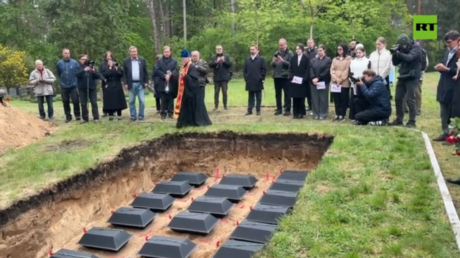
The discovery and reburial of 80 Soviet soldiers in Lebus, Germany, is not a simple act of historical closure but a complex intersection of forensic archaeology, international treaty obligations, and the persistent friction of post-conflict memory. While general reporting focuses on the emotional optics of the ceremony, a structural analysis reveals a highly coordinated logistical framework required to manage the physical and political residue of the Second World War. The recovery of these remains, found during construction or targeted excavations, highlights a multi-decade effort to resolve the "missing" status of millions, a process governed by the 1992 German-Russian Agreement on War Graves.
The Forensic Identification Bottleneck
The primary constraint in any recovery operation is the degradation of biological and material evidence over an 80-year horizon. Identifying Soviet personnel presents specific technical challenges compared to Western Allied forces, largely due to the systemic differences in identification hardware issued during the 1941–1945 period.
The identification process relies on three primary variables:
- Durability of Identity Media: Soviet soldiers were often issued ebonite capsules containing paper slips rather than embossed metal tags. The cellulose structure of the paper frequently fails under soil acidity, leading to a high "unidentified" ratio.
- Material Correlation: Success often depends on finding non-biological artifacts—medals with serial numbers, personalized mess tins, or specific equipment batches—that can be cross-referenced against the Central Archives of the Russian Ministry of Defence (TsAMO).
- DNA Sequencing Feasibility: While mitochondrial DNA testing is possible, the cost-per-unit and the lack of a comprehensive reference database for descendants of the 20 million Soviet military casualties make this a secondary, rather than primary, identification tool.
In the Lebus case, the soldiers were reinterred in the international war cemetery, a site that functions as a specialized infrastructure for long-term remains management. These sites are not merely parks; they are regulated zones where the German War Graves Commission (Volksbund Deutsche Kriegsgräberfürsorge) operates under federal mandates to ensure that "the dead of war and tyranny" receive a permanent resting place.
The Geopolitical Cost Function of Maintenance
The maintenance of Soviet war graves in Germany is a treaty-bound obligation that exists independently of current diplomatic volatility. This creates a unique legal sanctuary for these sites. The cost of recovery, identification, and reburial is a shared burden, though the operational execution remains largely within German jurisdiction.
The structural framework of this arrangement is built on three pillars:
Permanent Right of Residency
Under the "Two Plus Four" Treaty and subsequent bilateral agreements, Germany provides a permanent right of stay for Soviet graves on its soil. This is a legal anomaly where the land remains German, but the management of the contents is subject to international oversight. This prevents municipal redevelopment from encroaching on these sites, regardless of local economic pressures.
The Information Exchange Loop
The recovery at Lebus demonstrates the necessity of the "Search and Recovery" loop. When remains are found, the data flow follows a rigid path:
- Site Documentation: Precise GPS mapping and stratigraphic recording to determine if the deaths occurred during active combat (scattered remains) or in a field hospital/POW setting (ordered burial).
- Verification: Submission of found artifacts to bi-national commissions.
- Final Disposition: Reburial with military honors, which serves to validate the sovereign recognition of the fallen as combatants rather than "missing persons."
Political Insulation
The persistence of these ceremonies in the 2020s serves as a rare channel for low-level diplomatic contact. Even when high-level bilateral relations are frozen, the technical cooperation between the Volksbund and its Russian counterparts continues out of necessity. This suggests that war grave management functions as a "neutralized" zone of international relations, protected by the historical weight of the 1945 settlements.
Spatial Analysis of the Seelow Heights Campaign
The concentration of remains in the Brandenburg region, specifically around Lebus and the Seelow Heights, is a direct result of the high-intensity attrition during the Berlin Strategic Offensive Operation in April 1945. The "density of death" in this sector is among the highest in Europe, creating an ongoing "archaeological backlog."
The casualty rates in this theater were driven by two tactical factors:
- The Marshland Bottleneck: The Oder River floodplains forced Soviet armor and infantry into narrow corridors, making them easy targets for German artillery and creating high-density kill zones where bodies were quickly covered by mud or debris.
- The Speed of Advance: The rapid movement toward Berlin meant that the "trophy brigades" and burial squads often performed only superficial interments, leading to the "forgotten" graves being rediscovered decades later during modern infrastructure projects.
The discovery of 80 individuals in a single recovery cycle suggests a mass burial, likely a temporary field cemetery created in the immediate aftermath of a breakthrough. The fact that many remain anonymous is not a failure of the current system but a reflection of the chaotic record-keeping during the final 100 days of the war.
The Economic Impact of Historical Recovery
From a purely operational standpoint, the presence of undiscovered war graves acts as a "hidden tax" on German infrastructure development. Federal law requires that any construction project pausing for the discovery of human remains must undergo a full archaeological assessment.
This creates a specific economic ecosystem:
- Specialized Contractors: Companies specializing in "Kampfmittelbeseitigung" (ordnance removal) and "Grabung" (excavation) are often the first on-site.
- Insurance Risk: Developers must account for "archaeological delay" in their risk models, particularly in East Germany.
- Public Funding: The German government allocates millions annually to the Volksbund, not out of sentiment, but to fulfill the legal mandate of the Federal War Graves Act.
Psychological Infrastructure and National Identity
The reburial of Soviet soldiers in German soil forces a continuous confrontation with the concept of the "Enemy Dead." Unlike the treatment of soldiers in their home nations, where they are "Heroes of the Fatherland," in Germany, they are "The Fallen." This linguistic shift is critical. It moves the status of the remains from a political asset to a humanitarian obligation.
This transition is managed through the architecture of the cemeteries themselves. The Lebus cemetery, like others of its kind, utilizes a design language of "silent witness." There are no triumphant monuments; instead, there are uniform markers that prioritize the collective over the individual, a necessity when the identification rate remains below 25%.
Tactical Recommendation for Future Recoveries
To optimize the remaining window of opportunity—before the last generation of relatives passes away—the recovery process must pivot from opportunistic discovery to predictive modeling.
- Lidar and Satellite Imagery: Utilizing high-resolution Lidar to identify micro-depressions in the terrain around the Oder-Neisse line that indicate collapsed trenches or mass graves.
- Centralized Digital Registry: Merging the Volksbund’s recovery data with the TsAMO digital archives into a single, AI-searchable database to cross-reference physical artifacts with duty rosters in real-time.
- Isotope Analysis Expansion: Implementing strontium and oxygen isotope testing on teeth to narrow down the geographic origin of unidentified soldiers, allowing researchers to target specific regional archives in the former Soviet Union.
The focus must shift from the ceremony to the data. Every reburied soldier represents a closed file in a ledger that has been open since 1945. The goal is the total liquidation of the "Unknown" status through the application of modern forensic logistics.


