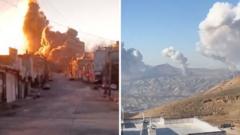
The headlines are screaming for your exit. State Department alerts are pinging your phone like a frantic heartbeat. Every major news outlet is running the same "get out now" script, painting a picture of a region on the verge of total collapse.
They are wrong.
Not because there isn't conflict—there is. Not because there isn't risk—there always is. They are wrong because they are applying a 1980s geopolitical playbook to a 2026 reality. When the US government urges nationals to leave, they aren't offering a nuanced security assessment; they are performing a bureaucratic liability hedge. If you follow the herd, you aren't just losing your seat at the table—you’re handing your competitors the keys to the room.
The Myth of the Monolithic Middle East
Mainstream reporting treats the Middle East like a single, flammable room. One spark in the Levant, and they expect the whole house to go up. This "contagion" narrative is lazy. It ignores the fact that the Gulf states, Jordan, and even parts of North Africa operate on entirely different security architectures than they did twenty years ago.
While the "experts" in DC cubicles warn of regional spillover, the actual data on the ground shows something different: Resilience through de-coupling. Look at the markets. Look at the infrastructure. In Riyadh and Dubai, the skyline isn't stopping. The capital flows aren't reversing. In fact, when the West panics and pulls its people, it creates a massive vacuum that is immediately filled by local talent and Eastern capital.
The "Lazy Consensus" assumes that an American presence is the only thing keeping these economies upright. The truth? Your departure is no longer a death knell for the local economy; it’s just a discount for the person who stays.
The Liability Hedge vs. Reality
Let’s be honest about what a "Travel Advisory Level 4" actually is. It’s not an objective measurement of your personal safety. It is a legal disclaimer.
I have spent fifteen years navigating high-risk zones. I’ve seen the gap between the State Department’s panic and the street-level reality. In 2006, in 2011, and again in 2020, the "Get Out" orders were issued with a broad brush. Those who stayed—those who understood the specific geography of risk rather than the generalized fear—became the dominant players in the following decade.
Understanding the Geometry of Risk
Risk isn't a blanket; it's a grid.
- Kinetic Risk: Targeted, localized, and largely predictable if you aren't standing next to a military asset.
- Logistical Risk: The real danger. Not a bomb, but a closed airport.
- Reputational Risk: The fear of what your board of directors will say if you stay.
The media focuses on the first. The government worries about the second. But most people flee because of the third. They leave because they don't want to explain why they stayed. That is cowardice masquerading as "safety protocol."
The High Cost of the "Safe" Choice
What happens when you leave?
You abandon networks that took years to build. You signal to your local partners that you are a fair-weather ally. In a culture where wasta (clout and connection) and long-term loyalty are the only currencies that matter, fleeing at the first sign of a headline is a permanent stain on your professional record.
Imagine a scenario where a private equity firm pulls its entire Western staff out of Amman because of tensions 100 miles away. They go to London. They "work remotely." Within three months, their local partners have realized they don't need the Western overhead. The deals start happening in Arabic. The Western firm loses its "eyes and ears" and eventually, its seat at the cap table.
By the time the State Department says it’s "safe" to return, the locks have been changed.
Dismantling the "People Also Ask" Propaganda
"Is it safe for US citizens in the Middle East?"
Wrong question. The question is: Are you an asset or a liability? If you are a tourist with no situational awareness, go home. If you are a professional with a deep understanding of your specific city’s security protocols, you are often safer in a high-security compound in a "conflict zone" than you are in a random US metro area during a civil unrest spike.
"Will the conflict spread to the entire region?"
The "Great Regional War" has been predicted every year since 1948. It ignores the sovereign interests of players like Saudi Arabia and Qatar, who have trillions of dollars in "Vision 2030" infrastructure to protect. They are not interested in a scorched-earth scenario. They have become the stabilizers. Betting against them is betting against the smartest money in the world.
"Should I cancel my business trip?"
Only if you want your competitor from Singapore or Shanghai to take the contract. They aren't leaving. They see your exit as their entry point.
The "Hyper-Local" Security Strategy
Stop reading the CNN ticker. Start reading the local logistics.
- Check the flight frequency: Is Emirates still flying? Is Qatar Airways still landing? If the commercial carriers haven't pulled out, the risk is being managed.
- Watch the local elite: Are the families of the country’s billionaires leaving? No? Then neither should you. They have better intelligence than you do.
- Diversify your exit: Don't rely on an embassy evacuation. Have a private security firm and three different overland routes planned.
This isn't about being "brave." It’s about being calculated. The "Get Out" narrative is designed for the lowest common denominator—the person who can't find the country on a map. If that’s you, leave. If you are here to build something, realize that the greatest dividends are paid to those who provide stability when everyone else is providing chaos.
The Professional Pivot
The status quo says: Protect the individual at all costs.
The insider reality says: Protect the position.
The downside of staying is obvious—physical risk. I won't sugarcoat it. You could get caught in the crossfire. But the downside of leaving is a slow, certain professional death. You become the person who blinked. In the Middle East, once you're seen as someone who blinks, you're done.
Stay. Narrow your focus. Harden your personal security. But do not let a bureaucratic press release dictate your geopolitical footprint.
The herd is running for the exit. That’s exactly why you should be walking toward the center of the room. You aren't "ignoring the news." You're ignoring the noise.
Stop asking if it's safe. Start asking what it will cost you to leave.
History is written by the people who didn't get on the last plane out.