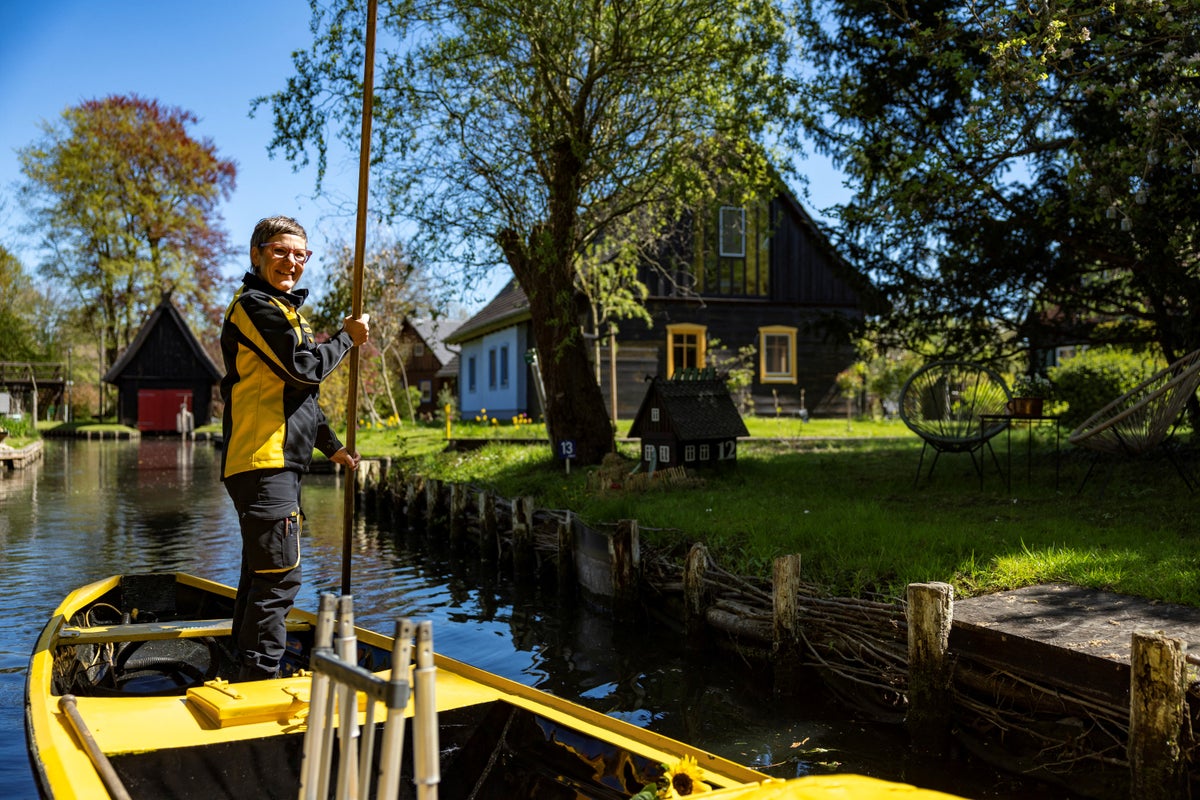
The iron gate of the lock groans, a sound that has echoed through the Spreewald for over a century. It is a heavy, metallic protest against the encroaching silence of the Brandenburg forest. Here, barely an hour south of the glass and steel of Berlin, the roads simply give up. They dissolve into a labyrinth of three hundred miles of tea-colored waterways, where the only traffic is the soft ripple of a flat-bottomed boat and the occasional splash of a kingfisher.
Hans-Joachim Schulz stands in the center of his yellow aluminum barge. He is not a tour guide, though he moves with the grace of a man who knows every submerged root and shifting sandbar. He is a postman. For the residents of Lehde, a village where the front door opens not onto a sidewalk but onto a canal, Schulz is the singular thread connecting their ancient, watery isolation to the frantic pulse of the modern world.
The Rhythm of the Pole
Most people measure their workday in minutes, meetings, and notifications. Schulz measures his in strokes of the Rudel—a long, wooden punting pole that he thrusts into the sandy bed of the river. He doesn't use a motor. The Spreewald is a UNESCO biosphere reserve, a delicate ecosystem where the buzz of an outboard engine would feel like a shout in a cathedral.
Instead, there is only the rhythmic thump-glide of the barge.
Consider the logistical nightmare of a simple Amazon package in a place like this. In a standard suburban neighborhood, a courier drops a box, snaps a photo, and vanishes in forty seconds. In Lehde, that same box must be loaded onto a specialized yellow boat at the Lübbenau post office. It must navigate narrow channels where the weeping willows hang so low they brush the postman’s shoulders. It must pass through locks that require physical strength to crank open.
This isn't about efficiency. It never was. It’s about a stubborn, beautiful refusal to let a way of life drown in the name of progress. The boat delivery service in Lehde has operated since 1897. While empires rose and fell, while the Berlin Wall was built and eventually chipped away into souvenirs, the mail stayed on the water.
The Invisible Stakes of a Letter
We often think of the postal service as a fading utility, a relic of a pre-digital age used primarily for junk mail and tax documents. But in a village of sixty-five houses accessible only by water, the postman is more than a delivery driver. He is a welfare check. He is a harbinger of the seasons.
Imagine an elderly resident, perhaps a woman whose family has farmed the marshy "islands" of the Spreewald for four generations. She wakes to the sound of the mist lifting off the water. She cannot drive to a grocery store; her "car" is a wooden punt she must propel herself. When she hears the soft clink of the mailbox lid on her private dock, she knows the world hasn't forgotten her.
Schulz delivers about 600 letters and packets a day during the peak season. In the winter, when the canals freeze thick enough to support a man’s weight, he abandons the boat and delivers the mail on foot, sliding across the ice or trudging through the snow. There is no "inclement weather" clause in a town with no pavement.
The stakes are emotional. In a world where we are increasingly disconnected from our neighbors, the postman in Lehde knows who is sick, who is expecting a grandson for the weekend, and whose roof needs repair. He carries the village’s secrets alongside their utility bills.
A Tradition Against the Current
The village of Lehde looks like a dream of the 19th century. The houses are constructed of dark logs, their gaps stuffed with moss and clay in the traditional Sorbian style. The Sorbs are a Slavic minority who have inhabited this region for over a millennium, and their culture is inextricably linked to the water.
For the people here, the yellow boat is a symbol of legitimacy. It proves that their choice to live in a "water village" is respected by the state. It would be far cheaper for the postal service to install a row of lockers at the edge of the nearest road and tell the residents to row out and get their own mail. But they don't.
There is a quiet dignity in the persistence of this service. It suggests that some things are worth the extra effort, the extra hour, and the extra muscle ache.
The Cost of the Picturesque
Tourism is the lifeblood and the poison of the Spreewald. During the summer, thousands of visitors pile into large excursion punts to stare at the picturesque houses and buy jars of the famous Spreewald pickles. They snap photos of Schulz as if he were an actor in a period drama.
But the reality is grueling.
Pushing a heavy barge laden with packages for six hours a day is an athletic feat. The water is shallow, but the mud is thick. The humidity in the forest can be stifling, and the mosquitoes are legendary. Then there is the mental toll of navigating a maze where every turn looks identical to the untrained eye.
Schulz has been doing this for decades. He has seen the water levels rise and fall. He has seen the younger generation leave for the cities, only to find themselves drawn back by the silence of the canals. He is the guardian of a pace of life that the rest of the world has forgotten how to maintain.
Beyond the Post
When we look at the yellow boat in the Spreewald, we aren't just looking at a curiosity for a travel magazine. We are looking at a mirror.
The struggle of Lehde is the struggle of any community trying to hold onto its soul in the face of a world that demands everything happen now. The boat is slow. The mail is late if the wind is high. The process is inefficient.
Yet, as Schulz glides past a garden where a resident is hanging laundry, he shouts a greeting. The resident shouts back. They discuss the height of the river. They talk about the cucumbers.
This interaction is the "hidden" delivery. You cannot track it with a QR code. You cannot optimize it with an algorithm. It is the social lubricant that keeps a secluded community from becoming a collection of isolated hermits.
The mail boat is a moving bridge.
The Ending of the Day
As the sun begins to dip behind the towering alders, the water turns from tea-colored to a deep, bruised purple. Schulz reaches the end of his route. His shoulders ache in a way that is familiar, almost comforting.
He poles the barge back toward the depot, the wake of his boat spreading out and gently slapping against the wooden foundations of the village. The ripples move outward, touching every dock, every mailbox, and every shore.
Tomorrow, the locks will groan again. The yellow boat will be loaded. And for another twenty-four hours, the people of the Spreewald will know that as long as the water flows, the world will still come knocking at their dock.
Silence returns to the forest, broken only by the drip of water from a lifted pole. Residents retreat inside, the blue light of television screens occasionally flickering through the windows of 200-year-old cabins. But on the wooden posts near the water, the mail sits—a physical proof of presence in a digital void.
The river keeps moving, and so does the man who masters it.