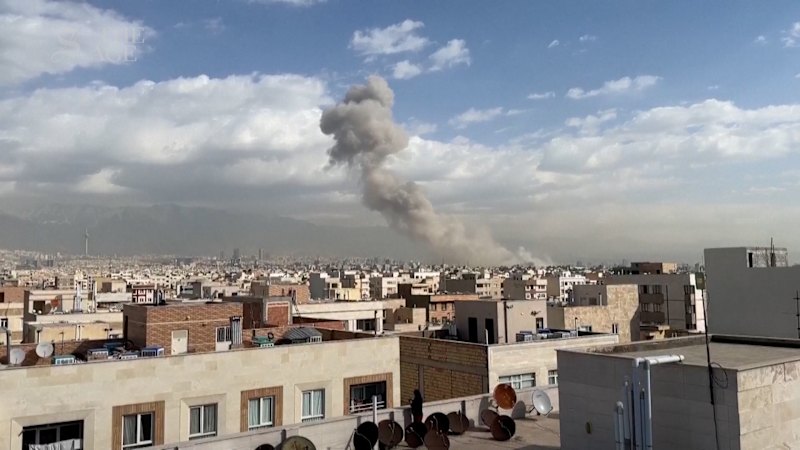
The headlines are screaming about escalation. They are wrong. Every time a missile streaks across the sky between Tel Aviv and Isfahan, the "geopolitical experts" dust off their 1914 analogies and predict the Big One. They see a region on the brink of a total collapse. I see a carefully choreographed industrial-military theater that serves the domestic interests of every player involved.
What the mainstream media frames as a "deterrence failure" is actually a masterclass in controlled volatility. If you believe we are watching the start of World War III, you aren't paying attention to the telemetry. You’re watching the ultimate "too big to fail" enterprise.
The Myth of the Uncontrollable Spiral
The prevailing narrative suggests that Israel and Iran are two runaway trains destined for a head-on collision. This is a fundamental misunderstanding of how modern kinetic signaling works. In the world of high-stakes intelligence, an explosion isn't always meant to destroy; sometimes, it’s meant to communicate.
When Israel strikes Iranian assets, or when Iran launches a swarm of slow-moving drones, they aren't trying to trigger a total war. Total war is bad for business. It’s bad for the IRGC’s massive black-market shipping empires, and it’s bad for Israel’s aspiration to be the "Startup Nation" of the Mediterranean.
Instead, these strikes are precision-engineered pressure releases.
By engaging in periodic, calibrated violence, both regimes satisfy their hardest-line domestic constituents without actually committing to the ruinous cost of a ground invasion or a full-scale regional conflagration. It’s a violent equilibrium. The "instability" we see is actually the mechanism that keeps the broader system stable.
Stop Asking if War is Coming
The most common question on Google and in newsrooms is: "Will Israel and Iran go to war?"
This is a flawed premise. It assumes "war" is a binary state—a light switch you flip from Off to On. In the 21st century, war is a permanent, low-boil subscription service. We are already in the war. We’ve been in it for twenty years. The strikes we see today are simply "feature updates" to a conflict that has no planned end date because neither side can afford to win it.
Think about the mechanics:
- For Iran: An external "Zionist threat" is the only thing keeping a restless, young, and largely secular population from completely boiling over against a stagnant theocracy.
- For Israel: The "existential Iranian threat" is the glue that holds together fractious coalitions and ensures a steady stream of military aid and technological integration with the United States.
If Iran’s nuclear program were truly destroyed, or if the Islamic Republic collapsed tomorrow, the current political structures in the Middle East would lose their primary justification for existence. Security budgets would vanish. The urgency would evaporate. The status quo thrives on the threat of the end, not the end itself.
The Iron Dome Fallacy
We love to talk about the tech. We see the videos of interceptors hitting targets and marvel at the $100,000-per-shot efficiency. But there’s a deeper, more cynical truth about the defense technology landscape.
The proliferation of sophisticated missile defense systems has actually made strikes more likely, not less. This is the Geopolitical Peltzman Effect. When you make a car safer with seatbelts and airbags, people drive more recklessly. When you give a nation an almost impenetrable missile shield, the threshold for launching a "symbolic" strike drops.
Israel can strike Iran because it knows its defenses can catch the inevitable, televised retaliation. Iran can launch a "massive" barrage because it knows Israel will catch most of it, preventing the kind of mass casualties that would actually force a regime-ending response.
The technology hasn't prevented war; it has subsidized it. It has created a digital sandbox where two powers can trade blows with a limited risk of real-world consequences, all while the defense contractors on both sides (and in Virginia) collect the data to iterate on the next generation of sensors.
The US Role: The Reluctant Ref
The competitor articles always frame the US as a stabilizer trying to "restrain" Israel. This is a convenient fiction for the State Department.
In reality, the US uses these flare-ups to field-test its own integrated air defense networks in the Middle East. Every time a "limited strike" occurs, the US Central Command (CENTCOM) gets a live-fire exercise that no simulation can replicate. They are mapping Iranian radar signatures, testing satellite hand-offs, and verifying the latency of the "Red Sea to Mediterranean" sensor net.
If the US truly wanted to stop the cycle, it would cut off the parts and the funding. It doesn't, because a controlled conflict in the Middle East keeps the oil flowing at predictable (if high) prices and keeps the regional powers dependent on the American security umbrella.
The Logistics of the "Shadow"
I have spent years looking at how supply chains and military logistics dictate policy. If these two nations were truly preparing for the "Final War," their behavior would look very different:
- They would stop talking. True escalations are silent until they are over. The sheer amount of pre-strike "leaks" and diplomatic signaling via the Swiss or the Omanis proves that the goal is communication, not annihilation.
- They would target economic vitals. You don't hit an empty warehouse or a radar site if you want to win; you hit the desalinization plants or the oil terminals. They don't do that, because that would be "uncivilized"—meaning, it would actually hurt the bottom line.
Your Strategy is Outdated
If you are a business leader or an investor looking at these strikes as a reason to "risk-off," you are playing a game from the 1970s. The markets have already priced in this perpetual motion machine.
The real risk isn't the missiles. The real risk is the Cyber-Kinetic crossover.
While the world watches the fireworks over Isfahan, the real damage is being done in the silent sectors:
- Logistics Sabotage: Small-scale disruptions in shipping manifests and port automation.
- Energy Grid Probing: Not shutting things down, but mapping the vulnerabilities for a "rainy day" that never comes.
- Information Laundering: Using the chaos of a strike to inject deepfakes or misinformation into the domestic discourse of the adversary.
The kinetic strikes are the "shiny object" designed to keep the public—and the legacy media—looking in the wrong direction.
The Cost of the Game
There is a downside to my contrarian view, and it's a grim one. The risk isn't "Total War"—it's Permanent Attrition.
By maintaining this high-tension equilibrium, both nations are draining their human capital. The smartest minds in Tel Aviv and Tehran are being funneled into building better ways to kill each other (or block those attempts) rather than solving the water crises, the energy transitions, or the economic stagnation facing their populations.
We are witnessing a massive misallocation of global IQ, all to maintain a "security" that is actually just a managed state of fear.
Stop reading the "breaking news" updates about which base was hit. It doesn't matter. The base will be rebuilt, the missiles will be replaced, and the press releases will be written before the smoke clears.
The "clash of civilizations" is actually a joint venture. The strikes will continue until the morale improves—or until the bills for the interceptors finally bounce.
Invest in the defense contractors, ignore the "World War III" clickbait, and realize that we aren't witnessing a breakdown of the world order. We’re witnessing its most profitable, stable, and cynical evolution.


