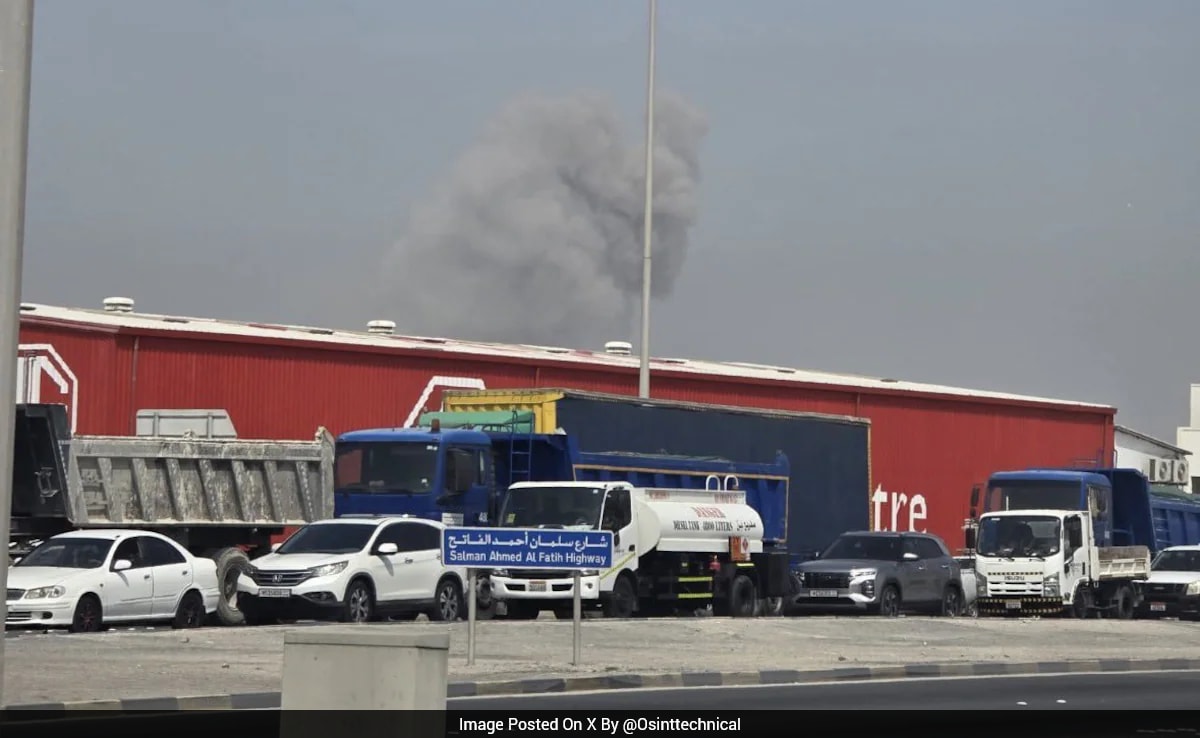
The security architecture of the Persian Gulf relies on a single, high-stakes equilibrium: the ability of the U.S. Navy’s 5th Fleet to project power from Naval Support Activity (NSA) Bahrain while maintaining a threshold of deterrence that prevents direct state-on-state or proxy-on-state strikes. When a missile attack targets this specific geography, it is not merely a tactical event; it is a stress test of the global maritime energy transit system. This analysis deconstructs the operational reality of such an engagement, the tiered defense systems involved, and the shifting cost-exchange ratios that define modern Middle Eastern conflict.
The Strategic Logic of Geographic Vulnerability
NSA Bahrain serves as the central nervous system for U.S. Naval Forces Central Command (NAVCENT). Its location in the Persian Gulf makes it both a peerless vantage point and a fixed target within the "engagement envelope" of regional missile inventories.
The rationale for targeting such a facility involves three distinct strategic aims:
- Deterrence Degradation: Demonstrating that the 5th Fleet’s presence does not grant immunity, thereby forcing a recalculation of U.S. risk tolerance.
- Logistical Friction: Every successful or near-successful strike necessitates a shift in defensive posture, which diverts resources from offensive or surveillance missions to force protection.
- Political Signaling: Targeting Bahrain specifically aims to create friction between the host nation and the United States, testing the domestic political stability of a key regional ally.
The Anatomy of the Strike Tiered Aerial Threats
Modern attacks on naval installations rarely rely on a single vector. Instead, they employ a "saturation logic" designed to overwhelm Integrated Air and Missile Defense (IAMD) systems. We must categorize the incoming threats by their kinetic profile:
- One-Way Attack (OWA) Unmanned Aerial Vehicles: These loitering munitions have low radar cross-sections and slow flight speeds. They are designed to drain the defender’s magazine of expensive interceptors.
- Tactical Ballistic Missiles (TBMs): These follow a predictable parabolic trajectory but impact at high velocities. They require specialized terminal phase interceptors like the MIM-104 Patriot (PAC-3).
- Land-Attack Cruise Missiles (LACMs): These fly at low altitudes to bypass radar horizons, utilizing terrain-following or GPS-waypoint navigation to strike from unexpected angles.
The success of a defense is measured not just by the interception rate, but by the Cost-Exchange Ratio. If an adversary launches a drone costing $20,000 and the defender uses an interceptor costing $2 million, the adversary achieves a strategic win through economic attrition, even if the target remains untouched.
The Kill Chain and Defensive Constraints
To understand why a missile strike in Bahrain is complex, we must map the defensive kill chain—the sequence of events from detection to destruction.
Detection and Classification
The first bottleneck is the sensor-to-shooter link. Radar systems must distinguish between civilian air traffic, environmental noise, and incoming threats. In the crowded airspace of the Persian Gulf, the margin for error is razor-thin. A failure in classification leads to either a successful strike or, conversely, a "blue-on-blue" incident where friendly or civilian assets are targeted.
Engagement Logic
Once a threat is identified, the IAMD system must assign a weapon. The decision matrix follows a strict hierarchy:
- Outer Tier: Aegis-equipped destroyers in the Gulf using SM-2 or SM-6 missiles.
- Middle Tier: Land-based Patriot batteries providing point defense for the base.
- Inner Tier: Close-in Weapon Systems (CIWS), such as the Phalanx, which uses high-rate-of-fire 20mm cannons for terminal defense.
The primary limitation here is magazine depth. A sustained salvo of low-cost missiles can deplete the available interceptors faster than they can be resupplied, creating a "window of vulnerability" that a subsequent, more sophisticated missile can exploit.
Systematic Consequences of Kinetic Escalation
A strike on a U.S. base in Bahrain triggers a cascade of effects across maritime and economic sectors. The logic of the market reacts faster than the logic of the military.
Energy Market Volatility
The Persian Gulf facilitates the transit of roughly 20% of the world’s liquid petroleum. A kinetic event at the 5th Fleet headquarters signals to insurance markets that the primary guarantor of safe passage is under direct threat. This leads to an immediate spike in War Risk Premia for tankers. The cost is not just in the potential loss of a ship, but in the increased operational overhead for every barrel of oil transiting the Strait of Hormuz.
Regional Alignment Shifts
Security in the Middle East is a commodity. When the U.S. base is targeted, regional partners evaluate the "protection value" of the American presence. If the U.S. fails to respond with sufficient force or fails to intercept the threats effectively, it creates an incentive for local states to seek alternative security arrangements or to de-escalate with the aggressor independently of U.S. interests.
The Information Operations Vector
In the immediate aftermath of a strike, the physical damage is often secondary to the perceived damage. Modern conflict includes a "battle for the narrative" where the adversary utilizes social media and state-run outlets to exaggerate the impact of the strike.
- Fact Verification Latency: The time it takes for the U.S. military to confirm damage reports creates a vacuum that is filled by misinformation.
- Signal Amplification: Images of smoke or sirens at a high-profile location like NSA Bahrain serve as psychological tools to project strength to domestic audiences and project weakness to the international community.
Tactical Realities of Base Defense
Defending a base like Bahrain is harder than defending a carrier strike group at sea. A ship can maneuver; a base is a set of known coordinates. This "static target bias" means the adversary has the luxury of time to plan trajectories and timing.
The second limitation is the urban environment. NSA Bahrain is located in Manama. High-altitude interceptions result in falling debris, which can cause civilian casualties and property damage. This collateral risk is a variable that attackers exploit, knowing that the defender is constrained by the need to minimize local impact.
The Calculus of Response
The U.S. response to a strike in Bahrain is governed by the "Proportionality vs. Deterrence" dilemma. A purely proportional response (striking the launch site) may fail to stop future attacks. A disproportionate response risks a full-scale regional war.
The strategic play involves moving beyond kinetic retaliation and addressing the Enabling Infrastructure. This includes:
- Supply Chain Interdiction: Disrupting the flow of components required for missile and drone production.
- Cyber-Kinetic Integration: Using non-kinetic means to disable command and control nodes before a launch occurs.
- Active Defense Expansion: Deploying Directed Energy Weapons (lasers) to solve the cost-exchange ratio problem, as these systems provide a "near-infinite magazine" at a low cost-per-shot.
The maritime security environment is transitioning from a period of "perceived safety" to one of "contested presence." The ability to hold NSA Bahrain at risk allows adversaries to dictate the tempo of regional tension. The only viable path forward for the 5th Fleet is the rapid deployment of autonomous interceptors and the hardening of regional alliances to ensure that a single missile does not unbalance the global energy supply.