Military escalation in the Middle East often functions as a high-cost substitute for a coherent long-term strategy. When kinetic actions—strikes, assassinations, or naval deployments—occur without a defined political endstate, they transition from strategic tools to operational loops that consume resources without altering the fundamental power dynamic. True strategy requires a clear mapping of desired outcomes, the resources required to achieve them, and a rigorous assessment of the adversary's threshold for pain versus their ideological commitment to survival.
The Kinetic Fallacy
The Kinetic Fallacy occurs when tactical success is confused with strategic progress. In the context of Iran, neutralizing a high-value target or degrading a drone manufacturing facility provides a temporary reduction in capability, but it does not address the underlying "Forward Defense" doctrine that Iran has cultivated since 1979.
Iran operates on a logic of asymmetric attrition. Their goal is to raise the cost of presence for Western powers until that cost exceeds the perceived benefit. When the West responds with escalation, it often validates the Iranian internal narrative of "resistance," potentially strengthening the regime's domestic grip while failing to dismantle the proxy networks that provide Iran with its primary defensive depth.
The Three Pillars of Iranian Power Projection
To analyze the effectiveness of any military escalation, one must first deconstruct the three specific pillars that sustain Iran's regional influence.
- Proximal Asymmetry: This is the "Ring of Fire" strategy. By funding and arming non-state actors in Lebanon, Yemen, Iraq, and Syria, Iran creates a buffer zone. Any direct strike on Iranian soil risks a multi-front activation of these proxies.
- Anti-Access/Area Denial (A2/AD): Iran’s investment in ballistic missiles and swarm-capable UAVs (Unmanned Aerial Vehicles) is designed to close the Strait of Hormuz or threaten high-value energy infrastructure. This creates a global economic "kill switch."
- Ideological Continuity: Unlike a corporate structure, the Islamic Revolutionary Guard Corps (IRGC) is built on a decentralized ideological framework. Removing a leader—while operationally disruptive—rarely results in a systemic collapse because the institutional memory and mission are distributed across the entire command structure.
The Cost Function of Deterrence
Deterrence is not a static state; it is a psychological and material equation. $D = P \times V$, where $D$ is deterrence, $P$ is the perceived probability of a response, and $V$ is the perceived value of the cost that response will inflict.
Escalation fails as a strategy when the adversary’s "Survival Value" ($S$) is higher than the "Cost of Compliance" ($C$). For the Iranian leadership, the cost of ceasing their regional activities is often viewed as existential. If they stop supporting their proxies, they lose their primary defense mechanism, making them more vulnerable to regime change. Therefore, no amount of conventional military pressure—short of total war—is likely to reach the threshold where $C < S$.
The Bottleneck of Incrementalism
Incremental military pressure creates a "Boiling Frog" scenario that favors the defender. When escalation happens in small, predictable steps, it allows the adversary to:
- Adapt Tech-Cycles: Rapidly iterating on drone and missile designs to bypass specific electronic warfare or kinetic interceptors.
- Normalize Hostility: Integrating the threat of strikes into their economic and social planning, thereby reducing the "shock" value of future actions.
- Identify Red Lines: Testing the limits of international resolve to see exactly how much they can get away with before a meaningful response is triggered.
This incrementalism creates a bottleneck where the West spends billions on defensive measures (like intercepting $20,000 drones with $2 million missiles) while the adversary spends significantly less to maintain the same level of threat.
The Escalation Ladder vs. The Strategic Map
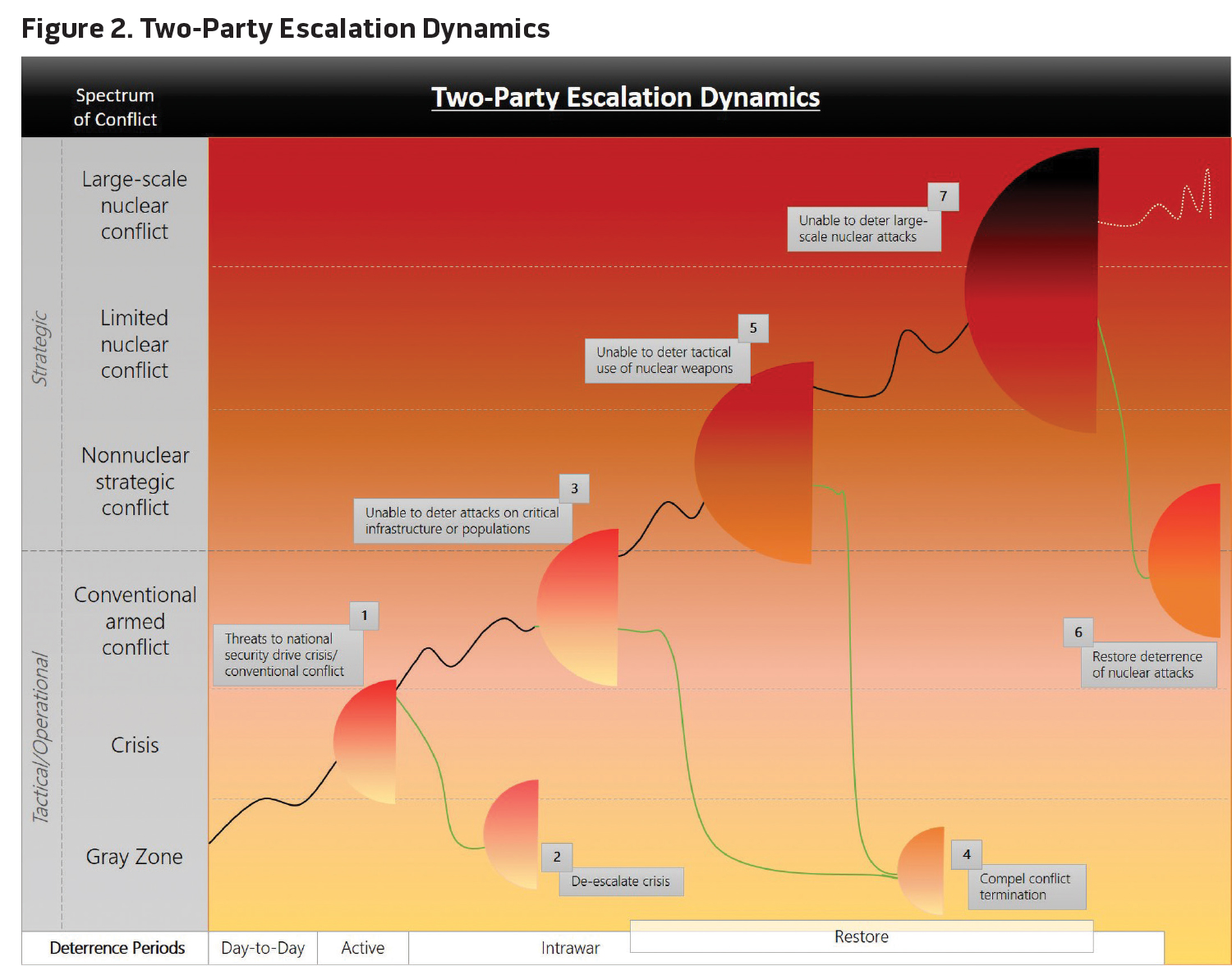
The Escalation Ladder, a concept popularized by Herman Kahn during the Cold War, suggests that there are distinct rungs of conflict that one can climb to signal intent. However, in a multi-polar Middle East, the ladder has been replaced by a web.
A strike in the Levant might trigger a cyber-attack on European maritime logistics or a disruption in the Persian Gulf’s LNG shipping lanes. Strategy is the ability to predict these second-order effects and prepare for them. Escalation without a map is simply "motion without progress."
A masterclass in analysis must recognize that the "Strategy Gap" is filled by political theater. Leaders often choose kinetic options because they are visible and provide an immediate sense of "doing something," whereas diplomatic or economic strategies take years to yield results and are harder to explain to a domestic audience.
Operational Reality of the IRGC
The IRGC is more than a military branch; it is a massive economic conglomerate. It controls significant portions of Iran's GDP through construction, telecommunications, and energy firms. This makes traditional sanctions less effective, as the IRGC can use its control over the state apparatus to shield itself from the worst effects of economic isolation, shifting the burden entirely onto the civilian population.
This economic integration means that military escalation is often targeting an entity that is already prepared for a siege economy. To truly disrupt this system, one must target the logistics and financial nodes that allow the IRGC to move capital across borders, which is a task for intelligence and treasury departments, not just air forces.
The Logic of the "Gray Zone"
Iran excels in the "Gray Zone"—the space between peace and total war. In this zone, they use deniability and ambiguity to achieve their goals. When the West responds with overt military force, it often plays into Iran’s hand by forcing a choice between total war (which the West does not want) or a retreat (which signals weakness).
Strategy must therefore involve competing in the Gray Zone. This includes:
- Information Operations: Undermining the narrative of "resistance" by highlighting the IRGC’s corruption and the cost their adventures impose on the Iranian people.
- Cyber-Kinetic Integration: Using non-attributable digital strikes to degrade military capabilities without the diplomatic fallout of a missile strike.
- Maritime Interdiction: Not just protecting ships, but systematically seizing the illicit oil and arms shipments that fund the proxy networks.
The Nuclear Variable
The shadow of the nuclear program complicates every military calculation. Any significant escalation risks pushing Iran toward "breakout" capability. If the regime perceives that a conventional defeat is imminent, the rational choice from their perspective is to acquire a nuclear deterrent as the ultimate insurance policy.
This creates a paradox: the more successful a conventional military strategy is at degrading Iran’s power, the more likely it is to trigger a nuclear crisis. Strategic planning must account for this "Threshold of Desperation."
The Strategic Play
The transition from military escalation to actual strategy requires a shift from "degrading" to "displacing." The objective should not be to simply blow up hardware, but to displace Iran’s influence through a sustained, multi-domain pressure campaign that prioritizes economic and political isolation over kinetic fireworks.
The final strategic move is to decouple the Iranian people from the IRGC’s regional ambitions. This is achieved by creating a clear "Off-Ramp" that offers economic reintegration in exchange for a documented, verifiable cessation of proxy funding and a rollback of the missile program. This must be backed by a credible, multi-national maritime task force that makes the cost of "Gray Zone" aggression too high to sustain.
Military force should be the "silent partner" in this strategy—a looming reality that is rarely used but always present, rather than a loud, frequent, and ultimately ineffective tool of political signaling.
Would you like me to analyze the economic impact of a potential Strait of Hormuz closure on global energy markets?


