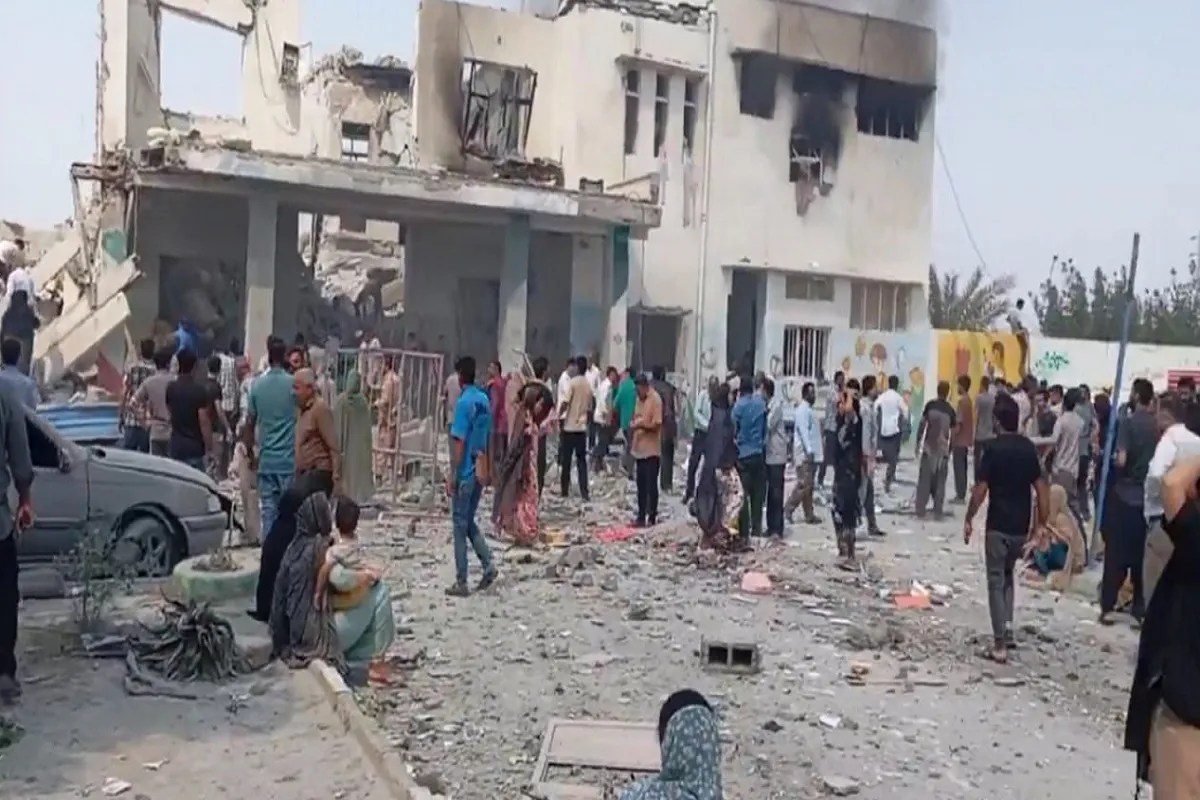
The reported deaths of 40 individuals, characterized as Iranian students, during joint US-Israeli kinetic operations represents a terminal shift in the theater of regional containment. This event transcends standard border skirmishes, signaling a transition from gray-zone operations—where deniability is the primary currency—to high-threshold direct attribution. When academic or civilian-adjacent demographics become casualties in high-precision strikes, the political cost of non-retaliation for Tehran exceeds the military cost of direct engagement. The resulting Iranian strike on Washington-affiliated assets indicates that the "shadow war" has reached a state of mechanical transparency.
The Architecture of Kinetic Miscalculation
The current escalation follows a predictable but lethal feedback loop. To understand why 40 casualties in a non-combatant category trigger a larger regional shift than 100 casualties in a militia setting, one must analyze the Symbolic Value vs. Operational Value matrix.
- Operational Value: Standard strikes target logistics hubs, drone manufacturing facilities, or command-and-control (C2) nodes. These are expected losses in a high-tension environment.
- Symbolic Value: Targeting or inadvertently hitting "students"—often the intellectual or ideological future of the state—forces the IRGC (Islamic Revolutionary Guard Corps) to respond to domestic optics.
The failure of precision intelligence in this instance creates a "Security Dilemma" where Israel and the US perceive their actions as defensive degradation of threats, while Iran perceives them as an existential assault on its sovereign human capital. This mismatch in perception is the primary driver of the current "tit-for-tat" cycle.
Structural Analysis of the Iranian Response Mechanism
Iran’s decision to strike Washington-linked targets directly, rather than through Lebanese or Iraqi proxies, suggests a breakdown in the Buffer Strategy. Historically, Iran utilized "Strategic Depth" by ensuring that any blood spilled was not Iranian and any missiles fired did not originate from Iranian soil.
The mechanics of the recent counter-strike reveal three distinct shifts in Iranian military doctrine:
- Direct Attribution Over Proxy Deniability: By claiming the attack or launching it from locations that make attribution instantaneous, Tehran is communicating that the "Red Line" regarding its citizens has been crossed.
- Saturation vs. Precision: While US-Israeli strikes focus on "surgical" removal of assets, Iranian doctrine relies on "Saturation Volleys." The intent is not necessarily to destroy a specific building but to overwhelm the Iron Dome or Aegis Combat Systems, proving that the cost of defense is economically unsustainable.
- The Washington Target Selection: Choosing "Washington" (referring to US regional headquarters or diplomatic-military outposts) is a calculated attempt to decouple the US-Israel alliance. Iran is testing whether the US will continue to provide the "Kinetic Umbrella" for Israeli strikes if American personnel are the ones paying the physical price.
The Technological Parity Gap
A critical component of this escalation is the rapid advancement of Loitering Munition (LM) technology. The gap between high-end Western electronic warfare (EW) and Iranian drone capabilities is narrowing.
The Cost-Exchange Ratio
The financial architecture of this conflict favors the cheaper aggressor.
- Interceptor Cost: A single Tamir (Iron Dome) or SM-3 (Aegis) interceptor costs between $50,000 and $2 million.
- Attack Cost: A Shahed-series drone or a basic ballistic missile costs between $20,000 and $150,000.
This creates a Negative Attrition Curve. For every successful defense, the defending coalition (US/Israel) loses more in "Replacement Value" than the attacker loses in "Production Value." If Iran can maintain a high-frequency strike rate, they can effectively bankrupt the regional defense posture without ever winning a conventional battle.
The Intelligence Failure Logic
The death of 40 students implies one of two intelligence states: Target Misidentification or Collateral Acceptance.
In the first scenario, human intelligence (HUMINT) or signals intelligence (SIGINT) incorrectly identified a civilian facility as a C2 node. This points to a degradation of the Mossad/CIA ground networks within Iran. In the second scenario, the strategic value of the target co-located with the students was deemed high enough to justify the "Collateral Damage Estimate" (CDE).
The latter is a high-risk gamble. In modern asymmetric warfare, the "Information Theater" is as important as the physical theater. By providing Tehran with a narrative of "martyred youth," the coalition has inadvertently unified the Iranian domestic public—a demographic that was previously fractured by internal economic protests.
Escalation Ladders and the Threshold of Total War
To quantify the risk of this turning into a regional conflagration, we must look at the Escalation Ladder developed by Herman Kahn, adapted for the 21st century:
- Sub-critical Friction: Cyberattacks, assassinations (Previous State).
- Limited Kinetic Exchange: Targeted strikes on military infrastructure.
- High-Threshold Provocation: Large-scale loss of non-combatant lives (Current State).
- Direct State-on-State Conflict: Missile volleys targeting capital cities.
- Total Regional War: Involvement of regional energy infrastructure (Strait of Hormuz).
We are currently hovering at Rung 3. The transition to Rung 4 depends entirely on the US response to the Iranian strike on "Washington." If the US responds with a strike inside Iranian borders—rather than targeting proxies in Syria or Iraq—the transition to Rung 4 is locked in.
The Economic Implications of the Kinetic Loop
The primary casualty of this specific escalation is the global energy market’s "Risk Premium." While actual oil flow has not been interrupted, the threat to the Strait of Hormuz increases with every direct strike.
The logistical bottleneck of the Strait handles roughly 20% of the world's petroleum liquids. A direct Iranian strike on a US asset is a signal that Tehran is willing to risk the "Economic Nuclear Option"—the closure of the Strait. This would trigger a global inflationary spike that neither the US nor its European allies are prepared to manage in the current fiscal climate.
The Asymmetric Advantage of Iranian Geography
Israel’s primary disadvantage is "Strategic Lack of Depth." It is a small, highly urbanized state where a single lucky strike on a population center causes catastrophic systemic shock. Iran, conversely, possesses massive territorial depth and a decentralized military command structure.
The IRGC has spent decades "hardening" their infrastructure, moving missile silos deep into mountain ranges (the so-called "Missile Cities"). A campaign to "neutralize" Iranian capabilities would require a sustained aerial bombardment lasting months, not days. The US and Israel are currently attempting to achieve through "decapitation strikes" what would actually require a full-scale theater war. This mismatch between Objectives (regime change or total neutralization) and Means (limited air strikes) is why the current strategy is failing to provide a deterrent.
Strategic Forecast: The Shift Toward Nuclear Hedging
The immediate consequence of the "40 Students" event will be an accelerated Iranian pivot toward "Nuclear Hedging." When a state realizes its conventional air defenses cannot protect its intellectual and military elite, the perceived value of a nuclear deterrent reaches a tipping point.
We should expect:
- Hardened Enrichment: Increased movement of centrifuges to deeply buried sites like Fordow.
- Expulsion of Inspectors: Total cessation of IAEA cooperation as a "retaliatory" measure for the strikes.
- Weaponization Timelines: A reduction in "breakout time" from months to weeks.
The coalition strategy of "Pressure through Attrition" is producing the opposite of its intended effect. Instead of forcing Tehran to the negotiating table, it is proving to the Iranian leadership that they are unsafe at any level of conventional de-escalation.
The only viable path to preventing Rung 4 of the escalation ladder is the re-establishment of a "Communication Corridor" between Washington and Tehran that bypasses the public theater. However, as long as the kinetic exchange remains the primary mode of communication, the probability of a "Black Swan" event—such as a strike on a major metropolitan center—approaches 85% within the next six fiscal quarters. The strategic play now is not more precision strikes, but the reinforcement of red-lines that allow both sides a face-saving exit from the current attrition loop.
Determine the exact technical specifications of the Iranian "Washington strike" to assess if the munitions used were "Direct-to-Satellite" guided, which would indicate a level of Russian or Chinese technical intelligence sharing previously unconfirmed in this theater.