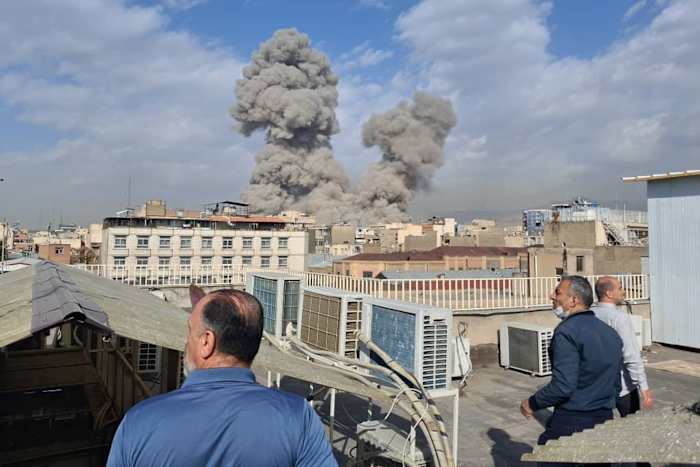
The recent joint military actions by the United States and Israel against Iranian sovereign assets represent a fundamental shift from containment to active structural degradation. This is not a standard escalatory cycle; it is a calculated application of "Kinetic Diplomacy," where the primary objective is to alter the internal power dynamics of the target state by demonstrating the total obsolescence of its defensive architecture. When Donald Trump publicly urges the Iranian populace to "take over your government," he is not merely using rhetoric—he is signaling the final stage of a multi-vector pressure campaign designed to collapse the gap between external military pressure and internal civil unrest.
The Triad of Target Acquisition
The efficacy of the recent strikes is measured by the neutralization of three specific operational pillars. Understanding these pillars clarifies why these specific sites were chosen over broader civilian or economic infrastructure.
- Anti-Access/Area Denial (A2/AD) Degradation: The first wave prioritized the removal of S-300 and potentially S-400 radar arrays and missile batteries. By blinding the Integrated Air Defense System (IADS), the coalition secures "freedom of maneuver." This creates a persistent psychological threat: the knowledge that any point within the Iranian interior is now reachable with zero warning.
- C4ISR Infrastructure: Targeting Command, Control, Communications, Computers, Intelligence, Surveillance, and Reconnaissance hubs disrupts the "OODA loop" (Observe-Orient-Decide-Act) of the Islamic Revolutionary Guard Corps (IRGC). When central command cannot verify the status of its borders, the internal security apparatus becomes sluggish, creating the friction necessary for domestic opposition to organize.
- Propulsion and Solid Fuel Production: By hitting the chemical mixing plants and planetary mixers used for ballistic missile fuel, the coalition attacks the Iranian "force projection" capability at its manufacturing bottleneck. Unlike a launched missile, a destroyed mixing plant takes years to replace due to specialized global supply chain constraints and sanctions on dual-use technology.
The Cost Function of Iranian Retaliation
Iran’s strategic response is governed by a diminishing set of variables. Their primary deterrent—the "Proxy Shield" consisting of Hezbollah, the Houthis, and various militias—is facing severe attrition.
The Iranian leadership now operates under a brutal cost-benefit analysis. If they retaliate with a mass drone and missile swarm, they risk a "Decapitation Strike" targeting the supreme leadership. If they do not retaliate, they face a "Credibility Collapse" among their hardline base and regional allies.
This creates a Strategic Deadlock. The coalition’s use of precision munitions—specifically Air-Launched Ballistic Missiles (ALBMs) that stay outside the range of point-defense systems—demonstrates a technological asymmetry that Iran cannot currently bridge. The cost of a failed retaliation is now higher than the cost of absorbing the strike, a reversal of the status quo that has held for a decade.
Cyber-Kinetic Integration and Information Hegemony
The military strikes were almost certainly preceded or accompanied by "Left of Launch" cyber operations. These operations do not just disable hardware; they inject uncertainty into the data streams the Iranian military relies on.
- Data Spoofing: Making friendly aircraft appear as threats or vice versa to induce "Blue-on-Blue" (friendly fire) incidents.
- Industrial Control System (ICS) Sabotage: Overloading power grids near military installations to force a reliance on backup generators, which are easier to track via thermal imaging.
This technological dominance provides the backdrop for the political messaging directed at the Iranian public. When an external power can strike with impunity, it signals to the domestic population that the current regime can no longer fulfill the most basic requirement of a state: the protection of its borders.
The Mechanics of Internal Power Shift
Donald Trump’s call for a government takeover targets the "Fragility Coefficient" of the Iranian state. For a revolutionary government to fall, three conditions must be met simultaneously:
- Defection of the Enforcers: Elements of the regular army (Artesh) or the lower ranks of the IRGC must perceive that the regime's survival is no longer in their personal interest.
- Economic Paralysis: The destruction of military assets forces the regime to divert dwindling hard currency from social subsidies to defense rebuilding.
- Perceived Alternative: The population must believe that the international community will support a transition rather than allow the country to descend into a vacuum.
The coalition strategy assumes that by stripping away the regime's "Aura of Invincibility" through visible military failure, the psychological barrier to mass protest is lowered. This is a high-stakes gamble on the social contract. If the Iranian people view the strikes as an attack on the nation rather than the regime, it could catalyze a "Rally 'Round the Flag" effect, strengthening the very hardliners the West seeks to displace.
Logistical Bottlenecks in the Post-Strike Environment
Iran’s ability to recover depends on its "Resilience Capacity." Current sanctions mean that high-precision electronics, specialized carbon fiber for centrifuges, and advanced metallurgy tools are nearly impossible to acquire legally.
The second limitation is the "Shadow Fleet." Iran relies on illicit oil sales to fund its defense budget. If the coalition moves from military targets to "Economic Choke Points"—specifically the oil loading terminals at Kharg Island—the regime’s ability to pay its internal security forces (the Basij) vanishes. Without pay, the loyalty of the internal suppression apparatus is non-guaranteed.
The Escalation Ladder: Next Tier Variables
The conflict is currently at Tier 3 of a 5-Tier escalation model:
- Tier 1: Proxy skirmishes and cyber probing (Status quo ante).
- Tier 2: Limited direct strikes on peripheral assets.
- Tier 3: Major kinetic attack on domestic military infrastructure (Current State).
- Tier 4: Systematic destruction of energy and dual-use industrial assets.
- Tier 5: Full-scale regime change operations or nuclear breakout attempt.
Transitioning to Tier 4 would signify a total abandonment of diplomatic pathways. The presence of US carrier strike groups and the deployment of THAAD (Terminal High Altitude Area Defense) batteries to Israel provide the necessary "Shield" for the coalition to continue "Sword" operations at Tier 3 without fear of a devastating counter-response.
Strategic Recommendation for Global Market Participants
The immediate volatility in energy markets is a distraction from the long-term structural shift. Analysts must focus on the "Geopolitical Risk Premium" being baked into regional logistics.
Investors and strategists should prioritize the following maneuvers:
- De-risk Supply Chains passing through the Strait of Hormuz: Assume a 15% probability of temporary closure and a 100% probability of increased insurance premiums.
- Monitor Iranian "Dash to the Bomb": If the regime perceives its conventional defenses are gone, the logic for a nuclear deterrent becomes absolute. Watch for movements at the Fordow and Natanz enrichment sites as the ultimate leading indicator of Tier 5 escalation.
- Evaluate the "Trump Effect" on Regional Alliances: The explicit call for regime change signals that a second Trump administration would likely move toward a "Maximum Pressure 2.0" model, eliminating any remaining "gray zone" for companies currently hedging their bets on Middle Eastern stability.
The operational reality is that the "Shadow War" is over. It has been replaced by a transparent conflict where the objective is the total psychological and structural dismantling of the Iranian revolutionary state.
Move assets toward high-certainty jurisdictions and prepare for a sustained period of "High-Intensity Friction" in the Levant and the Persian Gulf. The coalition has demonstrated the capability; the only remaining variable is the regime's breaking point.