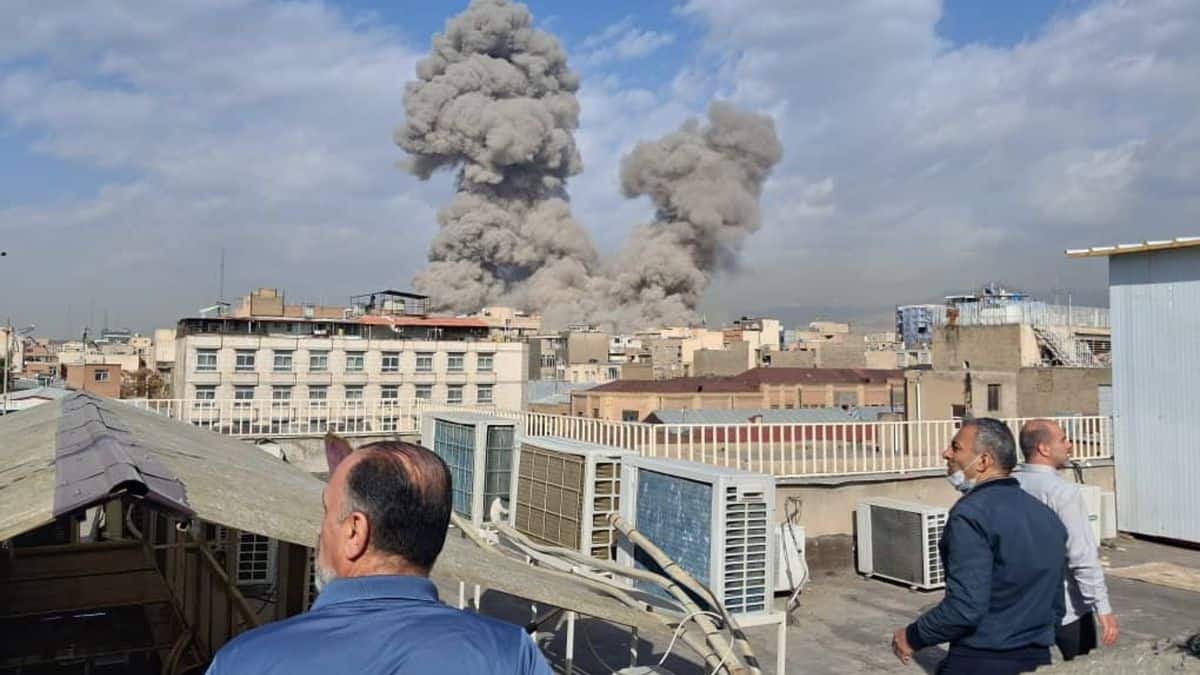
The shift in Israeli and American posture toward Iran marks the end of "strategic patience," a decade-long doctrine predicated on containment and proxy management. Prime Minister Benjamin Netanyahu’s recent assertion that a direct confrontation with Iran is "not going to take years" signals a transition from a low-intensity "Shadow War" to a high-intensity kinetic compression. This acceleration is not merely rhetorical; it is driven by a closing window of nuclear breakout capability and a fundamental change in the regional balance of power. Understanding this shift requires deconstructing the operational variables that determine the timing, scale, and probability of a direct conflict.
The Nuclear Breakout Function and the Terminal Window
The primary driver of the shortened timeline is the Iranian nuclear breakout clock. Breakout time—the duration required to produce enough weapons-grade uranium ($U_{235}$ enriched to 90%) for a single nuclear explosive device—has transitioned from months to weeks. This technical reality eliminates the luxury of long-term diplomatic cycles.
Israel’s strategy is governed by the "Begin Doctrine," which dictates that no enemy state in the Middle East shall be permitted to acquire weapons of mass destruction. The application of this doctrine to Iran involves three specific thresholds:
- The Enrichment Threshold: Iran’s accumulation of 60% enriched uranium provides a rapid "sprint" capability to 90%.
- The Hardening Threshold: The transition of enrichment activities to deeply buried facilities like Fordow increases the "cost of neutralization," as conventional munitions may eventually reach their limit of penetration.
- The Weaponization Threshold: The integration of a nuclear warhead onto a delivery vehicle, such as the Khorramshahr or Shahab-3 ballistic missiles.
The convergence of these three factors creates a "Zone of Immunity." Once Iran moves its critical assets into sufficiently hardened underground facilities and masters the weaponization cycle, the military cost-benefit analysis for Israel and the U.S. shifts from "preventative" to "existential." Netanyahu's urgency reflects a calculation that the window to strike with high confidence of success is closing.
The Triad of Deterrence Erosion
The acceleration toward conflict is further catalyzed by the degradation of traditional containment mechanisms. For years, the U.S. and Israel relied on a triad of deterrence that has recently begun to fracture.
The Failure of Sanctions as a Kinetic Inhibitor
Economic pressure was designed to create internal political friction within Iran, theoretically forcing a trade-off between nuclear ambition and regime survival. However, the emergence of a "Resistance Economy" and strengthened trade ties with non-Western powers has decoupled Iranian military R&D from global financial markets. Sanctions now function as a chronic condition rather than an acute deterrent.
The Proxy Saturation Limit
Iran’s "Ring of Fire" strategy—utilizing Hezbollah, Hamas, and the Houthis—was intended to create a multi-front deterrent against an Israeli strike. The recent degradation of Hamas’s military infrastructure and the systematic targeting of Hezbollah’s command hierarchy have significantly lowered the "retaliation tax" Israel expects to pay for a direct strike on Iranian soil. With the proxies weakened, the incentive for Israel to address the "head of the snake" in Tehran increases proportionally.
Technological Parity and the AI-Driven Intelligence Gap
The battlefield has moved from traditional sabotage (Stuxnet) to AI-integrated intelligence and precision targeting. Israel’s ability to conduct high-profile assassinations and kinetic strikes inside Iran suggests a deep intelligence penetration. However, Iran’s advancement in drone swarm technology and hypersonic missile development creates a closing gap in technological superiority. The longer Israel waits, the more capable Iran becomes at defending its airspace and retaliating with precision.
Operational Constraints and the Logistics of a Shortened Timeline
When Netanyahu states that a conflict will not take years, he is referencing a high-intensity, short-duration campaign designed to decapitate Iranian nuclear and military infrastructure. This "Compressed Kinetic Model" relies on three operational pillars.
Air Superiority and SEAD Operations: The first phase requires the Suppression of Enemy Air Defenses (SEAD). Iran’s deployment of the S-300 and domestically produced Bavar-373 systems necessitates a massive, coordinated electronic warfare and stealth-driven opening salvo. Unlike the multi-year campaigns in Iraq or Afghanistan, this would be a "shock and reset" operation.
The Bunker Defeat Mechanism: Neutralizing Fordow or Natanz requires the employment of Massive Ordnance Penetrators (MOP). Since Israel does not currently possess the heavy bombers (like the B-2 Spirit) required to deploy the largest MOPs, the timeline is inextricably linked to U.S. military cooperation or the delivery of specialized munitions and refueling tankers to the IAF.
Cyber-Kinetic Integration: A modern strike on Iran would not be purely aerial. It would involve the simultaneous disabling of Iran’s command-and-control (C2) grids, electrical infrastructure, and communication networks via cyber-offensive operations. The goal is to create a "strategic blackout" during the window of the kinetic strike to prevent a coordinated retaliatory launch.
The Geopolitical Cost Function
The decision to move toward a near-term conflict involves a complex cost function. Analysts must weigh the "Cost of Action" against the "Cost of Inaction."
- Cost of Action ($C_a$): Regional escalation, global oil price shocks, potential for long-range Iranian retaliation against Western assets, and the strain on the U.S.-Israel diplomatic relationship.
- Cost of Inaction ($C_i$): A nuclear-armed Iran, the permanent loss of Israeli regional hegemony, an emboldened "Axis of Resistance," and the high probability of a nuclear arms race in the Middle East (specifically involving Saudi Arabia).
The current Israeli administration has determined that $C_i$ now outweighs $C_a$. This shift is supported by the normalization of ties with several Arab nations through the Abraham Accords, which has created a quiet, regional anti-Iran coalition that provides intelligence and potentially even logistical support for containment efforts.
Redefining the "War" Paradigm
The phrase "US-Israel war on Iran" is often misinterpreted as a full-scale ground invasion. In reality, the strategic blueprint focuses on a Surgical Attrition Model. This model does not seek regime change through occupation but rather the "systematic dismantling of capability."
The objectives are hierarchical:
- Primary: Destroy centrifuges, enrichment stockpiles, and R&D facilities.
- Secondary: Neutralize ballistic missile production sites and launch pads.
- Tertiary: Degrade the IRGC's command structure and naval assets in the Persian Gulf.
This approach minimizes the duration of the "war" while maximizing the setback to Iran’s strategic goals. It avoids the "forever war" trap by focusing on hardware and infrastructure rather than territorial control.
[Image showing a map of Iran's major nuclear and military installations]
The Strategic Bottleneck: US Election Cycles and Domestic Stability
The timeline is also dictated by the political volatility in Washington. Israel views the current geopolitical climate as a unique window of opportunity. The threat of a shift in U.S. foreign policy toward isolationism or a return to the Joint Comprehensive Plan of Action (JCPOA) style of diplomacy creates a "use it or lose it" scenario for Israeli military planners who require U.S. backing—or at least non-interference.
The integration of U.S. Central Command (CENTCOM) with the Israeli Defense Forces (IDF) has reached an unprecedented level of interoperability. Joint exercises, such as Juniper Oak, are explicit rehearsals for the exact scenario Netanyahu is describing: a large-scale, long-range strike on a sophisticated adversary.
The Final Strategic Calculation
The inevitability of this confrontation is rooted in the "security dilemma": as Iran increases its security through nuclear enrichment and proxy expansion, it inadvertently decreases the security of Israel and the U.S., forcing them to respond. This feedback loop has reached its terminal stage.
The transition from "years" to "months" or "weeks" in strategic planning suggests that the intelligence community has identified a specific, non-negotiable red line that Iran is about to cross. Whether this is the installation of IR-6 centrifuges at a new depth or the acquisition of advanced Russian air defense systems (like the S-400), the trigger is no longer theoretical.
The strategic play now is the positioning of assets for a high-intensity, low-duration strike. This involves the hardening of domestic missile defenses (Iron Dome, David’s Sling, and Arrow systems) to absorb the inevitable first wave of retaliation, followed by a decisive blow to the Iranian nuclear core. The objective is not a perpetual state of war, but a definitive kinetic reset that removes the nuclear threat from the board for at least a decade. Success depends on the speed of the operation and the ability to maintain regional stability in the immediate vacuum following the strike.