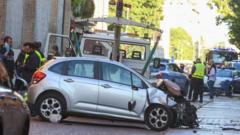
When a motor vehicle enters a pedestrian-dense zone and injures eight individuals, public reporting typically focuses on immediate casualties and driver descriptions. This approach obscures the structural, kinetic, and structural realities that govern vehicular mass casualty incidents (VMCIs). To understand why these events occur and how to neutralize their impact, we must analyze them through kinetic energy transfer equations, spatial architecture vulnerability, and defensive barrier engineering.
The core driver of severity in any vehicular impact is the linear kinetic energy formula:
$$E_k = \frac{1}{2}mv^2$$
Where $m$ represents vehicle mass and $v$ represents velocity. Because velocity is squared, an acceleration of just 15 kilometers per hour more than doubles the destructive force of a standard 1.5-metric-ton sedan. In dense urban centers, where pedestrian velocity approaches zero and human bodies possess no structural shielding, the vehicle operates as a kinetic energy dissipation device, transferring its force directly into human tissue and surrounding infrastructure.
The Three Phases of a Vehicular Mass Casualty Incident
Every VMCI unfolds across three discrete chronological phases. Mitigating casualties requires specific structural interventions at each phase.
1. The Penetration Phase
The penetration phase begins the moment a vehicle deviates from the designated roadway and crosses the threshold into a pedestrian zone. In poorly designed urban areas, this transition occurs without resistance. The vehicle capitalizes on geometric vectors—such as long, straight approach lanes or radiused corners designed for high-speed turns—to maximize its entry velocity before collision.
2. The Dispersion Phase
Once inside the pedestrian zone, the vehicle strikes the initial human targets. The primary mechanism of injury during this phase is primary impact trauma, followed closely by secondary impacts when victims are projected into vertical surfaces, pavements, or other infrastructure elements. The density of the crowd dictates the casualty rate; a highly compacted crowd prevents individuals from scattering, effectively turning the human mass into a continuous medium for kinetic energy absorption.
3. The Deceleration Phase
The incident concludes only when the vehicle’s kinetic energy reaches zero. This occurs via three potential mechanisms: mechanical failure of the vehicle, manual intervention (braking or steering into a fixed object by the driver), or structural resistance (collision with load-bearing architectural elements or engineered barriers).
Vulnerability Mapping in Urban Architecture
Pedestrian injuries in public spaces are rarely random. They are the direct consequence of architectural vulnerabilities that fail to separate high-mass vehicle vectors from low-mass pedestrian zones. Standard traffic management relies heavily on psychological compliance—paint on asphalt, stop signs, and low curbs. When a driver ignores these psychological cues, whether due to a medical emergency, mechanical failure, or intent, the physical environment must absorb the force.
The Buffer Strip Deficit
The distance between the active roadway and pedestrian traffic is the single most critical variable in human reaction time. A standard curb height of 15 centimeters provides zero mechanical resistance to a vehicle moving at speed; it serves merely as a visual marker. If the sidewalk width is less than three meters, pedestrians have less than 0.5 seconds to react to a vehicle traveling at 50 kilometers per hour. This eliminates the possibility of evasive action.
Geometric Acceleration Corridors
Urban layouts that feature long, unobstructed straightaways leading toward plazas, outdoor dining spaces, or public transit hubs create high-velocity vectors. If a vehicle experiences a stuck throttle or deliberate acceleration along these paths, it accumulates catastrophic kinetic energy before encountering any physical resistance. Intersection geometry that favors wide, sweeping turns instead of sharp, 90-degree angles allows vehicles to maintain high speeds while veering near pedestrian gathering points.
Engineered Mitigation and Barrier Dynamics
To neutralize the threat of VMCIs, urban infrastructure must transition from psychological compliance systems to physical energy-absorption systems. This requires the deployment of engineered perimeters rated to specific crash-test standards, such as the ASTM F2656 or the international IWA 14-1 certifications.
Active vs. Passive Passive Barriers
Passive barriers are permanently fixed structures engineered to stop a vehicle of a specific weight class at a designated speed.
- Fixed Bollards: Deep-foundation steel pipes encased in concrete. These systems do not rely on surface mass; they leverage underground structural footings to transfer the kinetic energy of the vehicle directly into the earth.
- Engineered Street Furniture: Planters, reinforced benches, and heavy-sculpture installations designed with internal structural steel skeletons linked to sub-surface anchors. These elements preserve urban aesthetics while functioning as heavy-duty defense barriers.
- High-Containment Curbs: Specialized concrete profiles designed to redirect a vehicle's tires back onto the roadway by generating counter-directional torque, effective at shallow impact angles.
Active barriers, by contrast, are dynamic systems deployed at vehicular checkpoints or transit entrance points. These include retractable bollards, wedge barriers, and drop-arm beams that can be deployed mechanically or electronically within seconds to seal a perimeter.
The Mechanics of Energy Dissipation
When a vehicle strikes a properly rated fixed bollard, the energy is managed through controlled deformation. The front crumple zone of the vehicle absorbs the initial fraction of the force, followed by the catastrophic failure of the vehicle's engine block against the unyielding steel core of the bollard. By arresting the vehicle within centimeters of the perimeter line, the penetration phase is cut short, reducing the dispersion phase to zero.
The primary limitation of barrier deployment is the capital cost and the displacement of risk. Installing deep-foundation bollards requires clearing underground utilities, a process that escalates municipal infrastructure budgets. Furthermore, reinforcing one public square often diverts vehicular threats to adjacent, unshielded streets, requiring a comprehensive regional topology assessment rather than isolated installations.
Operational Blueprint for Public Space Security
Municipalities and property managers cannot rely on reactive policing to halt a vehicle once it is in motion. Security must be baked into spatial design through an operational hierarchy of protection.
First, eliminate straight-line approach vectors. Introduce chicane designs, planters, and tight-radius turns into the roadway layout approaching pedestrian zones to force vehicles to maintain low velocities. This imposes a physical limit on the maximum potential velocity ($v$) variable before a vehicle ever nears a crowd.
Second, establish a clear zone of at least four meters between the vehicle travel lane and the pedestrian boundary. Fill this buffer space with high-absorption passive barriers. The barriers must be spaced no further than 1.2 meters apart; this gap is wide enough to comply with accessibility mandates for wheelchairs and strollers, yet narrow enough to prevent the narrowest modern passenger vehicles from squeezing through.
Third, integrate structural redundancy. Do not rely on a single line of defense. A comprehensive system uses outer perimeter traffic-calming measures, mid-tier physical barriers, and inner-tier structural elements like reinforced building facades and raised plaza platforms. If a high-mass vehicle breaches the outermost layer, its velocity is sufficiently degraded so that the secondary layer can achieve complete deceleration without casualty transfer.