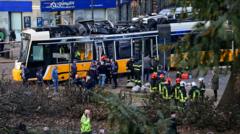
The fatal derailment of a primary transit artery in Milan serves as a violent reminder that urban rail systems are closed-loop environments where minor mechanical variances yield catastrophic kinetic energy transfers. When a multi-ton tram leaves its guided path at operational speed, the transition from rolling friction to unconstrained sliding transforms a controlled transit vehicle into a projectile. This event is rarely the result of a single isolated "accident" but rather the culmination of a failure chain involving track geometry, rolling stock maintenance, and human-interface protocols. To understand the Milan incident, one must deconstruct the physics of the derailment and the systemic vulnerabilities of aging European light rail networks.
The Mechanics of Flange Climbing and Track Geometry
A derailment occurs when the lateral force $F_l$ exerted by the wheel against the rail exceeds the vertical load $F_v$ holding it in place, specifically when the ratio $F_l / F_v$ surpasses the Nadal limit. In the context of Milan’s historic and modern tram mix, two primary physical mechanisms likely dictated the outcome:
- Wheel Flange Climbing: As a tram enters a curve or a switch point, the leading wheel's flange rubs against the inner gauge of the rail. If there is a sudden change in track friction—often caused by debris, improper lubrication, or rail "pitting"—the wheel can climb the rail head. Once the flange base clears the top of the rail, the vehicle loses all lateral constraint.
- Switch Point Failure: The most sensitive nodes in the Milanese network are the mechanical switches. A gap as small as a few millimeters between the "tongue" rail and the stock rail can allow a wheel flange to "pick the switch," forcing the front and rear bogies onto diverging paths. This creates a torsional shear that typically flips the lead car.
The age of the Milanese infrastructure introduces a variable of track gauge widening. Over decades of use, the distance between the two rails can expand due to the degradation of the underlying sleepers or the loosening of tie-plates. This allows for excessive "hunting oscillation," where the tram sways violently at speed, increasing the probability of a high-energy strike against the rail head that triggers a jump.
The Kinetic Energy Dissipation Problem
The severity of the casualties in the Milan incident—two dead and dozens injured—is a direct function of how the vehicle dissipated its kinetic energy upon leaving the tracks. In a standard braking scenario, energy is converted to heat via friction. In a derailment, that energy is absorbed by the vehicle's structural frame and, ultimately, the passengers.
The formula $KE = \frac{1}{2}mv^2$ dictates that even a slight increase in velocity results in a squared increase in destructive potential. Milan’s trams, particularly the older "Ventotto" 1500 series and even the newer "Sirio" models, operate in dense urban corridors where the proximity of "hard" infrastructure (buildings, utility poles, and stone bollards) leaves zero margin for error.
When the tram derailed, the deceleration was likely "instantaneous" rather than "progressive." Because tram interiors are designed for maximum passenger density rather than impact safety, they lack the crumple zones, seatbelts, or airbags found in automotive engineering. Passengers become unrestrained projectiles within the cabin, leading to the high injury count reported. The death toll suggests a "crush zone" compromise where the vehicle's structural integrity failed upon impact with a fixed object, likely a pylon or a secondary tram.
Infrastructure Maintenance as a Predictive Variable
The ATM (Azienda Trasporti Milanesi) manages one of the most complex tramway networks in Western Europe. Maintaining this system requires a rigorous audit of the Pillars of Permanent Way Integrity:
- Rail Profile Analysis: Constant monitoring of the "head" of the rail to ensure the profile matches the wheel flange shape. Wear and tear flatten the rail, reducing the effectiveness of the guiding geometry.
- Bogie Harmonization: Trams must have their wheelsets periodically "turned" on a lathe to remove flat spots and ensure perfect circularity. A flat spot on a wheel creates a rhythmic impact (pounding) that can crack rails or fatigue the axle.
- Signal-to-Speed Integration: Many sections of the Milan network rely on driver adherence to speed limits rather than automated Train Protection Systems (TPS). If a driver enters a curve at 35 km/h that is rated for 20 km/h, the centrifugal force can easily overcome the gravitational hold of the tram on the track.
The failure in Milan highlights a bottleneck in European urban planning: the tension between preserving "historic" charm and implementing modern safety redundancies. Many of the tracks in the city center are embedded in cobblestones (pavé), which makes visual inspection of the rail fastenings and the underlying substrate nearly impossible without significant excavation. This creates a "blind spot" in the maintenance lifecycle.
The Human-Machine Interface and Operational Stress
While mechanical failure is a primary suspect, the human element acts as the final gatekeeper. Tram drivers in Milan navigate an environment of extreme "cognitive load," managing heavy pedestrian traffic, erratic motorists, and complex signaling.
- Fatigue and Micro-sleeps: If the derailment occurred during a transition shift or early morning hours, circadian rhythms may have slowed the driver's reaction to a perceived track obstruction or a vibrating bogie.
- The "Feedback Loop" Failure: Experienced drivers often "feel" a derailment starting—a specific vibration or sound. However, modern, sound-insulated cabins can dampen these tactile warnings, preventing the driver from initiating an emergency "sand" drop (which increases friction) or a full magnetic track brake application.
The logic of the investigation must move beyond "blaming the driver" and instead look at the Systemic Error Margin. If the system allows a single human error to result in two deaths, the system design itself is the root cause. This points toward a lack of Automatic Train Stop (ATS) technology at critical junctions, a standard in heavy rail that is often omitted in "light" street-level tramways due to cost and complexity.
Strategic Mitigation of Urban Rail Risks
To prevent a recurrence, transit authorities must shift from reactive maintenance to predictive modeling. This involves the deployment of "instrumented" trams—regular passenger vehicles equipped with sensors that map the entire track geometry in real-time.
- Acoustic Emission Monitoring: Installing sensors at high-risk switches to detect the specific "shriek" of a climbing flange before the actual derailment occurs.
- Kinematic Envelope Expansion: Redesigning "hard" infrastructure near tracks to provide a "soft" runoff area, similar to gravel traps in motorsports, though this is difficult in the constrained streets of Milan.
- Digital Twin Implementation: Creating a virtual model of the Milanese network that simulates the wear and tear of specific bogie types on specific curves, allowing engineers to replace rail segments weeks before they reach the point of failure.
The Milan derailment is not an anomaly; it is a data point on a curve of rising infrastructure debt. As cities push for higher frequency and higher capacity on 19th-century footprints, the margin for physical error shrinks. The only logical path forward is the total automation of speed control at switch points and the aggressive replacement of embedded trackage that has outlived its fatigue life.
Authorities must now perform a forensic metallurgical analysis of the rails at the point of origin and a frame-by-frame breakdown of the tram’s black box data. This data will likely show that the derailment began several meters before the final impact, during a phase of "unstable equilibrium" that the current safety systems were not designed to catch.


