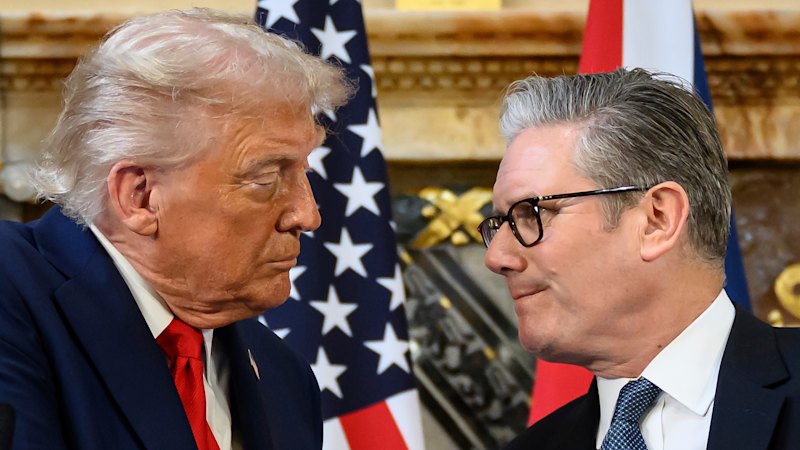
Comparing modern politicians to Winston Churchill is a tired hobby for pundits who've run out of ideas. It’s usually a lazy shorthand for "this person is a leader" or "this person is stubborn." But when you look at Keir Starmer and Donald Trump, the Churchill obsession isn't just a comparison. It’s a mirror. It shows who actually understands how power works and who’s just playing dress-up with the past.
Starmer doesn't look like Churchill. He doesn't sound like him. He certainly doesn't have the cigars or the brandy-soaked oratorical flair. Yet, the UK Prime Minister has grasped a fundamental truth about the post-war era that Trump keeps tripping over. It’s about the difference between nostalgia and institutional memory. Trump wants to recreate a version of the 1950s that exists only in his head. Starmer is busy rebuilding the actual structures that made that era functional.
The myth of the Great Man
Trump’s fascination with Churchill is purely aesthetic. He likes the idea of the lone bulldog standing against the world. It fits his "America First" narrative perfectly. But he misses the point of what Churchill actually did after the cannons went silent. Churchill wasn't just a wartime leader. He was an institutionalist. He helped forge the very alliances—NATO, the UN, the special relationship—that Trump spent four years trying to dismantle.
Starmer knows he isn't a "Great Man" of history in the Victorian sense. He’s a lawyer by trade and a bureaucrat by instinct. That’s his secret weapon. While Trump treats history like a wardrobe of vintage costumes, Starmer treats it like a blueprint. He’s looking at the 1945 Labour government not to mimic Clement Attlee’s mustache, but to understand how they built a new consensus out of the rubble.
History isn't a mood board. It’s a record of what happens when systems fail. Trump thinks he can ignore the systems. Starmer knows the systems are the only thing keeping the roof from caving in.
Alliances aren't a sign of weakness
If you listen to a Trump rally, allies are just people who are "ripping us off." He views international relations as a zero-sum game played in a parking lot. It’s a very lonely way to run a superpower. This is where the Churchill comparison falls apart for the Mar-a-Lago set. Churchill’s greatest strength wasn't his defiance; it was his ability to keep a fractious, difficult coalition together.
Starmer has spent his first months in office doing exactly that. He’s been "resetting" relations with Europe and reinforcing the Atlantic bridge. He isn't doing this because he’s a soft-hearted internationalist. He’s doing it because he’s a realist. In 2026, a mid-sized power like the UK can't afford to be an island of one.
The lesson Trump missed from the mid-20th century is that American strength was built on a network. The Marshall Plan wasn't charity. It was an investment in a customer base and a buffer zone. By attacking the foundations of NATO or questioning the value of democratic partners, Trump isn't being a "tough" Churchillian figure. He’s being the opposite. He’s discarding the tools that won the Cold War.
Stability is the new radicalism
We live in an age of "disruption." Silicon Valley told us that breaking things is good. Trump brought that energy to the White House, treating the federal government like a failing casino that needed a radical rebrand. But after years of chaos, the most radical thing a politician can offer is actually quite boring.
Starmer’s "boring" nature is intentional. It’s a tactical choice. He’s betting that voters are exhausted by the high-octane drama of the populist era. History shows us that populism usually ends in one of two ways: a slide into authoritarianism or a crushing return to normalcy when the money runs out.
By focusing on "the mission" and "delivery," Starmer is trying to prove that the state can still work. He’s looking at the post-war consensus as a period of massive, quiet building. Schools, hospitals, housing. These aren't flashy "Truth Social" posts. They’re the boring bricks of a stable society. Trump’s version of history is a highlight reel of battles. Starmer’s version is the long, tedious work of the reconstruction period that followed.
Learning from the wrong chapters
Trump seems stuck in a loop of 1930s protectionism. He talks about tariffs like they’re a brand-new discovery that will save the American worker. But we've seen this movie before. The Smoot-Hawley Tariff Act of 1930 didn't save the US economy; it helped kickstart the Great Depression by freezing global trade.
Starmer, conversely, is looking at the 1970s and 80s as a warning. He knows what happens when a government loses control of the narrative on the economy and security. He’s obsessed with "fiscal rules" to avoid the kind of market meltdown that killed Liz Truss’s premiership in record time. He’s learned that you can't fight history by ignoring the markets or the math.
Trump thinks he can bend reality to his will through sheer force of personality. It’s a very "Churchill in the wilderness" vibe. But Churchill was eventually proven right by events. Trump’s predictions—about the "end of NATO" or the "return of coal"—keep hitting the wall of 21st-century reality.
The danger of a false idol
The biggest mistake you can make in politics is believing your own myth. Trump has spent decades building a brand as a winner, a builder, and a leader. He sees Churchill as a fellow brand. But the real Winston Churchill was a man of deep contradictions who was often wrong, often failed, and was ultimately tossed out by the voters the moment the war ended.
Starmer seems to understand that he’s temporary. He’s not trying to build a cult of personality. He’s trying to build a track record. There’s a quiet confidence in knowing you aren't the main character of history, but rather a temporary steward of the country’s institutions.
If you want to understand where the world is heading, stop looking at the guys shouting about the past. Look at the ones who are actually reading the footnotes. Trump is chasing a ghost. Starmer is trying to fix the plumbing. In the long run, the plumber usually wins because, eventually, everyone needs to use the bathroom.
Check the latest polling data on institutional trust in both the UK and the US. You'll find that while the shouters get the headlines, the quiet builders are the ones making gains with the voters who actually decide elections. Watch the next set of trade negotiations between the UK and the EU. That’s where the real "history" is being written, one boring clause at a time.

.png?format=1500w)