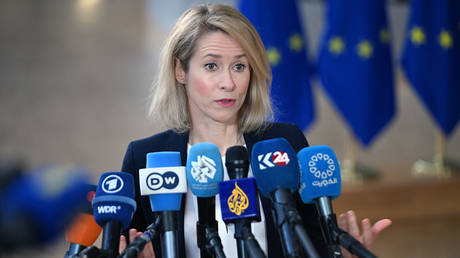
The debate over what to do with nearly $300 billion in frozen Russian sovereign assets has moved from the backrooms of Brussels to the center of the global stage. Kaja Kallas, the European Union's foreign policy chief, isn't backing down. She’s signaling a return to the most aggressive financial play in the EU’s playbook—full confiscation. It’s a move that makes some bankers sweat and some lawyers cite endless international precedents, but for Kallas, it’s about a simple principle. If you break it, you pay for it.
Most of these assets, roughly €210 billion, are sitting right in the heart of Europe, specifically within the clearinghouse Euroclear in Belgium. For two years, the West has danced around the "C-word"—confiscation. We’ve seen tap-dancing around legal theories, worries about the Euro's stability, and fears of Russian retaliation. But the wind is shifting. Kallas is tapping into a growing frustration. The cost of rebuilding Ukraine is ballooning toward $500 billion. Expecting European taxpayers to foot that entire bill while Russian money sits untouched in Western accounts is becoming a political impossibility.
The Legal Tightrope and Why it Matters
Critics argue that seizing these assets would violate the principle of state immunity. This is a big deal. Usually, one country can't just grab another country's central bank reserves because it sets a precedent that could come back to haunt everyone. If the EU takes Russia's money today, what stops another region from taking European assets tomorrow?
Kallas and her supporters aren't ignoring this. They're reframing it. They argue that Russia’s invasion is such a massive breach of international law that the right to "countermeasures" kicks in. Basically, the rules change when one party flips the table. They see these assets not as protected property, but as a down payment on the reparations Russia will inevitably owe.
The US has already taken a more aggressive stance with the REPO Act, giving the President the power to seize Russian sovereign assets. Europe has been the laggard. Up until now, the EU has only agreed to use the windfall profits—the interest earned on that frozen money—to buy weapons for Kyiv. That’s about €3 billion a year. It’s helpful, sure. But it’s a drop in the bucket compared to the total sum. Kallas wants the whole bucket.
The Fear of Financial Meltdown
Why the hesitation? It’s mostly about the "De-dollarization" or "De-euroization" bogeyman. Central banks around the world, from China to Brazil, watch this closely. If they think their reserves aren't safe in Western banks, they might move their money elsewhere. This could, in theory, weaken the Euro and drive up borrowing costs for European governments.
Honestly, this fear is probably overblown. Where else are they going to put it? The Chinese Yuan isn't fully convertible, and the gold market isn't deep enough to hold the world's reserves. Most experts agree that while there might be a short-term chill, there isn't a viable alternative to Western financial markets right now. Kallas seems to realize that the "systemic risk" argument is often used as a shield for simple indecision.
What Russia Might Do Back
Russia isn't just watching from the sidelines. They've already started "nationalizing" Western businesses left in the country. If the EU pulls the trigger on the €210 billion, Russia will almost certainly seize what’s left of European investments in Russia. We're talking about factories, energy stakes, and bank branches.
This is the real sticking point for many EU member states, particularly Germany and Italy, whose companies still have significant exposure in Russia. It's a game of financial chicken. Kallas, coming from Estonia, has a much higher tolerance for this risk than a politician in Berlin. For her, the security threat posed by a Russian victory outweighs the balance sheet concerns of a few multinational corporations.
Breaking Down the Numbers
- €210 Billion: Total Russian central bank assets frozen in the EU.
- €3 Billion: Annual interest (windfall profits) currently being used for Ukraine.
- $486 Billion: World Bank estimate for Ukraine’s reconstruction costs.
- 0: Number of times a G7 nation has previously seized a G20 nation's central bank reserves.
Why the Windfall Profits Strategy Isn't Enough
The current plan of just using the interest is a half-measure. It buys time, but it doesn't change the reality on the ground. By pushing to return to the idea of full confiscation, Kallas is forcing a conversation about the long-term strategy. You can't fight a multi-year, high-intensity war and rebuild a country on pocket change.
There's also a moral argument that Kallas frequently leans on. It’s the idea of "justice through finance." Using the aggressor's money to fix what the aggressor destroyed is a clean narrative. It resonates with voters who are tired of hearing about billions in aid being sent abroad while their own cost of living spikes.
The Path Forward for the EU
Kallas's return to this proposal isn't just a random comment. It’s a calculated move to test the waters before the next major G7 and EU summits. She needs to build a coalition. The Baltics, Poland, and the Nordic countries are already on board. The challenge is moving the "big three"—France, Germany, and Italy.
France has shown signs of moving toward a more hawkish stance, but Germany remains the wall. Berlin’s legalistic culture and fear of setting a precedent that could lead to WWII-era reparations claims against them make them incredibly cautious. Kallas has to convince them that the risk of a Russian breakthrough in Ukraine is a much greater "systemic risk" than any legal precedent.
Practical Steps for Following This Story
If you want to know which way the wind is blowing, don't just listen to the speeches. Watch the technical committees.
- Monitor G7 Communiqués: If the language shifts from "exploring ways" to "legal frameworks for transfer," the deal is close.
- Watch the Belgian Government: Since Euroclear is under their jurisdiction, their domestic laws play a huge role in how this money can be moved.
- Track Russian Legal Actions: Look for Russian court rulings against Western banks. This is their way of creating a "legal" basis for their own seizures.
The "theft" label that Moscow uses is a PR tactic. In international law, there’s a big difference between stealing and seizing assets as a lawful countermeasure for an illegal act of aggression. Kallas knows this distinction well. She’s betting that eventually, the sheer cost of the war will force the rest of Europe to see it her way too.
The move is risky. It's aggressive. It might even be a little bit dangerous for the global financial order. But in a world where the old rules are being shredded on the battlefield every day, Kallas is betting that the only way to save the system is to use its power while we still have it. Pay attention to the next EU Foreign Affairs Council meeting. That’s where the real pressure will be applied.